Artist from Finland
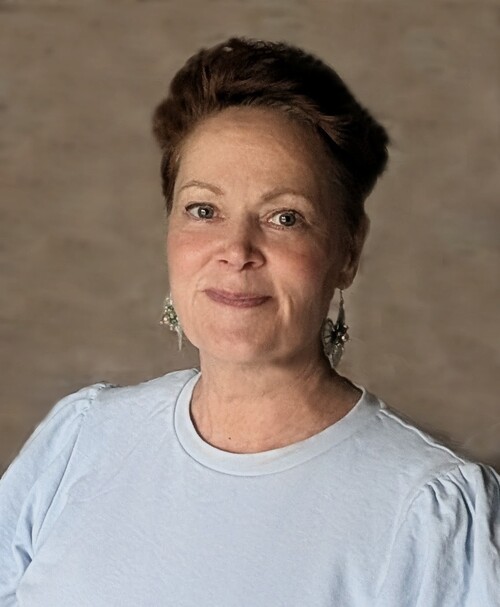
Tarja Onali is a Finnish self-taught artist and portrait painter based in Joutsa and Hartola, Finland.
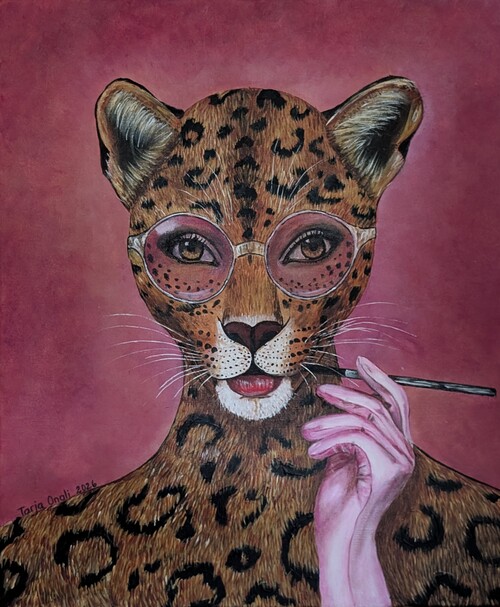
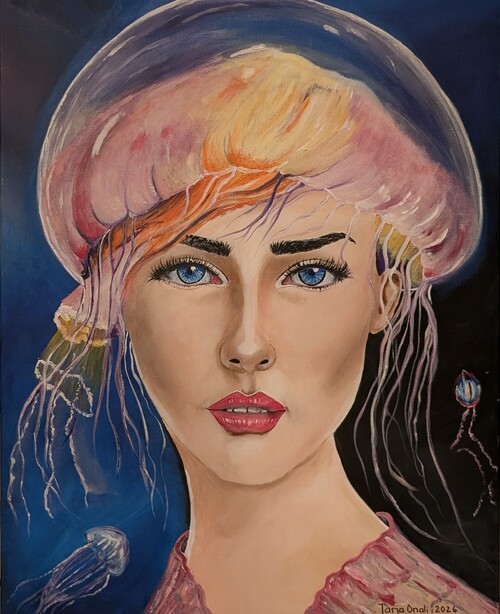
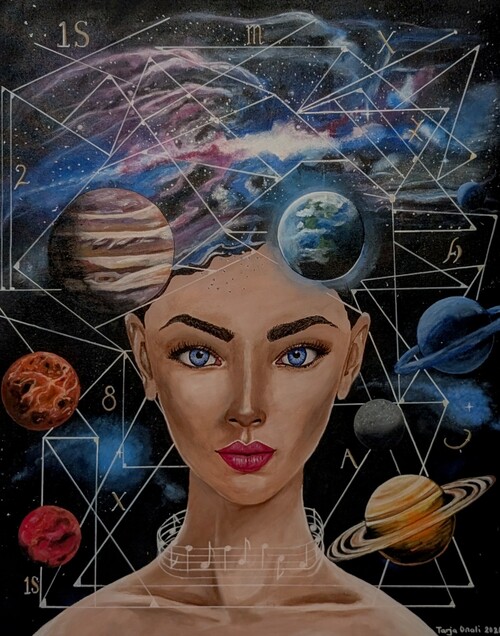
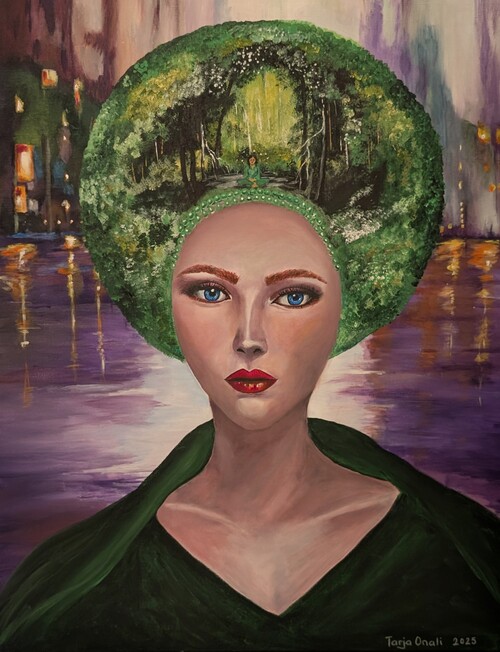
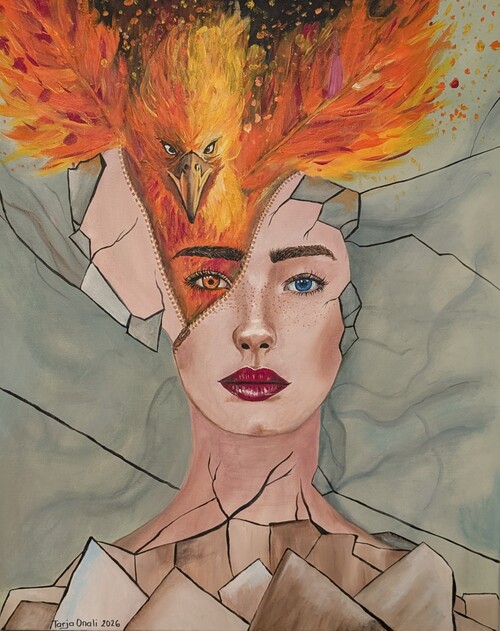
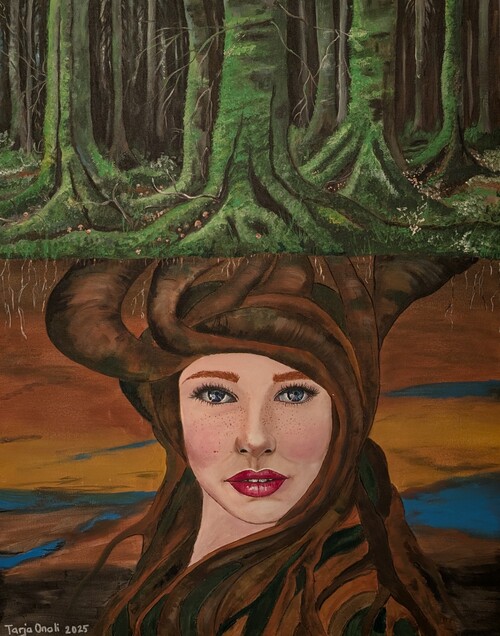
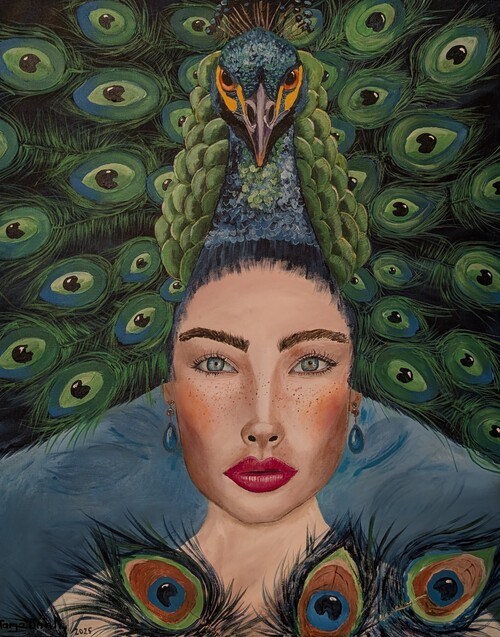
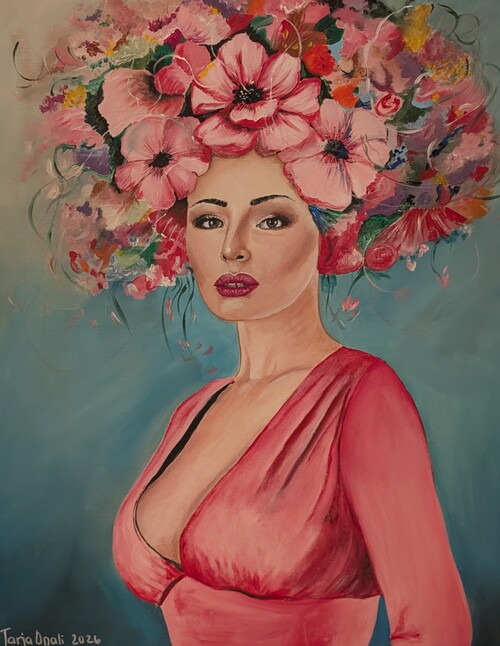
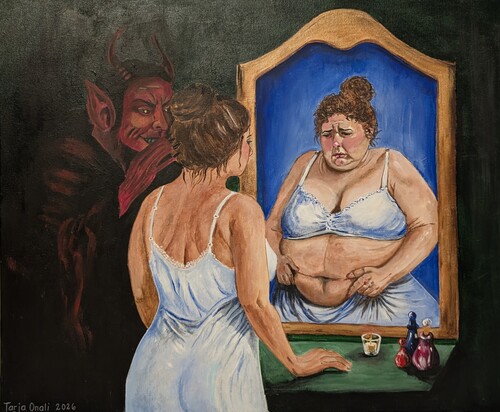
“I primarily work with acrylic paint, and conveying emotion is at the heart of everything I create. Although the subjects of my work have varied over time, I am best known for paintings in which female figures are accompanied by symbolic elements such as flowers, animals, forests, objects, or other forms that rise above their heads.
Art has fascinated me for as long as I can remember. As a child, I watched my uncle paint and admired his ability to create entire worlds with a brush. One of my earliest artistic memories is visiting an exhibition by Ferdinand von Wright in Helsinki, Finland, with my grandmother. The experience left such a strong impression on me that I still remember it today. Years later, a visit to the Museum of Russian Art in St. Petersburg deepened my admiration for the power and skill of painting.
For most of my life, however, I never imagined that I would become an artist myself.
The turning point came unexpectedly. While drawing with my grandchildren, I sketched a view of Porvoo, Finland. I was surprised by the result. My granddaughter pointed out that perhaps I could draw better than I had always believed. The idea stayed with me. Later, after seeing a painting by Frida Kahlo, I decided to create my own interpretation of a woman surrounded by flowers. The result was a dark-skinned woman with flowers forming a symbolic crown above her. The painting was entirely my own, and it became the beginning of the journey I am still on today.I began painting in February 2024 without any formal art education. Since then, ideas have followed one another rapidly, and my work has been exhibited in galleries and exhibitions both in Finland and internationally.
My paintings often begin with a feeling, a conversation, a single word, or an image that stays in my mind. I am not interested in creating something obvious. Instead, I look for unexpected ways to express ideas and emotions. That is why intelligence may appear as an octopus, peace as a woman carrying the flags of the world, or the passage of time through clocks and hourglasses.
The female figure is a natural way for me to tell a story. Faces create an immediate connection with the viewer, while the symbols above them reveal thoughts, emotions, memories, contemporary concerns, and the invisible layers of life. Through this combination, I explore the meeting point between the inner and outer worlds.
I draw inspiration from people, nature, and life itself. Joy, sorrow, love, beauty, fear, hope, and uncertainty all find their way into my work. Nature is particularly important to me. I see in it not only beauty, but also change, resilience, responsibility, and the cycle of life. Human beings are part of nature, not separate from it.
When I paint, I rarely know exactly how the finished work will look. The original idea may transform completely during the process. I trust my intuition and allow the painting to guide its own development. Every artwork has its own energy and its own story.
Sometimes I even find myself talking to my paintings. I might say, “You turned out beautiful,” or “You became better than I expected.” It may sound unusual, but to me it reflects the relationship that develops during the creative process. A painting is not just an image; it becomes something I spend time with, struggle with, and gradually come to understand.
For me, painting is much more than creating pictures. It is a way of understanding life, exploring emotions, and making visible the things that might otherwise remain unseen.”
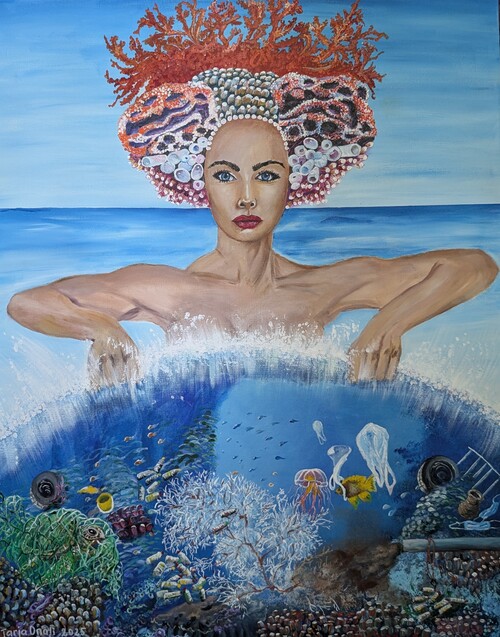
CRITICAL REVIEW: In the exhibited painting, Tarja Onali delivers one of the most powerful, direct, and politically engaged interpretations of the NATURAL FLOW 2026 concept, tackling head-on the theme of environmental sustainability and marine conservation. The artwork is structured upon a striking visual and conceptual dichotomy, orchestrated around a monumental female figure who rises from the waters like an ancestral marine deity or an anthropomorphic personification of the Ocean itself.
The upper portion of the canvas celebrates the primordial beauty and royalty of nature: the woman’s fierce, magnetic gaze establishes immediate eye contact with the viewer, while her head is crowned by a complex and vivid tiara of branching corals, sea sponges, and limestone structures—symbols of the biological wealth of the deep. However, the dramatic core of the artwork unfolds in the lower half, where the figure, with a solemn and almost theatrical gesture, lifts the liquid surface to reveal the invisible layer of degradation caused by human impact. Beneath the crest of the wave, pristine waters populated by jellyfish and schools of fish clash with the suffocating accumulation of anthropic waste: ghost fishing nets, tires, single-use plastics, aluminum cans, and drainage pipes. Onali exploits the versatility of acrylics to construct a sharp material and chromatic contrast between ecosystem purity and toxic pollution, transforming the canvas into a stern ecological manifesto that calls for a profound collective responsibility toward the cycle of life.
– Dr. Carmela Loiacono, Art Curator
more. Instagram profile
INTERVIEW with Tarja Onali
Carmela Loiacono talks with Tarja Onali who took part in the International Art Exhibition NATURAL FLOW – The 2nd Edition 2026 in Lecce at MUST – Museo Storico della città di Lecce, from July 03 to 18, 2026.
Carmela Loiacono – In your artwork “See the Sea!”, the female figure that characterizes your artistic research takes on the appearance of a majestic marine deity or a personification of the Ocean itself. While her head is adorned with a beautiful crown of corals, her hands reveal the tragic reality of plastic pollution and waste at the bottom of the sea. How did the idea come about to use the female body as a “shield” or a “veil” that lifts to expose this environmental tragedy?
Tarja Onali – Using the woman as a kind of shield or veil is also connected to the fact that I often use women as the main characters in my paintings. In this work, the idea came from seeing her as a queen of the sea, standing in the middle of the ocean. She has a beautiful coral reef on her head like a crown, and she is lifting the wave into the air with her hands.
Then another reality is revealed inside and underneath the wave. Her expression is firm, almost like she is saying, “You really need to wake up now and look at what we are doing to the sea.” I wanted her to make the viewer stop and look more carefully, instead of just seeing the painting as a beautiful image of the sea.
Carmela Loiacono – In your biography, you state that you like to explore “the invisible layers of life” and look for unexpected ways to express ideas rather than creating something obvious. In this painting, this concept becomes literal: the sea water on the surface appears beautiful, but beneath it hides human-made waste. From a creative process standpoint, how did you manage the emotional and chromatic transition on the canvas between the pristine beauty of the coral reef and the darkness of trash and industrial pollution?
Tarja Onali – In this work, the idea of the invisible layers of life comes from the fact that at first you see a beautiful and colourful sea. There are bright corals, jellyfish and colourful fish. But when you start looking more closely, you begin to find the waste caused by people.
For example, one fish is caught in plastic waste, and there are fishing nets around a turtle. There is also other waste that has ended up in the sea, but you don’t necessarily notice it at first.
For me, it was important that the pollution is not the first thing the viewer sees. I wanted them to notice the beauty of the sea first, and then, by looking a little closer, discover another reality underneath. That combination of beauty and pollution was very important to me in this work.
Carmela Loiacono – Your statement emphasizes that nature also means “responsibility” and that human beings are an integral part of it, not separate. Your artwork delivers a very strong and direct ecological message to the audience of NATURAL FLOW – The 2nd Edition 2026. What reaction or inner shift do you hope to have triggered in the viewers who locked eyes with your protagonist’s fierce gaze and, immediately after, witnessed the details of ghost nets and plastics trapped within the painting?
Tarja Onali – I hope it makes the viewer think about something. I don’t want them to just see it as a beautiful painting, but to start looking a little closer and notice what is really there.
I don’t want to blame anyone. I just want to make people think about the fact that we are part of nature and that we also have a responsibility for it. If someone leaves the exhibition and keeps thinking about the painting and about what we are doing to nature, then I feel I have achieved what I wanted with the work.