Artist from Italy
Alessandro Carbonara is a pharmacist and a Fine-Art Photographer, born in Bari (Puglia, Italy) in 1983. Since 2024, he has decided to begin an artistic journey, driven by the desire to get involved, because nothing in life ever starts too late.
Self-taught since 2007, he has studied in manuals and magazines, leaving room for an inner creative flow.
He believes that passion is the wood that constantly feeds the fire of creativity. Perfectionism is his core belief.
He considers photography a tool for creating, documenting and transmitting what is essential, not trivial. He tries to give photography its due value as an expressive and narrative art form, winking at different methods. He prefers the photographic genres of portraiture, from classic to experimental, and expressive, evocative, unconventional landscape photography.
More about Alessandro Carbonara: alessandrocarbonara.photo | Video interview

INTERVIEW with Alessandro Carbonara
Carmela Loiacono talks with Alessandro Carbonara who participated in four International Art Exhibitions:
1) STORIES OF IDENTITY – From hidden places to daily life in Matera at cultural hypogeum Lega Navale Italiana Matera-Magna Grecia with his photos series “Breath”.
Carmela Loiacono – Please introduce yourself and talk about the selected works you presented during the exhibition STORIES OF IDENTITY – From hidden places to daily life.
Alessandro Carbonara – I’m a photographer for passion and pharmacist by profession. Firstly I was to thank you, Carmela Loiacono, the curator of the exhibition, for the possibility you gave me.
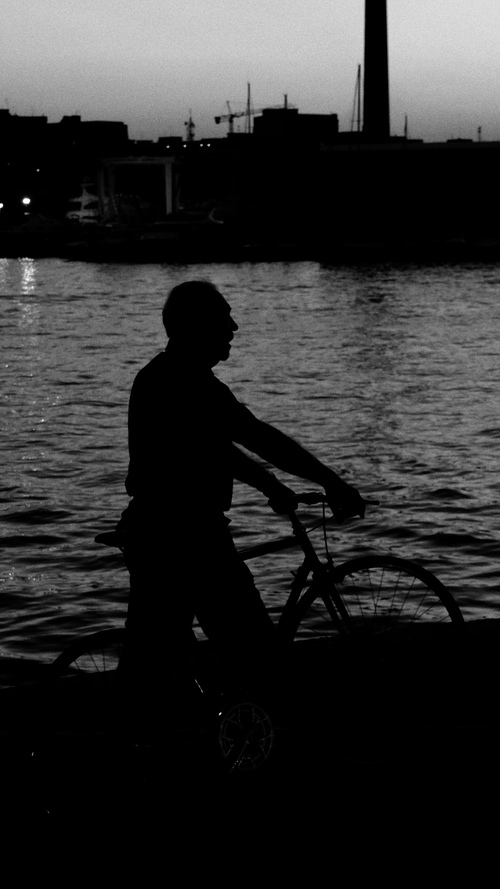
Regarding the context of the photos, I wanted to play on the words of the exhibition title “Stories of Identity”. The story as a time span that wants to tell something, in which something happens. I decided to tile the four artworks: “Breath”, because the time span, in which the entire composition takes place, is that of a complete respiratory act. So about a few second when something happens. The identity can normally be represented by a series of elements, which are intended to define something or someone in a certain way. However, since photography is a form of art and in art it’s good to step outside the box. In this case on the concept of identity, I preferred that the identity of the individuals shown in the photos was hidden. In fact, the main exposure is the landscape, as a result, the figures are underexposed, so they aren’t recognizable, because in this case identity should not only be what the subject represented in the photo has to tell, but also it should be the identity from the point of view of the viewer. So consequently I like to imagine that anyone can identify with the couple in the photos, whom I firstly don’t know. I took these photos in Monopoli on the harbor and I like the idea that any of us can imagine being there, present at that moment. In this scene something happens. We can imagine that they could be a married couple just taking a walk. The peculiarity comes from the fact that they aren’t in all four photos together, but for example in the first photo where the woman walks alone and then she’s joined later by her husband and they stop and look in the same direction. So there is also something, a storytelling that I leave to free interpretation in the eyes of the viewer of photo’s sequence.
2) NATURAL FLOW – Exploring water’s essence in Matera at cultural hypogeum Lega Navale Italiana Matera-Magna Grecia with his diptych of photos: “Fluctuations I and II”.
Carmela Loiacono – In the artworks “Flactuations I and II” the intense blue forms the backdrop to small droplets of water that imprison a hidden force. What is their deeper meaning?
Alessandro Carbonara – The water droplets are of great importance throughout the composition, as are the background and the ethereal human figure. They are a source of life, survival, and completion, almost as if representing cells of the human body about to unite to develop tissues, which in turn form organs and which, together, define the human figure in its complete and finished form. We are witnessing an extraordinary stage in the formation of human life, normally invisible because it develops in the mother’s womb, but artistically visible in a small evolutionary moment.
3) CREACTION in Matera at cultural hypogeum Lega Navale Italiana Matera-Magna Grecia with his photos: “Mater Terra”, “Acrofobia” and “Fermarsi”.
Carmela Loiacono – Could you kindly tell me about the works “Mater Terra,” “Acrofobia,” and “Fermarsi” exhibited during the CREACTION exhibition in Matera? What techniques you used for each photograph?
Alessandro Carbonara – Through the photographic technique known as ICM (Intentional Camera Movement), I sought to recreate an idea of movement capable of conveying an expanded perception of time. By convention, we live without being aware of the infinitesimal instant, and in Fermarsi and Acrofobia I wanted to evoke physical and temporal sensations that we might perceive if we had the ability to slow down or momentarily stop time.
The feeling of emptiness that arises at the beginning and end of a sudden movement is indeed perceived by our brain, but our sight cannot fully capture it.
Mater Terra is a digital collage composed of two photographs representing the passage of time for both a human being and a landscape — the latter marked by centuries and far more enduring than the former.
Although separated by time, the profiles of the woman and the caves seem to merge, as if aging together, in a visual union that gives us the impression that the head and the land are intertwining — creating a connection between mother (fertile earth) and earth (mother of nature).
4) STORIES OF IDENTITY – The 2nd Edition in Matera at cultural hypogeum Lega Navale Italiana Matera-Magna Grecia with his photos: “Inferno”, “Purgatorio” and “Paradiso”.
Carmela Loiacono – The works “Inferno,” “Purgatorio,” and “Paradiso” make up the series presented during the exhibition STORIES OF IDENTITY – The 2nd Edition in Matera. What is the deeper meaning hidden within each photograph? Are there specific messages you wanted to convey?
Alessandro Carbonara – In the three realms of the afterlife — viewed from a cultural rather than a religious perspective — we are called to spend our spiritual eternity. Whether it will take place before a higher God, through atonement of sins, or in awaiting a final judgment, we cannot know. Yet these three realms embody the essence of who each of us has been on earth.
The black souls in Inferno bear an eternal weight.
Undefined souls in shades of grey are in a state of purification.
White souls are pure, wandering blissfully.
None of these conditions can be seen as entirely separate — redemption and damnation may coexist in a dynamic process where the two fates transform into one another.
Is there a message? Yes! Let us strive to be the best vessels for our souls; let us take care of our bodies while on earth, for they will not accompany us at the moment of passing.
Carmela Loiacono – How would you describe your creative process? What or who influenced or is influencing your work?
Alessandro Carbonara – I always try to convey some emotion, I don’t want photography to simply be a photocopy of reality. There must be something more to what I do, and my photographic tool must become an extension of both my eye and my mind. The vision must create an expansion in the instant it is conceived. I would like to be the drop that creates circles in the ocean, which although losing intensity as they expand, continue to influence everything they encounter on their journey.
I do not have a single source of inspiration. I want to be inspired and contaminated by everything around me. I don’t want to have any limits.
Carmela Loiacono – What do you think about shared art on social media? Could it be an alternative way of communicating contemporary art?
Alessandro Carbonara – We are children of our past, but we live projected into the future. Social media are our calling card and should therefore be used in the best possible way. Yes. Social reaches further than our voice.
Carmela Loiacono – What are your future goals and/or projects?
Alessandro Carbonara – I would like to try to make a recognisable mark in my photography by continuing to study, reinterpret or create unconventional genres. During this quest for maturity, I will continue to exhibit my photo-works by collecting feedback from my observers.
To keep improving, seeking new ideas, new inspirations, new ways to reflect — to let myself be guided by curiosity in all its forms.
To live while trying not to waste my time.