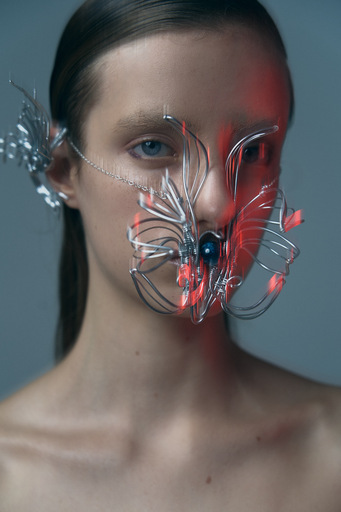
Artist from China
Jiaying Qian is a designer and maker.
Jiaying’s work draws on traditional and contemporary textile craft methods and techniques, exploring nature and humanity through slow design and handwork.
Jiaying began her design journey at the University of New South Wales Art & Design, where she completed a Bachelor design. Jiaying considers her work to be a meditative exercise, using textiles as a medium for her creations, and focuses on the use of natural fibers and the research of sustainable materials. Her practice often to explore the possibilities of biomaterials/environmentally friendly materials for textile development. Create visual, tactile and emotional experiences for the audience.
more. www.jiayingqian.com

INTERVIEW with Jiaying Qian
Carmela Loiacono talks with Jiaying Qian who takes part in the International Art Exhibition NATURAL FLOW – Exploring water’s essence in Matera, at cultural hypogeum Lega Navale Italiana Matera-Magna Grecia.
Carmela Loiacono – Please introduce yourself and talk about the selected video artwork: “Fading Ocean” you presented during the exhibition NATURAL FLOW – Exploring water’s essence.
Jiaying Qian – My name is Jiaying Qian, originally from China, and I’m currently a practice-based PhD candidate at the University of New South Wales Art & Design in Australia. I’m a designer, researcher, and textile artist, focusing on the intersection of material, technology, and smart textile design.
The artwork “Fading Ocean” was created as a textile installation to raise environmental awareness, particularly about the bleaching of coral reefs due to rising sea temperatures, which is a serious issue affecting Australia’s Great Barrier Reef. I handcrafted each piece of coral using 100% wool yarn, which I spun myself from raw fleece sourced from Australian farms. Through the integration of thermochromic pigments and shape memory alloys, the corals respond to heat—gradually turning white and curling up, as if struggling for survival. It was important for me to create a tactile, responsive medium that evokes an emotional connection to environmental degradation.
Carmela Loiacono – How would you describe your creative process? What or who influenced or is influencing your work?
Jiaying Qian – My creative process is rooted in a deep curiosity about non-human life forms and how we might collaborate with them in design. I often start by researching biological systems, then translate that knowledge into experimental material exploration—whether that’s through smart textiles, interactive installations, or speculative devices.
One of my early inspirations was the Crochet Coral Reef project by Christine and Margaret Wertheim. Their work beautifully connects handcraft, mathematics, and environmental activism. It was eye-opening to see how something as traditional as crochet could be reimagined as a powerful language for scientific and ecological storytelling. That project inspired me to explore textile as a medium not just for expression, but for critical engagement with urgent issues like climate change and species loss.
I’m also influenced by scholars like Neri Oxman, and Katherine Hayles, whose work challenges anthropocentric perspectives and opens up new ways of thinking about ecology, material agency, and co-creation. I find myself constantly drawn to the intersection of traditional craft and emerging technologies as a space for dialogue between the human and non-human world.
Carmela Loiacono – What do you think about shared art on social media? Could it be an alternative way of communicating contemporary art?
Jiaying Qian – Absolutely. Social media creates a space for art to reach beyond the walls of galleries and museums. It allows for more experimental, personal, and even vulnerable forms of expression. For textile and interactive works, where touch and transformation are key elements, videos and process documentation shared online can make the artwork accessible in new ways.
It also opens up global conversations—someone on the other side of the world might respond to the themes of environmental loss in Fading Ocean and reflect on their own ecological reality. I see it as a collaborative form of storytelling.
Carmela Loiacono – What are your future goals and/or projects?
Jiaying Qian – My current research explores co-creative textile production involving biological, digital, and human agents. One ongoing project involves translating data from living organisms like kombucha or slime mold into sounds and G-code, allowing these non-human entities to “design” textile patterns through 3D printing.
In the future, I aim to continue developing wearable and responsive textile installations that challenge traditional notions of authorship and highlight more-than-human forms of creativity. I hope to contribute to a broader conversation about sustainability, empathy, and collaboration—both within and beyond the field of design.