Artist from Mexico
Rubén Avendaño is a Mexican-born, Los Angeles based cinematographer and photographer whose work has been shaped over more than two decades behind the camera. His path has moved through television and into still photography, earning two Emmy nominations along the way and taking him as far as the White House, where he filmed alongside President Joe Biden.
But the work does not begin there. It begins earlier.
It traces back to a boy who learned to look closely, who found a way through uncertainty by paying attention to light, to gesture, to the small shifts that often go unnoticed. That instinct never left. It simply evolved.
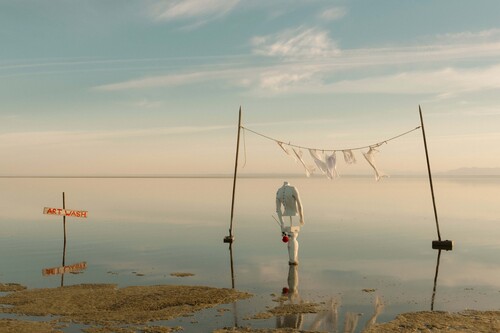
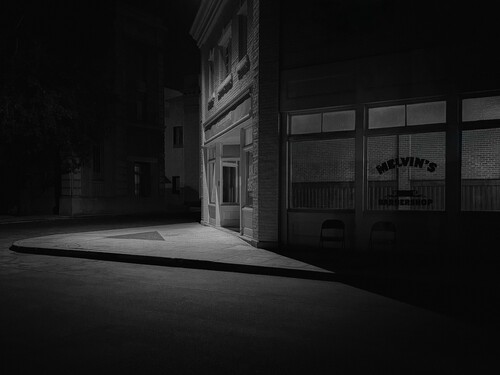
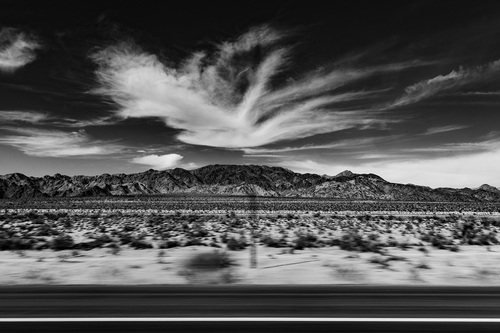
Today, his photographs are less about capturing and more about recognizing. They hold a sense of presence, moments that feel discovered rather than constructed. There is no rush to explain them. They exist as they are, fragments of experience shaped by patience and a willingness to stay with what reveals itself.
His work moves between memory and observation, carrying an undercurrent of resilience without announcing it. What remains is an openness, a belief that even in difficult terrain something luminous can surface. Not as escape, but as a way of seeing differently.
Artist statement
“I come to photography from a place of attention rather than certainty. I’m less interested in constructing meaning than in recognizing it when it happens. My work begins with awareness, slowing down enough to notice light, gesture, and the emotional temperature of a moment before language steps in.
For many years I’ve worked in television as a camera operator, traveling and documenting people in unscripted environments.That experience shaped how I see. It taught me that truth rarely announces itself. It reveals itself in the pause between gestures, in the language of what isn’t said. Photography, for me, is an extension of that way of looking. I don’t chase images. I listen for them.
As someone shaped by Mexican roots, I carry a deep sensitivity to presence and impermanence. I come from a culture grounded in memory, ritual, and respect for what came before us. That lineage guides how I approach my work. I’m drawn to shadows, to transitions, to moments that seem suspended between past and future. Those spaces feel charged with something deeper, something that calls for attention and care. They feel familiar to me.
I’m not interested in spectacle or explanation. I’m interested in honesty, frames that hold silence as much as subject, images that allow the viewer to bring their own memory and meaning without being instructed how to feel.
At its best, photography feels less like authorship and more like witnessing. When I’m present, fear and expectation fall away. The work becomes simple. I stand where something real is happening and let it reveal itself. What remains is not a statement about who I am, but a record of having been there and having paid attention.”
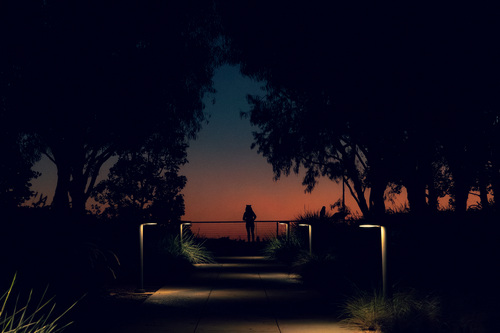
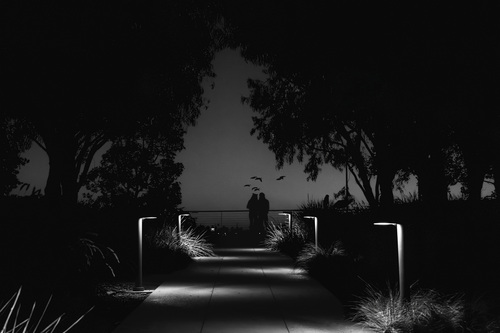
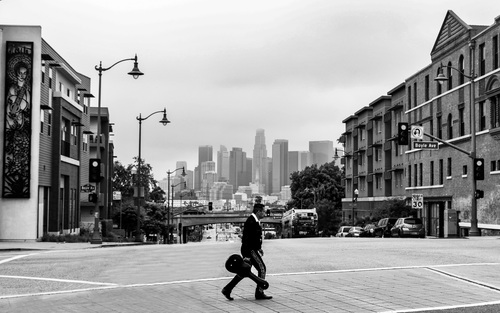
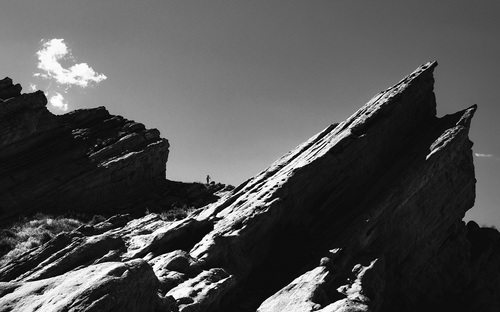
CRITICAL REVIEW: In keeping with the theme New Horizons – Authenticity, Resilience, and Renewal, the two works, Playa Vista #1 and Playa Vista #2, represent a journey toward new inner horizons. The solitary figure standing at the end of the illuminated pathway embodies the individual in a moment of transformation, suspended between what is being left behind and what remains to be discovered. The dialogue between the color version and the black-and-white interpretation suggests two states of human experience—memory and rebirth, vulnerability and awareness—while the pathway becomes a metaphor for a journey of resilience and authenticity. These works invite viewers to perceive limits not as barriers, but as thresholds, affirming the possibility of redefining oneself and opening up to new perspectives. – Dr. Carmela Loiacono, Art Curator
more. www.rubenavendano.art | Instagram @cameraruben

INTERVIEW with Rubén Avendaño
Carmela Loiacono talks with Rubén Avendaño who took part in the International Art Exhibition NEW HORIZONS – Authenticity, Resilience and Renewal in Matera, at Casa Cava, from March 21 to 27, 2026.
Carmela Loiacono – You often speak about attention rather than intention. While making “Playa Vista”, was there a moment when you simply knew it was time to stop and stay with what was unfolding? What do you notice in yourself in that instant?
Rubén Avendaño – At Playa Vista, I saw a couple with their dog, sharing the last light of the day. Then, for a brief moment, she stepped into her own space and turned toward the horizon. Her silhouette revealed itself, held gently by the trees, while the sun softened into a tone that felt almost intentional, though it wasn’t mine. It all aligned without effort.
In that instant, something in me becomes still and receptive. There is no urge to direct or interfere, only to witness and respond. I feel a sense of recognition, like I am being let in on something that was already happening long before I arrived. What remains is gratitude, for the light, for the timing, and for the chance to hold a fragment of that experience and carry it forward.
Carmela Loiacono – The shift from color to black and white feels less like an effect and more like a quiet transition in perception. Did that shift belong to the moment itself, or did it reveal itself later, with distance?
Rubén Avendaño – The shift to black and white didn’t feel like a choice I made in the moment. It came later, with a bit of distance. But when I looked back, it felt like it had always belonged that way. Sometimes color carries too much information, and with time you begin to see what was underneath it. The black and white revealed something more essential, something that was already there but harder to recognize at first.
Carmela Loiacono – Your images seem to hold space rather than define it. How do you recognize when a photograph has said enough, and it’s time to leave the rest open?
Rubén Avendaño – For me, a photograph feels complete when it stops asking for anything. There’s a point where adding more begins to take away from it. I try to listen for that. It’s subtle, but it’s there. When the image holds its own weight without explanation, I know it’s time to step back and leave the rest open.
Carmela Loiacono – Your work is deeply rooted in presence — in being there, attentive to what emerges. When the work travels without you, do you feel that presence remains, or does it transform into something else?
Rubén Avendaño – Presence changes once the work leaves me. When I’m there, it’s very physical, very immediate. But once the photograph travels, it becomes something quieter. I don’t think the presence disappears, but it transforms. It belongs to the viewer now, to their own pace and their own way of seeing. What I felt in the moment becomes just one layer among many.
Carmela Loiacono – As your practice continues to evolve, what are you currently moving toward?
Is there something you feel you are beginning to see, or understand, that you weren’t ready for before?
Rubén Avendaño – Lately, I feel like I’m moving toward less. Less certainty, less control. I’m becoming more interested in what I don’t immediately understand. There’s a kind of patience I didn’t have before, a willingness to stay with things longer without needing to resolve them. I think I’m starting to see that not everything needs to be translated. Some things are meant to remain just as they are.