Artist from Bulgaria
A Freelance artist with interests in sculpture, art glass, art jewellery, and fine arts.
Born on July 10, 1964, in Varna.
Graduated high school in his hometown – Varna.
Graduate of St. Kliment Ohridski Sofia University, Major: Informatics, Specialty Computer Graphics, in 1991.
Earned the title Master of the Co-operative of Masters of Arts and Crafts for artistic jewelry in 2011.
A Master of the National Chamber of Crafts, in Media Technology and Media Design in 2009.
Founder of DESIGN Ltd, Manager, Designer and Production Engineer thereof, from 1994 to 2013. DESIGN Ltd was a company that specialised in art and advertising glass and ceramics products, featuring in its portfolio the décor of a major part of the glass, porcelain, ceramics, and enamel products plants and ateliers in Bulgaria, as well as of a number of private workshops. The company also created art glass products exported to the Netherlands and France.
Founder of IRIS Ltd, Manager, Designer and Production Engineer thereof since 1996. The company specializes in artistic and advertising print, as well as in organizing and participating in culture related events.
Artist statement
Through language that is as abstract and figurative as it is minimalistic, I address moral and ethical issues that, as time goes by, inevitably trouble each one of us. I compile a narrative about the life of the character by putting the viewer in their place; it is not always a comfortable one, and quite windy at that.
more. www.vladimirvankov.com
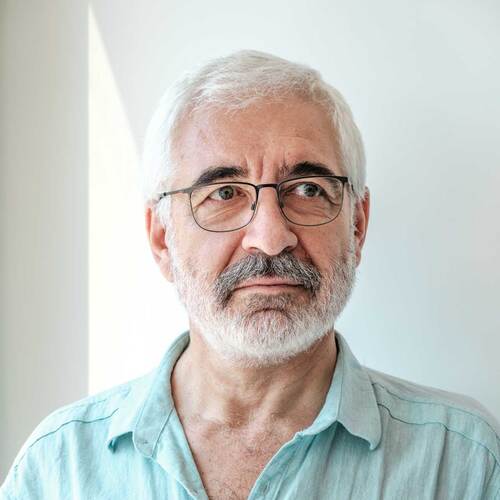
INTERVIEW with Vladimir Vankov
Carmela Loiacono talks with Vladimir Vankov who takes part in the International Art Exhibition STORIES OF IDENTITY – The 2nd Edition in Matera, at cultural hypogeum Lega Navale Italiana Matera-Magna Grecia.
Carmela Loiacono – Please introduce yourself and talk about the selected works: “Paternity”, “Maternity” and “Internal Conflict” during the exhibition STORIES OF IDENTITY – The 2nd Edition.
Vladimir Vankov – My name is Vladimir Vankov, and I am an independent visual artist working primarily in sculpture, but also in painting, glass art, and artistic jewelry. I was born on July 10, 1964, in Varna, Bulgaria. I have an university degree in mathematic sciences and a long background as a founder, manager, technologist, and designer of companies working in artistic glass, porcelain, and industrial printing. Over 40 years of artistic practice, I have participated in numerous exhibitions, both solo and group. My works are held in private collections in Bulgaria, the United Kingdom, Austria, Belgium, Denmark, Germany, Russia, Ukraine, Japan, the USA, and Canada.
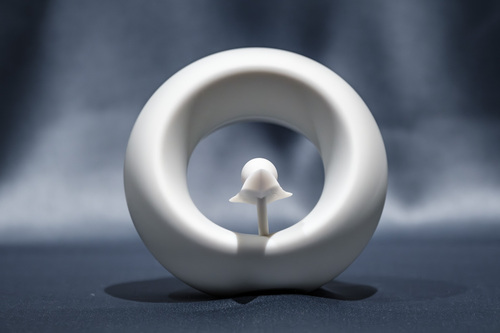
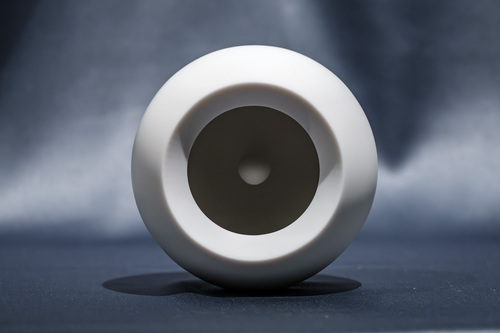
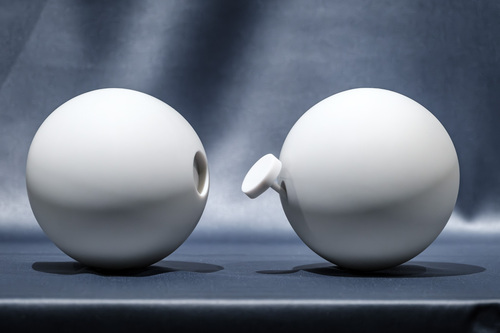
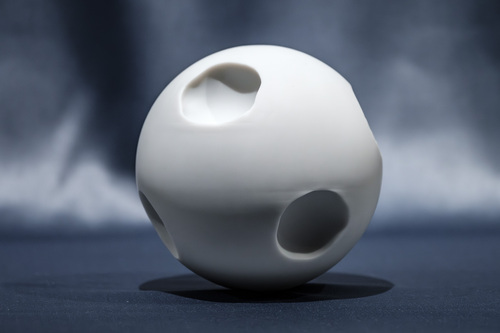
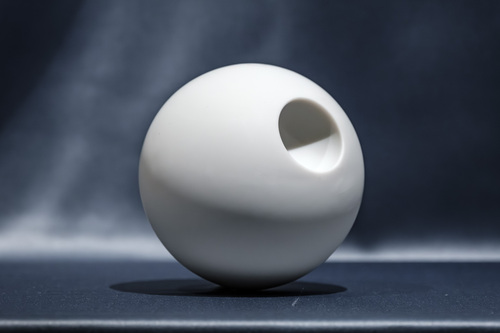
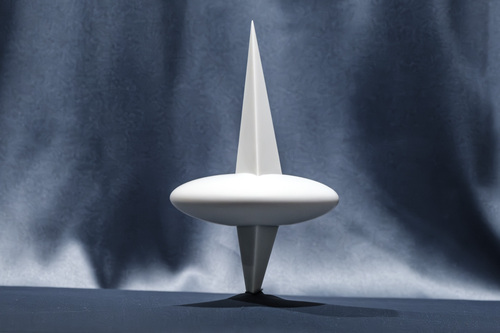
I was delighted that my works “Paternity,” “Maternity,” and “Internal Conflict” were selected for the curatorial project “Stories of identity II.” They are part of the narrative in my cycle “Where to now?” Perhaps not the most visually spectacular pieces (like the levitating figures “Alone” and “Where to now?”), but they are maybe the most intimately human. “Paternity” was the first artwork I created using this abstract visual language. Naturally, it was dedicated to my children. I was incredibly happy when I managed (in my opinion) to transform such an abstract category, such a profound feeling, into a plastic form—encompassing its past, present, and future. “Maternity” was the logical continuation, and the two pieces marked the beginning of “Where to now?” cycle. It’s a story about human life and the moments that define it: the searchings, the hesitation, the suffering, the joy, the decisions, and the responsibilities. My aim was to present these moments in a way that puts the viewer in the protagonist’s shoes. The idea was for the viewer not to think about the material, color, texture, or background—just to see a sculptural form that speaks. That was also why I chose this size, as it’s the optimal size to be taken in with a single glance. As for “Internal Conflict,” the idea for it came to me at the beginning of the war in Ukraine. It took me some time to realize that war is not so much a conflict between two forces as it is an internal conflict of humanity itself. The parallel with the internal conflict of the human soul came naturally. The sculptural solution was a real challenge: a defined, unified whole that tears apart while remaining whole—on the verge of disintegration, but with the possibility of becoming whole again.
Carmela Loiacono – How would you describe your creative process? What or who influenced or is influencing your work?
Vladimir Vankov – Every artist’s creative process is different. At my age, after experiencing many personal and social upheavals and re-evaluations of societal value systems, as well as learning many lessons from life, a natural approach has developed that allows me to examine the philosophical and ethical problems and mental states that concern every person. First, through my own lens, I analyze a problem in depth—rationally, emotionally, and morally. I clarify my position and concept for myself, and only then do I begin to search for its plastic expression. This is an iterative process that continues until I achieve a result that is as expressive and stripped of all unnecessary details as possible. In doing so, I let the form evolve according to its own internal forces; I don’t compromise it to fit the requirements of a specific technology or material. Only at the end do I choose the appropriate material and technique for execution. I also pay serious attention to the presentation of the finished work, believing that its adequate presentation by creating its own environment (a stage) is essential for the audience to fully perceive it. Working with a highly abstract visual language, I prefer to add a text with my own vision, which is an integral part of the work and sometimes the most difficult part. My task is to ask questions—not always pleasant or easy ones—when the audience encounters my art, and I leave the answers to the responsibility of each individual viewer. It is a real satisfaction to see that no visitor remains indifferent. That is where I find meaning in my work and motivation to continue.
This is where my inspiration comes from: seeing people entangled in their daily worries and their unresolved internal, interpersonal, and social problems, without expecting to be put in front of a mirror and asked the questions they avoid or have not yet reached. Then, I see the change in their gaze. It’s incredible. And deeply obligating. As for the artists who inspire me, there are many in one way or another, but I believe that the main inspiration must come from within and be hard-won.
Carmela Loiacono – What do you think about shared art on social media? Could it be an alternative way of communicating contemporary art?
Vladimir Vankov – I don’t have a simple answer regarding the online sharing of modern visual art, especially on social media. Of course, given the speed and immediacy with which published information reaches its target audience, these platforms should not be underestimated, especially considering the minimal effort required from the viewer. On the other hand, these channels cannot provide the experience of a live encounter with the artwork, of sharing the feeling and breathing with it. The effort a viewer makes to visit a gallery and immerse themselves in the specially created atmosphere guarantees a much more fulfilling connection with the artwork. It is on its “stage,” which is something unattainable when viewing it on a screen at the current level of technology (with the exception, to some extent, of some interactive 3D platforms), especially on a smartphone screen. The sense of real dimensions and the interaction with the environment and other exhibited works are also lost. The artwork is in an uncontrolled light and color environment. From my own experience, I can say that the live experience is in the vast majority of cases significantly different from the expectation built from prior visual information. In short, at the risk of sounding a little retrograde, I believe that publishing visual art online is an inseparable part of modern life, but it should be done with taste and moderation. The photo or video material and its presentation should be thoughtful to preserve the idea as much as possible and avoid the simplified, fast-food-style perception. At best, it should be an invitation to a live meeting. And that requires a special kind of professionalism.
Carmela Loiacono – What are your future goals and/or projects?
Vladimir Vankov – My main goal is to continue working. I have a number of works started that I need to finish, as well as some that are at the idea and sketch stage. But even more important is to provide the ways for them to reach a wider audience. In particular, this means organizing exhibitions, with my current focus being on Europe. Of course, this also implies an organized online presence.
To be specific, these are works in the philosophy and style of my cycle “Where to now?”, as well as large-format works in metal, stone, and glass. I am also working on two monumental metal compositions for an urban environment. But most of all, I am working on the philosophical dimension of my ideas—exploring what each of them can contribute to a better world inhabited by more consciously humane people. I do not impose my views, but I offer them, along with the questions they raise. Each person makes their own choices—and takes responsibility for them.