Artist from the Netherlands
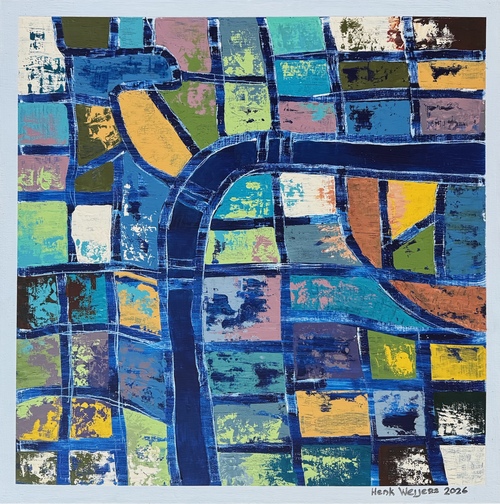
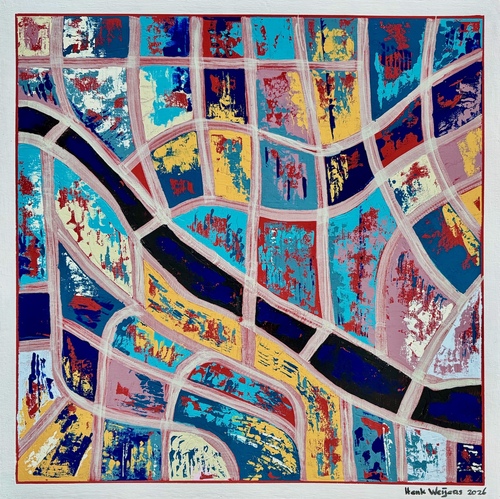
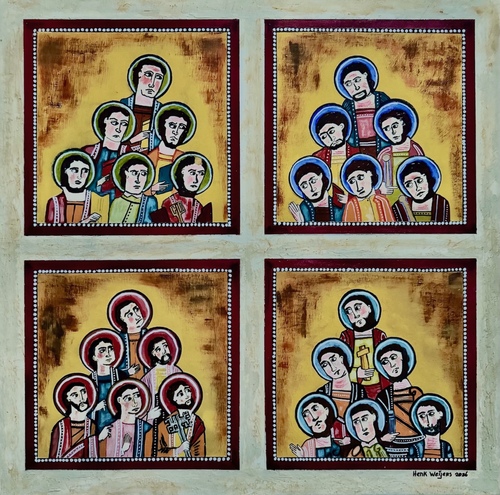
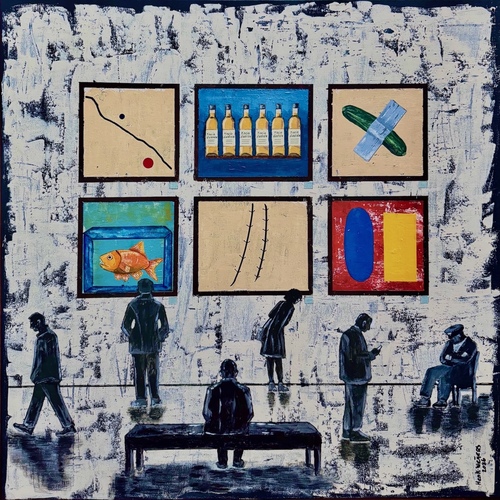
Henk Weijers (b. 1959, Rotterdam, the Netherlands) is a painter based in Kuala Lumpur, Malaysia. Working primarily with acrylic on canvas, he is known for paintings that move between geometric abstraction and expressive impressionism. His work explores the relationship between structure and painterly expression, often combining clear compositional frameworks with layered colour and textured surfaces. Henk Weijers’ paintings are characterized by defined geometric structures, an emphasis on colour relationships, and carefully balanced compositions. Within these frameworks, he develops expressive surfaces through layered application of paint and gestural marks. His subject matter includes abstract compositions as well as landscapes and architectural elements, interpreted through colour, and composition rather than descriptive realism. Recent notable works include a series of semi-abstract Swiss landscapes (2026), Cerrado (2026) and Deferred Pleasures (2026). Deeply concerned about the fate of people of Ukraine, Henk Weijers donates all proceeds from the sale of his artwork to support them.
Henk Weijers has exhibited internationally, including at the Divulgarti group exhibition Margini di Pagina, Spazio Guido Tommasi Editore in Milano Italy (February–March 2026).
CRITICAL REVIEW: Across the landscapes of Lauterbrunnen, Burgdorf, and Lavaux, Henk Weijers develops a coherent artistic practice that interprets the territory through an essential pictorial language, characterized by bold contours, sculptural forms, and vibrant fields of color. Rather than pursuing a naturalistic representation, his synthesis of form constructs a vision in which the landscape becomes an expression of its intrinsic balance and of the continuous relationship between the elements that shape it.
Lauterbrunnen offers an essential vision of the Alpine landscape, where mountains, meadows, and sky merge through a formal synthesis characterized by intense color fields and a strong simplification of forms. The composition emphasizes the rhythm of color and material, transforming the natural subject into a perceptual and emotional experience. Although it does not occupy the central focus of the scene, water is evoked as a generative presence within the landscape. The valleys, shaped by the action of glaciers and waterways, suggest the continuous dialogue between natural elements, while the blue tones permeate the entire composition, conveying a sense of freshness, balance, and vitality.
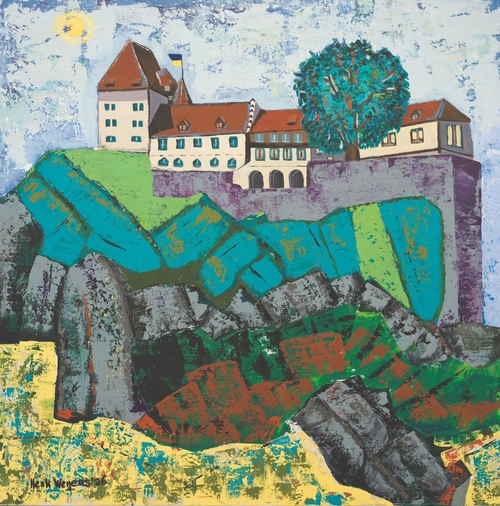
In Burgdorf, architecture integrates harmoniously into the landscape, establishing a balanced dialogue with the forms of nature. Through a synthetic pictorial language and a luminous palette, you create a space where rock, vegetation, and human presence coexist without hierarchy, expressing a profound sense of belonging to the territory.Water manifests itself indirectly as a fundamental element of the landscape: it is the force that, over time, has shaped the structure of the rocks and made human settlement possible within a natural environment rich in resources. The diffused luminosity and the predominance of blue and green tones evoke a living ecosystem, where the flow of water becomes a symbol of continuity and harmony.
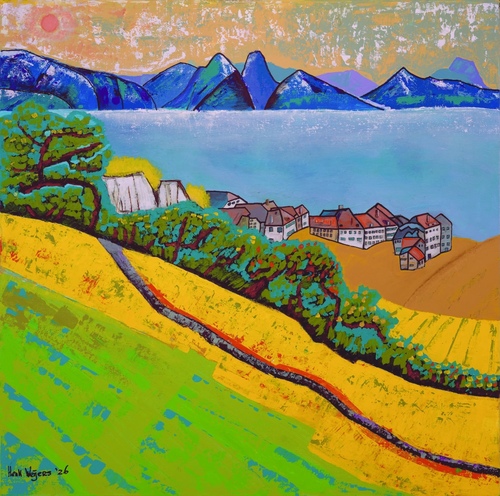
The artwork interprets the landscape of Lavaux through an essential pictorial language, in which intense fields of color and defined lines construct a composition of strong formal balance. The colors, vibrant yet delicate, guide the viewer’s gaze across the landscape, creating a dynamic tension between the solidity of the mountains and the lightness of the atmosphere surrounding the lake.
The geometric patterns of the vineyards and architecture emerge with clarity, engaging in dialogue with the sculptural monumentality of the natural landscape. Within this balance between structure and atmosphere, the lake appears almost intangible, a subtle presence that unifies the composition and introduces a sense of stillness and contemplation. – Dr. Carmela Loiacono, Art Curator
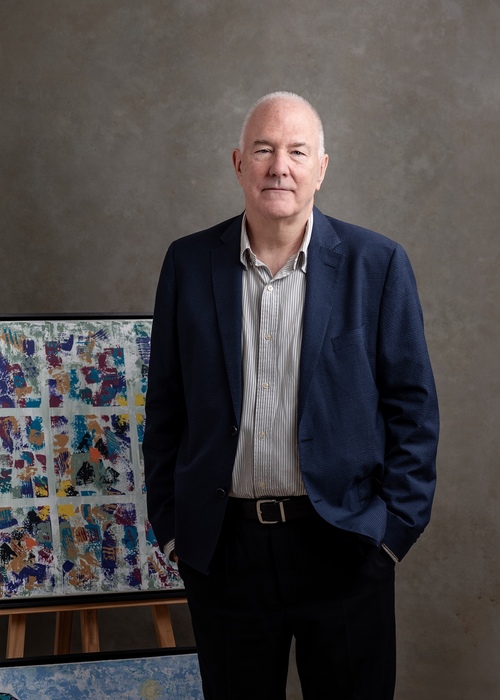
INTERVIEW with Henk Weijers
Carmela Loiacono talks with Henk Weijers who took part in the International Art Exhibition NATURAL FLOW – The 2nd Edition 2026 in Lecce at MUST – Museo Storico della città di Lecce, from July 03 to 18, 2026.
Carmela Loiacono – In your exhibited works (Lauterbrunnen and Burgdorf), water does not occupy the central focus of the scene, but is instead evoked indirectly as a “generative presence” and a force that shapes the landscape and glaciers. How did your signature style, which moves between geometric abstraction and expressive impressionism, allow you to evoke the memory and impact of water without resorting to a realistic or descriptive representation?
Henk Weijers – In Lauterbrunnen and Burgdorf, I was less interested in depicting water as a visible element than in expressing the traces it leaves behind. Water has shaped the beauty of these landscapes over centuries—carving valleys, feeding waterfalls and rivers, eroding rock, and transforming into glaciers. Even when it is not immediately visible, its presence can still be felt in the contours and rhythms of the land.
My approach, which moves between geometric abstraction and expressive impressionism, is particularly evident in Burgdorf. The castle forms the structured centre of the composition and serves as a focal point of human life. Its presence and history reflect the prosperity of the surrounding region—a prosperity that has, in turn, been sustained by an abundance of water. I therefore deliberately painted the castle with greater (geometric) definition, while treating the vegetation and rocks more freely and expressively. This contrast reflects the relationship between the ordered, human-made world and the natural forces that have shaped and sustained it.
Carmela Loiacono – In the artwork dedicated to Lavaux, the lake is described as an “almost intangible” presence—a subtle element that unifies the composition, introducing a sense of stillness and contemplation that dialogues with the sculptural monumentality of the mountains and vineyards. How did you manage the chromatic and material balance on the canvas to render the lake water as such an ethereal presence, capable of balancing the bold contours and vibrant color fields of the Swiss landscape?
Henk Weijers – The composition of Lavaux grew out of my frequent hiking visits to the region, during which I became very familiar with its vineyards, changing colours, varied shapes and expansive views across Lac Léman (Lake Geneva). Rather than depicting one particular viewpoint, the painting brings together the impressions and memories gathered during these walks. With its abundance of colour and form, Lavaux became a visually intense painting, and I felt the composition needed a quiet space where the eye could rest. I repainted the lake twice before achieving the effect I was seeking. I applied the paint with a palette knife and, while it was still wet, gently blended the colours on the canvas using a damp cloth. Blending directly on the canvas is not normally part of my process, but in this instance it created the sense of tranquillity and the visual pause the painting required. I also found inspiration in the work of the Post-Impressionist painter Ferdinand Hodler, whom I greatly admire. While living in Switzerland, I had the opportunity to see many of his works, including several of his numerous interpretations of Lac Léman — a subject which he painted more than a hundred times.
Carmela Loiacono – Your research investigates continuity, ecological harmony, and the flow of nature. At the same time, your biography reveals a deep connection to real-world urgency, supporting the people of Ukraine. Do you see a conceptual link between the “vital, life-giving flow” of water that you depicted and your own powerful gesture of solidarity and social responsibility toward human life?
Henk Weijers – My wife is Ukrainian, and since 2014 we have been actively involved in volunteering and fundraising in support of the Ukrainian military. Our website, yadonor.fund, provides an overview of our work, which focuses primarily on sourcing medical equipment and defensive supplies. A parallel could perhaps be drawn between water and medical assistance, as both sustain and protect life. However, I would hesitate to present this as a deliberate theme in my work, since that interpretation would be somewhat retrospective. What is more direct is my commitment to donate the proceeds from the sale of my paintings to the humanitarian projects led by my wife.