Artist from USA/China
Chenglin Li is a computational artist and designer whose practice explores how artificial intelligence reshapes perception, authorship, and contemporary identity. Working at t he intersection of generative systems and visual culture, she investigates algorithms not simply as tools, but as active agents t hat influence imagination, aesthetics, and t he way we understand ourselves.
Her work reflects on transformation in t he digital age. As AI increasingly structures information and creative production, Li questions how artists can remain authentic while navigating systems that subtly shape thought and visual language. Through rule-based processes and machine interpretation, she creates evolving visual environments that examine the tension between human intention and computational autonomy.
Li received her undergraduate degree from New York University and a master ’s degree from t he University of California, Berkeley. She also spent two years working in traditional industries, gaining insight into real-world technological infrastructures — an experience t hat informs her critical and reflective approach to computational creativity.
Her projects have received international recognition, including awards from the iF Design Award, IDA, GRAND PRIX DU DESIGN PARIS, EPDA, C2A, MUSE Design Awards, and t he New York Product Design Awards. Her work has been exhibited internationally, including at t he Carrousel du Louvre in Paris.
Through her practice, Li seeks to redefine artistic identity in an era shaped by intelligent systems, affirming awareness, responsibility, and authenticity as forms of creative resilience.
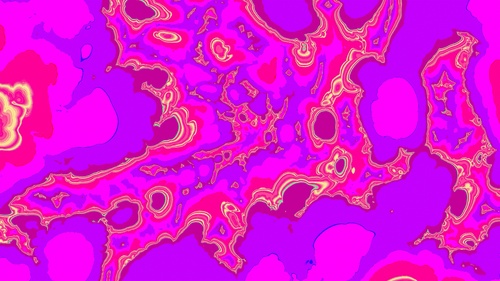
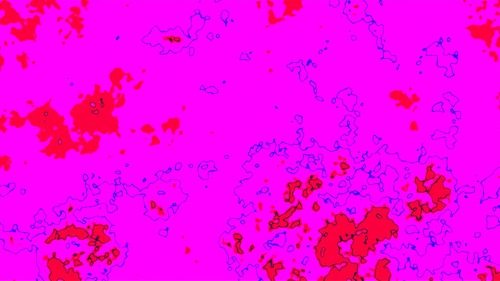
CRITICAL REVIEW: The “Algorithmic Genome” critically engages with the question of identity in the age of artificial intelligence, challenging the very notion of authorship. Built upon generative principles such as rhythm, mutation, and entropy, the work produces continuously evolving forms, highlighting the tension between human control and algorithmic autonomy.
Rather than judging technology, the piece reveals its influence on our imagination, suggesting that the real risk lies not in the replacement of the artist, but in the unconscious assimilation of computational logics.
Within the context of Matera, named Mediterranean Capital of Culture and Dialogue 2026, a city layered between memory and rebirth, “Algorithmic Genome” becomes a reflection on resilience: identity emerges as a dynamic process, where authenticity arises through awareness and the ability to redefine the human role in the face of change. – Dr. Carmela Loiacono, Art Curator
more. Video link | Portfolio

INTERVIEW with Chenglin Li
Carmela Loiacono talks with Chenglin Li who took part in the International Art Exhibition NEW HORIZONS – Authenticity, Resilience and Renewal in Matera, at Casa Cava, from March 21 to 27, 2026.
Carmela Loiacono – In “Algorithmic Genome”, identity is constructed through generative principles such as rhythm, mutation, and entropy, creating a system that continuously evolves. How do you perceive this shifting balance between human intention and algorithmic autonomy, and where do you locate yourself within this process?
Chenglin Li – In Algorithmic Genome, I do not perceive the relationship between human intention and algorithmic autonomy as a fixed boundary, but rather as a living threshold—fluid, unstable, and never entirely resolved. The system is initiated through a set of conditions, rules, sensitivities, latent rhythms, yet once activated, it unfolds into behaviours that exceed precise anticipation.
My role is not to prescribe form, but to cultivate the conditions from which form may emerge. I establish an initial logic, then remain within the process as both observer and participant, attentive to its deviations, its mutations, its quiet assertions of independence. Authorship, in this sense, is neither relinquished nor imposed; it is negotiated. I situate myself within a field of attunement, where intention and emergence coexist in a sustained, productive tension.
Carmela Loiacono – Your work suggests that the real risk is not the replacement of the artist, but the unconscious assimilation of computational logic.
How can artists remain aware and authentic while working within systems that subtly shape perception, imagination, and aesthetic language?
Chenglin Li – The risk, as I understand it, lies not in replacement, but in absorption—in the gradual internalisation of computational logic as an unexamined aesthetic instinct. These systems do not merely generate images; they recalibrate perception itself: how we see, anticipate, and recognise form.
To remain authentic is to resist this silent drift towards automated thought. It demands a sustained awareness of the systems we engage with; their architectures, their limitations, and their embedded biases. Authenticity arises through friction: through the acts of editing, interrupting, and interrogating outputs, rather than passively accepting them as resolved.
In this regard, awareness is not external to practice; it constitutes the practice. It is an ongoing reflection on how perception is constructed, and a deliberate effort to reassert authorship within that construction.
Carmela Loiacono – By using AI as a “cognitive engine” to generate the structure of the artwork, you create a tension between collaboration and influence. Do you see this relationship as a form of co-authorship, or rather as a space of resistance where the artist must actively reclaim agency?
Chenglin Li – I would not describe this relationship as co-authorship in the traditional sense, as the system does not possess intention; it produces variation rather than meaning. What it offers is a field of possibilities: a proliferation of forms that require selection, framing, and interpretation.
Rather than a space of resistance, I understand this as a process of calibration. The artist must remain actively engaged, guiding, filtering, and reshaping what emerges, so that the work does not collapse into mere output. Agency is not reclaimed through opposition, but sustained through attention.
It is within this continuous act of calibration, between control and surrender, precision and openness, that the work attains its coherence.
Carmela Loiacono – Within the context of NEW HORIZONS, your work reflects on transformation as an inevitable condition. Looking ahead, how do you envision the future of artistic identity in an AI-driven world, and what role can artists play in redefining what it means to remain human?
Chenglin Li – In an AI-driven landscape, artistic identity may gradually detach from medium and instead become rooted in modes of thinking, in how one constructs systems, orchestrates processes, and frames experience. As tools become increasingly ubiquitous, distinction will no longer reside in their use, but in how perception itself is shaped.
Within this context, the artist assumes the role of a navigator of complexity, capable of revealing the latent structures embedded within technological systems, exposing their assumptions, and proposing alternative modes of engagement.
To remain human is not to resist technology, but to remain present within it, to preserve intentionality, sensitivity, and critical awareness. It is to continue shaping meaning within an environment that increasingly automates form, and to insist that behind every system there persists the possibility of reflection, of choice, of consciousness.