Artist from USA
Christopher B Fowler is an American photographer whose work explores the abstract qualities of reality through images of natural landscapes and built environments. His artistic path began in drawing and filmmaking before evolving into photography as his primary medium.
Influenced by Edward Steichen and Thomas Eakins, he developed a strong focus on light, contrast, and visual structure. His images emphasize line, form, texture, and pattern, often approaching abstraction.
Drawing from everyday scenes, he reveals a perceptual dimension that transcends the subject.
After an early engagement with writing and poetry, he fully committed to photography in the late 1980s.
Since then, he has exhibited his work in galleries in the United States and internationally.
His creative process is intuitive, guided by moments of visual discovery rather than preconception.
Working primarily with film, he applies minimal post-production to preserve the original experience.
He ultimately leaves interpretation open, inviting viewers to engage personally with each image.
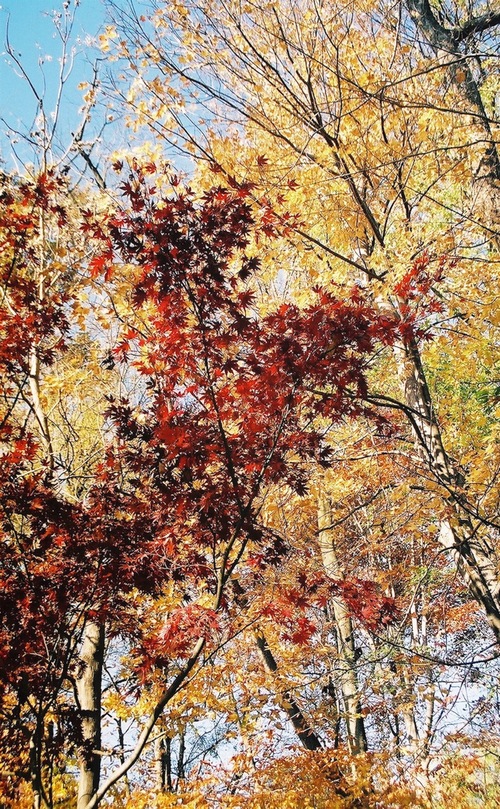
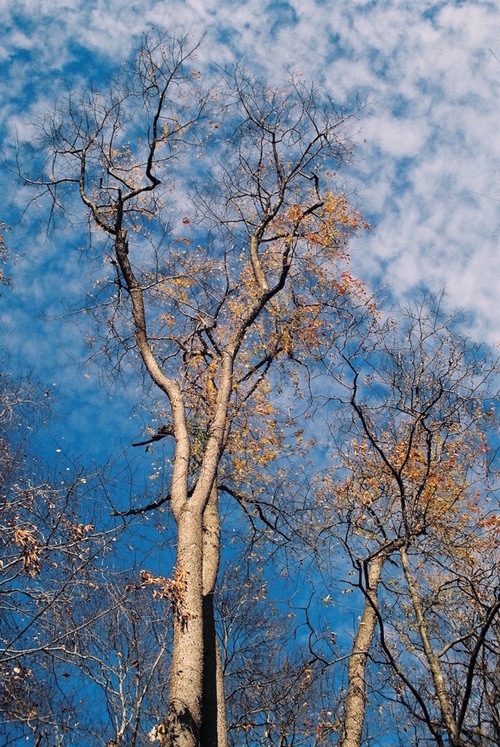
CRITICAL REVIEW: The “Tree series” reflects the themes of resilience, verticality, persistence, and silent growth, as the tree is a universal metaphor for resistance, rootedness, and regeneration.
The images “Redbud”, “Along the Towpath VI”, “A Splash of Red” and “Feel the Wind Blow II” isolate the subject, making it an essential, almost human presence. The tree becomes a body that resists, that goes through seasons and wounds without losing its identity. In his photographs the tree is not landscape but presence. Rooted in the earth and reaching upwards, it becomes a metaphor for silent resilience: the kind that does not shout, but persists.Here, the limit is not a boundary, but a point of strength from which to start again. – Dr. Carmela Loiacono, Art Curator
more. www.christopherbfowler-photographer.com | Artist Statement

INTERVIEW with Christopher B Fowler
Carmela Loiacono talks with Christopher B. Fowler who took part in the International Art Exhibition NEW HORIZONS – Authenticity, Resilience and Renewal in Matera, at Casa Cava, from March 21 to 27, 2026.
Carmela Loiacono – In the works “A Splash of Red”, “Feel the Wind Blow II”, “Along the Towpath VI”, and “Redbud”, the tree does not appear as a simple element of the landscape, but as an autonomous, almost human presence, capable of resisting and transforming over time.
How did this vision of the tree as a symbol of silent resilience and persistent identity emerge, and what does this subject represent in your artistic journey?
Christopher B Fowler – On my website (www.christopherbfowler-photographer.com) I have three quotes that have particularly resonated with me:
The first is from Dylan Thomas who said that art is about telling the truth. The second is from Georgia O’Keeffe who said that what appeals to us about mountains and rocks and trees is not that they’re mountains and rocks and trees but rather the lines, planes, textures, etc., they present to us. And the third is from Joseph Campbell who said it’s the task of the artist to reveal the radiance behind the physical reality.
The short answer, as per the Georgia O’Keeffe quote, is that trees have the characteristics that people are–and I am–drawn to.
There have always been trees around me. My father was a schoolteacher and I grew up on the campus of the school, which sat on 300 acres of land much of which was wooded. There was even a modest arboretum. I was climbing trees even as a small child. (Memorably, I fell from the top of a full-sized fir tree at the age of four, or or five at the most–memorably particularly for my mother, who saw the whole thing from the kitchen window–though I remained uninjured). The school had long lunch hours on Tuesdays and Thursdays and I would often spend the time before classes resumed walking around the arboretum and sitting in the shade of the trees.
One of my Dad’s assignments every year was organizing and running a film festival and, one year, he screened a short film by the filmmaker Donald Fox (“Omega”) that included the image of a tall tree, shot from below, arching with the wind—an image I’ve never forgotten and one which undergirds my sense of trees’ resilience.
Trees as metaphors also came into my consciousness at some point thereafter—something attached to the earth but reaching up towards the sky, while at the same time, reaching, equally, down into the darkness of the earth. They may not finally be anthropomorphic models of us, but they are certainly evocative of the same drives and desires that we have.
Carmela Loiacono – You have described your creative process as one in which images often “find” you. How does this moment of recognition unfold, and how do you translate a perceived experience into a photograph that preserves that same intensity?
Christopher B Fowler – I’m afraid It truly has been that I’m just caught by something I see and then photograph it. I’ve since come to recognize, at least provisionally, that it is likely the interplay of the abstract elements, as per Georgia O’Keeffe above, that gets my attention. I should add there have also been times when I was composing a shot I thought I’d wanted, when, out of the corner of my eye or the edge of the viewfinder, I spotted something additional, the inclusion of which was, then, what truly made the picture.
Carmela Loiacono – Your photographs seem to reveal something beyond the visible, transforming everyday elements into meaningful experiences. How do you work to make this deeper, almost invisible dimension perceptible within the image?
Christopher B Fowler – The distinction between ”depiction” and ”art”, as I see it, is that the latter involves not just conveying the image of the subject but the experience of it.
I’ve heard it said of the painter Constable that he thought, if he painted things carefully enough, he would reveal the hand of God.
Certainly one other aspect of when I’m looking through the lens I feel a sense of connection to… something (the radiance behind the day to day reality, as per Joseph Campbell quote above?). It’s part of the experience to be conveyed to the viewer.
As regards my creative process, the task is to become clear, in what I’m seeing, as to what exactly it is that is catching my attention, then compose the image to include what is supporting it and disinclude, or at least minimize, what is distracting or detracting from it.
Carmela Loiacono – Looking ahead, what new horizons do you feel drawn to explore in your photographic practice? Will you continue developing this research on nature as presence, or are you envisioning new visual and conceptual directions?
Christopher B Fowler – At the moment, I’m not feeling led to go off in any new directions stylistically. What is evolving are the subjects I’m discovering I can apply it to—and the range of subjects I move between now seems, itself, pretty broad, as the attached images show.
I remember talking to an abstract-art painter who said she periodically went back and forth between figurative and abstract work. Moving back and forth amongst the various subjects that I’m drawn to, as well as to new ones that catch my eye, is probably the more likely trajectory I’ll be following.
But we’ll see…