Artist from USA / China
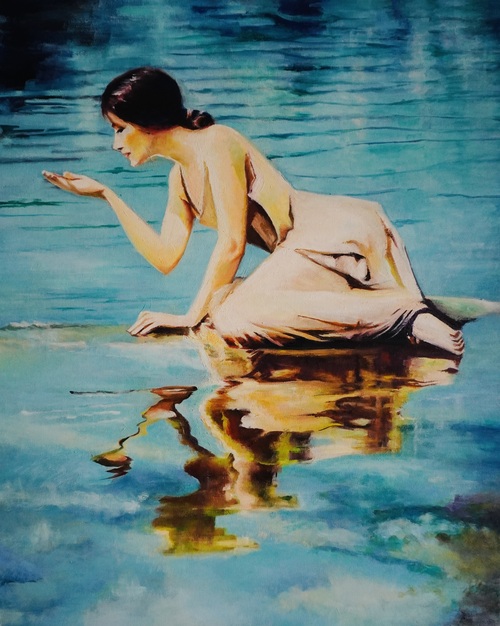
Embarking on a lifelong journey to capture beauty through art, Qingzhu Lin draws inspiration from the Great Masters of the European Renaissance. His focus lies in creating figurative paintings and landscapes that echo the marvels of the natural world, seamlessly blending tradition with innovation. His artistic voyage traces its roots to the enchanting wonders of childhood memories. The stamps he collected and the vivid recollection of a cherished oil painting adorning his childhood home sparked a profound inspiration within him, igniting a lifelong devotion to the world of art.
Throughout his career, he has eagerly immersed himself in the global art scene through extensive travels. Museums, exhibitions, and galleries became his sanctuaries, offering solace in the pure joy of experiencing art in its myriad forms. Upon retiring, he embarked on a personal quest to nurture and refine his artistic talent, endeavoring to express the beauty that surrounds us. Exploring new techniques and honing his skills, each brushstroke became a testament to his unwavering commitment to capturing the essence of beauty and sharing his unique artistic perspective.
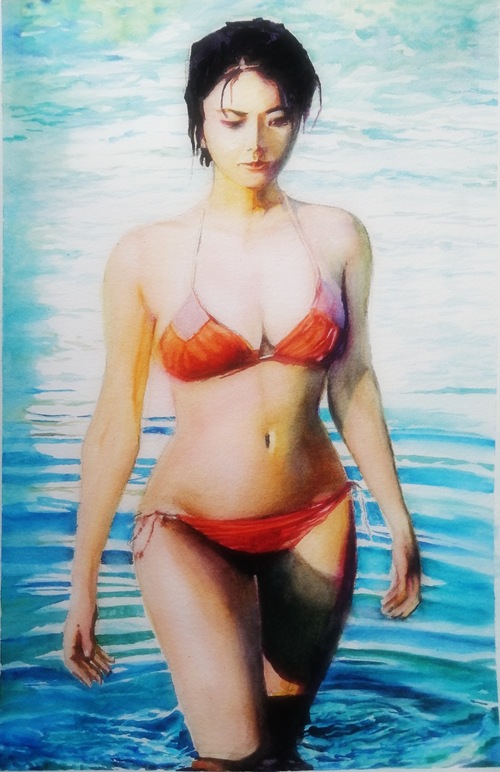
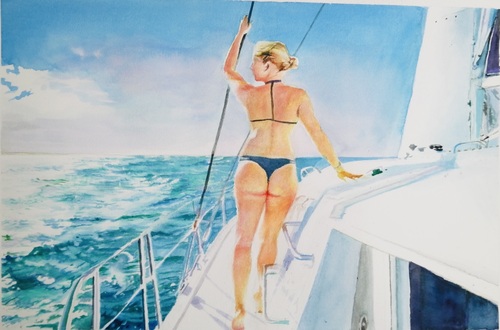
His portfolio stands as a testament to his dedication, influenced by both his Chinese heritage and the aesthetics of the Renaissance. His paintings embody a harmonious fusion of styles, cultures, and influences. Inspired by Leonardo Da Vinci’s meticulous attention to the human figure, his portraits captivate viewers, revealing his meticulousness and commitment to portraying the spirit of his subjects. Additionally, his art celebrates the characteristics of Chinese painting, reflecting his deep-rooted connection to his cultural heritage. By primarily focusing on portraits and landscapes, he expresses his affinity for traditional subjects. Employing delicate brushwork reminiscent of traditional Chinese ink paintings, he skillfully imbues depth and form into his lines using oil and watercolor paints. Renowned art curator Roberta Desolati aptly describes his works as a harmonious blend of styles, cultures, and influences. His paintings resonate with both Eastern and Western traditions, bridging the gap between artistic legacies. Through masterful brushwork, he strives to capture the essence of beauty and breathes life into his creations.
Artist Statement
“In my artistic pursuit, I aspire to create artworks that not only possess inherent beauty but also resonate with the desires and aspirations of the audience. With unwavering dedication, I strive to capture the true essence of art and unravel the profound significance it holds for the world. Through a harmonious fusion of styles and cultures, I aim to bridge the gap between tradition and innovation, inviting viewers to embark on a journey of aesthetic exploration and discovery. My ultimate goal is to create art that transcends boundaries, inspiring and enriching the lives of those who behold it.”
CRITICAL REVIEW: Within the exhibition framework of NATURAL FLOW – The 2nd Edition 2026, recently hosted at the MUST OFF Gallery of the MUST in Lecce, the artistic inquiry of international painter Qingzhu Lin stood out as an extraordinary celebration of transparency, understood both as a formal virtue and a space for emotional resonance. Through the masterful use of watercolor—a medium of choice that, by its very biological and chemical nature, implies direct interaction with the liquid element—Lin allowed the water to become a co-author of the work, guiding the pigment in a dance of flows, absorptions, and controlled refractions.
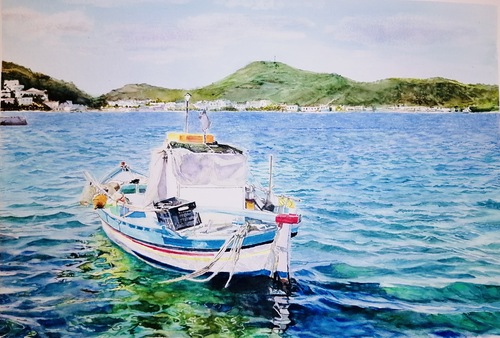
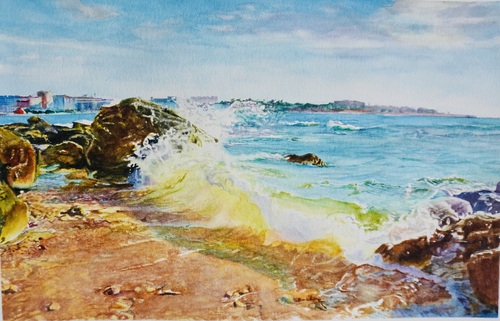
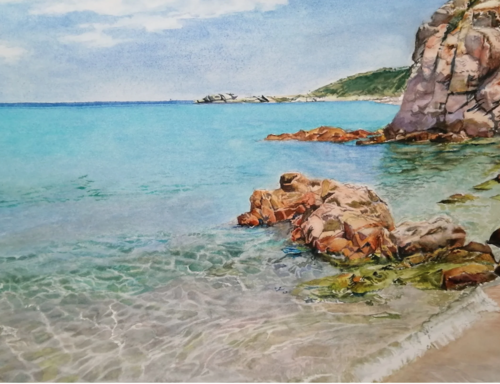
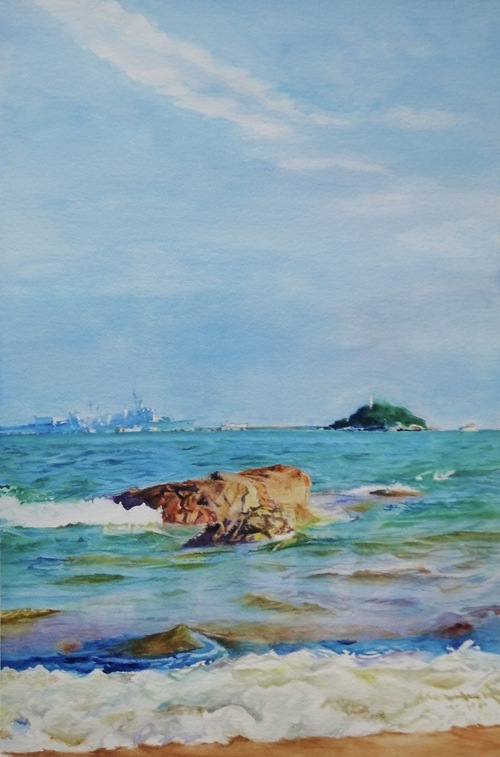
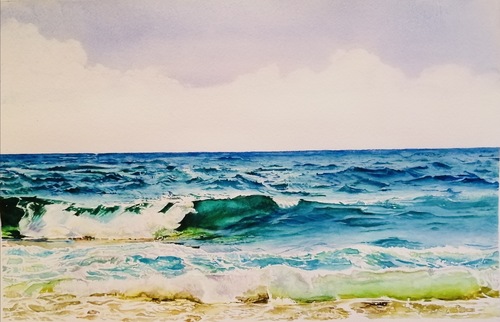
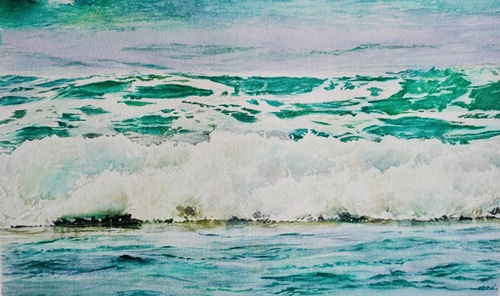
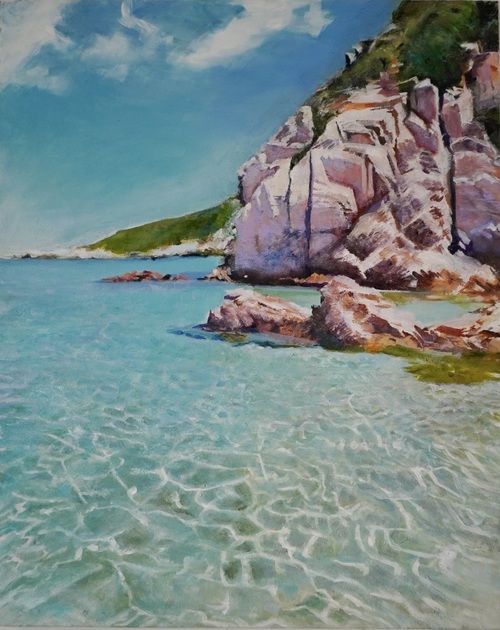
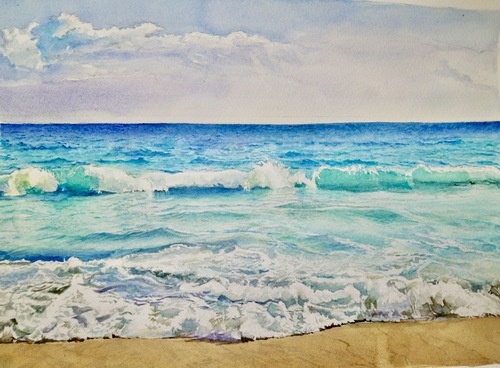
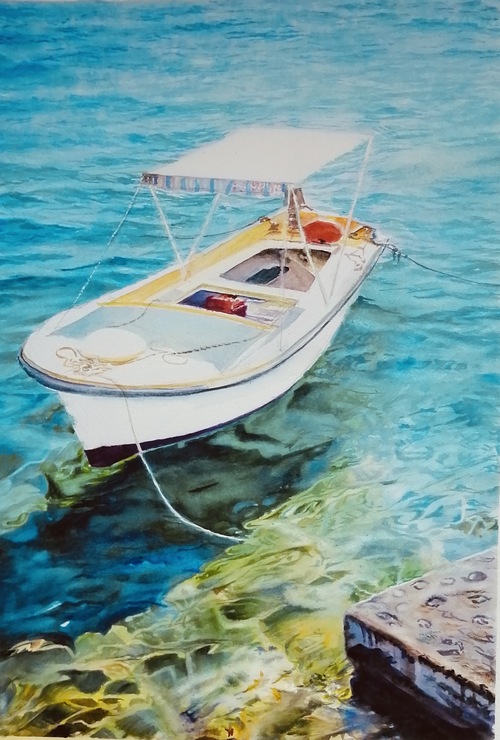
The exhibited triptych of seascapes offered a stratified reading of the liquid element, unfolding in a continuous narrative that explored different variations of the concept of “flow” and dialogue with the coastline. In “Calm Harbor”, the moored traditional vessel evoked the flow of memory and the ancestral bond between humankind and the sea, where turquoise and emerald glazes suggested a latent, continuous movement within a deceptive stillness. This contemplative calm broke into the theatricality of “Crash Waves”, a work in which the artist captured the vital energy of the wave crashing against the rocks; a chromatic virtuosity where fluidity transformed into pure kinetic energy, perfectly embodying the binomial of transformation and force that underpinned the entire exhibition. Finally, the gaze arrived at the meditative dimension of “Rocky Shoreline”, where the clarity of the shoreline and the luminous ripples of the water’s edge engaged with the austere rock walls, offering a visual purification in which water became a symbol of regeneration and global sustainability.
Qingzhu Lin’s stylistic signature lay precisely in this successful synthesis between the luministic accuracy of Western classical realism and the lyrical sensibility of his Eastern roots. By harnessing the intrinsic brightness of the paper, the artist made the light of the landscape vibrate without ever weighing it down, giving the water a volumetric yet airy quality. Within the context of the group exhibition at the MUST, his works acted as a poetic anchor of rare intensity, reminding us that the preservation of these ecosystems is not only a pressing environmental necessity, but a duty to safeguard the very beauty of the human spirit. – Dr. Carmela Loiacono, Art Curator
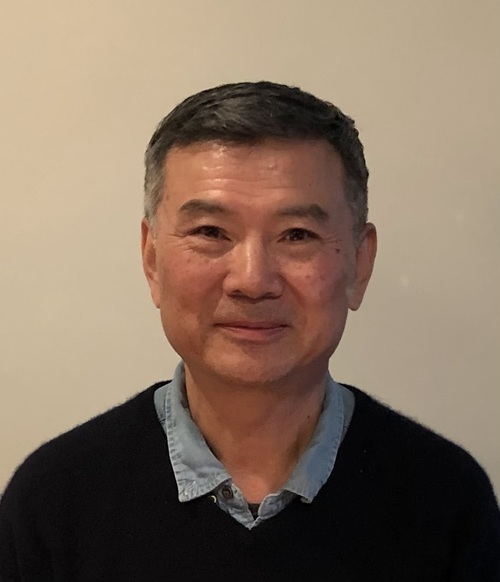
INTERVIEW with Qingzhu Lin
Carmela Loiacono talks with Qingzhu Lin who took part in the International Art Exhibition NATURAL FLOW – The 2nd Edition 2026 in Lecce at MUST – Museo Storico della città di Lecce, from July 03 to 18, 2026.
Carmela Loiacono – Your biography highlights a profound connection to both the European Renaissance and traditional Chinese painting. Looking at your artworks dedicated to the sea, how does the fluidity of watercolor allow you to bring together Western precision of detail and the poetic sensitivity and calligraphic brushwork of your cultural heritage?
Qingzhu Lin – For me, merging European Renaissance techniques with traditional Chinese painting is not about combining two opposing styles, but about finding where they naturally meet in spirit. The European classical tradition brings structure, precise observations of light, and tangible spatial depth. Traditional Chinese painting, on the other hand, emphasizes Qi (vital energy), poetic rhythm, and the expressive freedom of calligraphic brushwork.
The fluidity of watercolor—and the way pigment moves across the surface—creates a natural bridge between these two worlds. Compared with other objects, water seems not easy to capture for the shaping images, it must be curated for its balanced and movement line.
However, watercolor allows us for the precise structure of light and shadow to sit alongside open, breathable spaces where the brush stroke retains its lyrical energy. The medium encourages a balance between form and atmosphere, capturing both the tangible detail of the landscape and the quiet, contemplative spirit behind it.
Carmela Loiacono – In your works exhibited at NATURAL FLOW – The 2nd Edition 2026, you approach water in very different ways: from the motionless clarity of the shoreline and the chromatic vibration supporting a moored boat, to the kinetic force of a crashing wave. As a curator, I am fascinated by this versatility: does the choice to portray these diverse conditions of water respond to a conceptual reflection on time, or does it stem from a technical desire to experiment with the expressive limits of the pictorial medium?
Qingzhu Lin – Portraying water in its distinct states—from still clarity to kinetic force—is both a technical exploration and an inner reflection.
Technically, water is one of the most demanding subjects because it has no fixed form of its own; it exists entirely through light, reflection, and movement. Experimenting with different movements allows me to push the expressive range of brushwork and medium. Conceptually, however, these varying conditions reflect different states of time and inner composure. Calm water represents stillness, clarity, and reflection—a moment where time feels suspended. Moving water or a crashing wave captures energy, vitality, and the natural flow of life. I do not view these as separate conceptual themes, but as different facets of a single, continuous harmony found in nature.
Carmela Loiacono – In your Artist Statement, you declare that your ultimate goal is to create art that transcends cultural boundaries, resonating with the audience’s desire for harmony and beauty. Considering that contemporary art languages often address the theme of water through the lens of the ecological crisis, what do you think is the spiritual, or even political, value of choosing to display the pure and pristine beauty of the marine landscape today?
Qingzhu Lin – While contemporary art often uses nature to comment on crisis or social commentary, my goal has always been to create a space for quietude, emotional restoration, and inner peace. I believe there is deep, enduring value in presenting the pure and undisturbed beauty of the marine landscape today.
Rather than making a political statement, showcasing pristine nature offers a spiritual sanctuary. It reminds the viewer of humility, goodness, and the timeless harmony that exists beyond human conflict.
Presenting pure beauty is not an escape from reality, but an invitation to reconnect with what is quiet, essential, and worth preserving in the human spirit.