Categoria: Artists

  • Amanda Stuart

    Artist from United Kingdom

    Amanda Stuart is a multidisciplinary artist from the United Kingdom, working across composition, sound, video, digital art and photography.
    A spark of inspiration might come from nature, a work of art, a place, a snippet of sound, the marvels of science, or a deeply felt emotion. From these beginnings, she strives to realise dramatic, fantastical landscapes of sculptured sound and image.
    She explores the beauty, significance, and fragility of the natural world. Rooted in exploration and experimentation, she creates immersive, interwoven experiences, where sound and image converge—inviting listeners and viewers into layered worlds of resonance, wonder and reflection.
    Amanda holds a Master of Music in Creative Music Technology (Distinction) from the Royal Welsh College of Music & Drama. Her work has received international recognition, including the IAWM Pauline Oliveros International Prize for Electroacoustic Media (2015) for Song of the Trees, and an Honorary Mention (2014) for Not Missing You, praised by the Boston Classical Review as “as beautiful to look at as it is to hear.” Sanctum and Oceana were shortlisted for the Saatchi Gallery – London Art Collective ARTEVOL 2025 Exhibition: Voices from the Undefined.

    Recent presentations include:
    • ART@ONE EXHIBITION – “THE ART OF DIGITAL” Cambridgeshire UK (2025)
    • NATURAL FLOW:, International Art Exhibition, Cultural Hypogeum Lega Navale Italiana, Matera, Italy (2025);
    • INTERMEDIACIONES XI, Video Art and Experimental Video Showcase, Medellín, Colombia (2024)
    • CITIES AND MEMORY – MIGRATION SOUNDS, Pitt Rivers Museum, Oxford (2024)
    • Semi-Finalist – Pebbles Underground Film & Video Art Festival, Toronto (2024);
    • MA/IN 2023 International Festival for Experimental Film and Video in Matera, Italy 2023, in partnership with ARTESCIENZA 2023 FESTIVAL, Rome July 2023

    more. www.amandastuart.com | video Oceana

    INTERVIEW with Amanda Stuart
    Carmela Loiacono talks with Amanda Stuart who takes part in the International Art Exhibition NATURAL FLOW – Exploring water’s essence in Matera, at cultural hypogeum Lega Navale Italiana Matera-Magna Grecia.

    Carmela Loiacono – Please talk about the selected video art work “Oceana” you exhibited during the exhibition NATURAL FLOW – Exploring water’s essence. 
    Amanda Stuart – Special thanks to Carmela for selecting my video art piece “Oceana” for the exhibition NATURAL FLOW, International Art Exhibition, Cultural Hypogeum Lega Navale Italiana, Matera, Italy (2025).
    Oceana is a dramatic descent into the deep, where the underwater soundworld calls and the ocean breathes. It begins in the depths of the water, submerged with pulsing sonar like sounds, building to rushing water and long haunting calls. (Original audio of the Orca and Ross Seals is heard at 1:15). More harmonious calls are heard before moving into a distant almost birdlike section. Strange noises of wailing and deep granular sounds move through the ocean. A storm builds and the turmoil leads to a dramatic climax which suddenly releases. Back down into the deepest part of the ocean, we are immersed in powerful rushing moaning sounds that dominate the seascape. Slowly rising up through the layers of the ocean, we are left gently floating into the wild blue yonder.
    I was delighted to be chosen to take part in the Polar Sounds project – a collaboration between Cities and Memory, the Helmholtz Institute for Functional Marine Biodiversity (HIFMB) and the Alfred Wegener Institute, Helmholtz Centre for Polar and Marine Research (AWI) who made the original sound recording of the Killer Whales and Ross Seals in the Antarctic. The aims of the project was to highlight the soundscapes of the Antartica and the importance of sound communication between the animals and how it is affected by climate change.
    The Oceana soundscape was created by transforming a 2 minute sample of Orca and Ross Seal calls into 61 different sounds and the visuals created by layering and transforming fourteen of my paintings.

    Carmela Loiacono – How would you describe your creative process? What or who influenced or is influencing your work?
    Amanda Stuart – My process is one of surrender—listening as much as seeing. I follow the rhythm of the brush as I would the rise and fall of a melody, allowing colour to move like sound through space. Shapes drift into being the way notes gather into harmony, each one finding its place in an unfolding composition. Layers of colour swell and fade like soundscapes— fluid, unplanned—until a flicker of recognition passes through me, a moment when something alive begins to hum beneath the surface. From there, each brushstroke, each note, each texture of sound either belongs or it does not; the work itself decides.
    My practice explores the intersection of beauty and drama, crafting immersive visual and sonic experiences that guide audiences through journeys of emotion and intensity—from subtle gestures to powerful, climactic moments.
    In both my visual and sonic works, I blend delicate gestures with moments of striking intensity, weaving translucent colours with dense textures to create layered, dreamlike worlds of resonance and reflection. Whether through the stillness of a painted surface or the dynamic interplay of sound and moving image, I want to invite sustained contemplation and sensory immersion.
    Drawing inspiration from nature, science, places, and deeply felt emotions, I shape layered sonic and visual landscapes—ranging from the most delicate gestures to powerful climaxes. Often imagining my works within performance spaces, I allow the setting to guide form and narrative, building a sonic and visual palette that evolves organically.
    Experimentation with new technologies and transformative techniques is central to my process, yet accessibility remains key. My aim is to create organic cohesive works that invite audiences on believable yet unexpected journeys.

    Carmela Loiacono – What do you think about shared art on social media? Could it be an alternative way of communicating contemporary art?
    Amanda Stuart – I think social media is a powerful way of sharing and communicating contemporary art. It allows art to reach wider audiences instantly, creating connections across distances and sparking conversations that might not happen otherwise. At the same time I feel experiencing art in a dedicated space offers something unique—the chance to slow down, spend time with each piece, feel its scale, and let it resonate with your body and soul. Ideally, both approaches can complement each other: social media opening doors and sparking curiosity, and physical spaces deepening the encounter.

    Carmela Loiacono – What are your future goals and/or projects?
    Amanda Stuart – My future goals are to remain brave and open in creating work from whatever ideas and emotions arise, to experiment with large-scale installations, and to continue sharing my art with wider audiences.

  • Nic Galloro

    Artist from USA

    As a life-long environmentalist, Nic Galloro has been acutely aware of the quantity of waste produced by society.  Within that refuse, he recognizes the design qualities intended for practical function, but taken our context, they become sculptural elements decoded differently by human perception.  A narrative dialogue emerges from these juxtapositions. When a presence is achieved, the piece is finished.  

    As a youth, he believed in recycling. There was money to be made by finding empty soda bottles. He participated in the very first Earth Day on April 22, 1970. He was drawn to informational platforms concerning the subject of pollution. Because he lives by the shores of the Susquehanna River and Chesapeake Bay in the state of Maryland, USA, he physically sees the plastics in the water. The most startling vision was seeing floating wood and plastic debris behind the trapped waters of the Conowingo Dam a few miles away.  When the flood gates were opened to release the excess water, a parade of plastic floated by. He thinks it was this vision that inspired him to create art, reflecting the experience. His aim is to hear viewers remark on the appearance of excessive plastics and hopefully raise awareness.
    more. nicgallorogallery | strawberrylanestudio

    Nic Galloro participated in two International Art Exhibitions:
    1) NATURAL FLOW – Exploring water’s essence in Matera, at cultural hypogeum Lega Navale Italiana Matera-Magna Grecia, from March 01 to 22, 2025 with his sculptures: “Filling Up” and “Reap What’s Sown”.

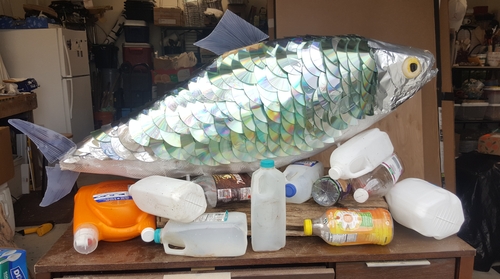
    2) NATURAL FLOW – The 2nd Edition 2026 in Lecce at MUST – Museo Storico della Città di Lecce, from July 03 to 18, 2026 with his sculpture: “Pull Tab Fish .625 “.

    INTERVIEW with Nic Galloro concerning the International Art Exhibition NATURAL FLOW – Exploring water’s essence in Matera, at cultural hypogeum Lega Navale Italiana Matera-Magna Grecia.

    Carmela Loiacono – Please introduce yourself and talk about the selected sculptures: “Filling Up” and “Reap What’s Sown” you exhibited during the exhibition NATURAL FLOW – Exploring water’s essence. 
    Nic Galloro – My name is Dominic Galloro.  I go by Nic Galloro as an artist name.  I am a sculptor but also a life-long environmentalist. I am intrigued with the idea of using reclaimed materials to make artwork.  Within that refuse, I recognize the design qualities intended for an industrial, practical function and can be manipulated; taken our context, they become sculptural elements. A narrative dialogue emerges from these arrangements. 
    Two particular artworks: Reap What Sewn and Filling Up express the sentiment that I wish to convey in my art. They both take the form of wall-mounted fish.  Reap… is a comment on how manufactured human waste can find its way into living organisms.  The title is a biblical reference about cause and effect. The other work shows the stomach of a fish completely full of the disposed waste.  It is an exaggeration, but I wanted to emphasize the sense of excess waste in the environment.  Both works were presented in Natural Flow, an exhibition of works with a similar theme in March 2025.  Dr. Carmela Loiacono was kind enough to extend an invitation to exhibit these works at the Cultural Hypogeum Lega Navale Matera, Italia. She showed an in-depth understanding of the work and was most helpful with the logistics to make it all happen – a true pleasure.

    Carmela Loiacono – How would you describe your creative process? What or who influenced or is influencing your work?
    Nic Galloro – For me, the creative process is used to make visual statements.  Art objects appeal to a different part of the brain. There is a lasting vision that may have a longer life than words.
    Influence for me comes from the work of Robert Rauschenberg because he used non-traditional elements in his art. Christo Javachef taught me not to accept obstacles and limitations (I had the pleasure of working on his Surrounded Islands project). In Baltimore, MD is a museum dedicated to Visionary Art. It is a vast collection of artwork created by people with no formal training. The commonality is having a deep desire to create art. 
    I share that sentiment.

    Carmela Loiacono – What do you think about shared art on social media? Could it be an alternative way of communicating contemporary art?
    Nic Galloro – Yes, social media is a good way to expose artwork to a wide audience. The world has shrunk with the advent of technology.

    Carmela Loiacono – What are your future goals and/or projects?
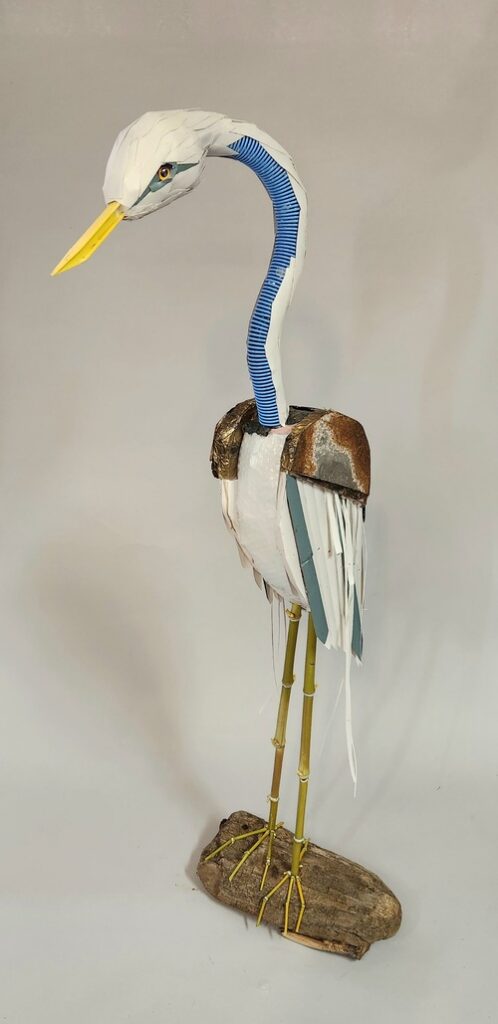
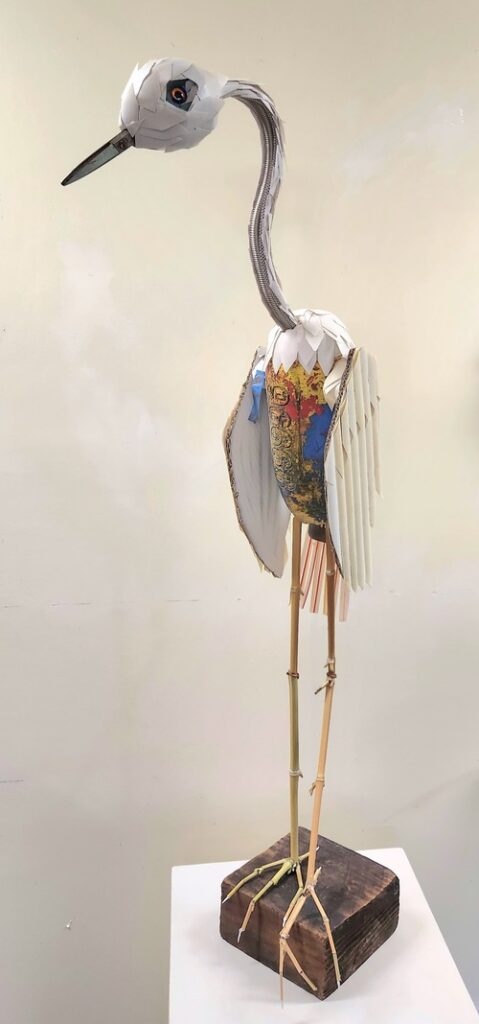
    Nic Galloro – Currently I am refining a proposal for a three meter tall heron to be installed on the Seine river near Paris. Though only a sketch was required, I decided to build it regardless. It was challenging and exciting working in a larger size than I am accustomed to and using materials foreign to my experience.

    Carmela Loiacono – We had the pleasure to meet in person in Matera, during the opening of the exhibition, did you enjoy cooperating with me? Did you like to stay in Matera? 
    Nic Galloro – The date of the exhibition was fortunate because we had intended to visit the city before I became aware of the show. Accommodations were arranged directly across the street from the museum so attending the opening was easy.  After the event we spent a few enjoyable days in the ancient city.

  • Irina Schiwon

    Artist from Germany 

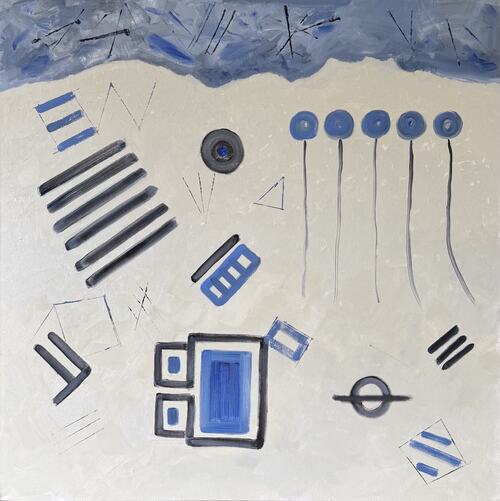
    Irina Schiwon was born in Altaj, Siberia (Russia) in 1958. After graduation in Computer Science in St. Petersburg, she moved to Germany in 1984, where she has lived for 40 years and considers her second home.  In fact, it was in Germany that she began creating her first works based on the models of Kandinsky, Miro and the  masters of Bauhaus. 
    She worked for many years abroad, where she was also inspired by Poljakov and Max Ernst, and held her first exhibitions and created her first commissioned works for private clinics and cultural pubs.
    Since 2010, she has exhibited in solo exhibitions in Moscow and Berlin. In 2015, she opened her own studio in Berlin and continued to present her paintings in various exhibitions in Magdeburg, Dresden, Cuxhaven, Innsbruck and Berlin. 
    From 2023 to 2025, she has exhibited her works in solo exhibitions in Tuscany, Castellina in Chianti and Magdeburg, Germany, and in collective exhibitions in Venice, Matera and Bologna. She produces further commissioned works for organizations, companies and in collaboration with the interior designers “Picture & Frieze”.

    Artist statement
    “Abstraction is not chaos. Each of my paintings has its own signature. I let myself be guided by emotions and bring my feelings onto the canvas. In doing so, every basic idea is my focus, I do not make sketches and I think in the original. The color is an expression of my passion.

    Every stroke is emotion, if I am not satisfied, the abstract allows me to wipe it off, cover it up, change it or even destroy it. In the abstract, color gives me the freedom to work through, edit, change or adapt until it finally fits my basic idea.”


    For more information visit: www.irina-schiwon-abstrakt.de
    Facebook: Irina Schiwon Instagram: @irinaschiwon

    Solo exhibition in Matera

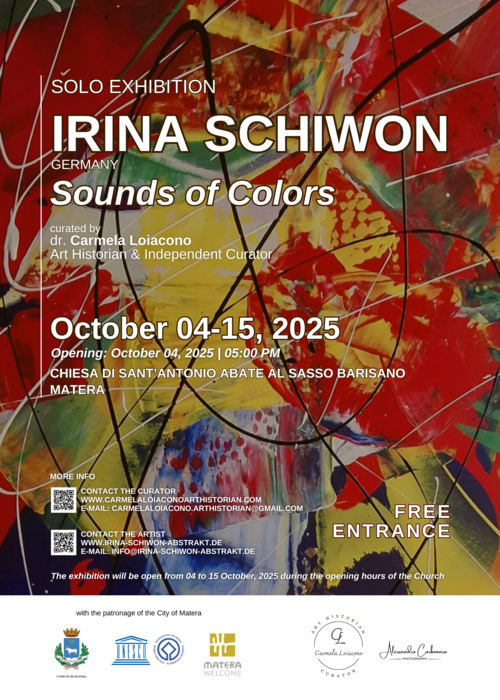
    The solo exhibition Irina Schiwon: Sounds of Colors has been an amazing success!
    Opened from 04 to 15 October 2025, at Chiesa di Sant’Antonio Abate al Basso Barisano, located at Via Sant’Antonio Abate in Matera, the solo exhibition of the German artist Irina Schiwon has been curated by art historian Dr. Carmela Loiacono with the patronage of the City of Matera.

    Click the following links to know more about Irina Schiwon

    Presentation of the solo exhibition and the artist Irina Schiwon


    Presentation of the exhibition

    The solo exhibition “Irina Schiwon: Sounds of Colors” presents a selection of 24 abstract paintings, whose theme focuses on the musicality of the colors. 
    All the artworks are inspired by her experiences, external influences and her travels abroad, in Italy, France and other countries, creating a unique and fascinating exhibition itinerary, where colors become a metaphor for life, strength, resilience and hope for the future. 
    The exhibition has been a unique opportunity to immerse yourself in the essence of vibrant colors, bold and captivating brushstrokes, and the evocative sound of positive energy that stimulates the mind and emotions.

    For more information visit: www.irina-schiwon-abstrakt.de
    Facebook: Irina Schiwon Instagram: @irinaschiwon

  • Marc Noël Avatar

    Artist from Belgium 

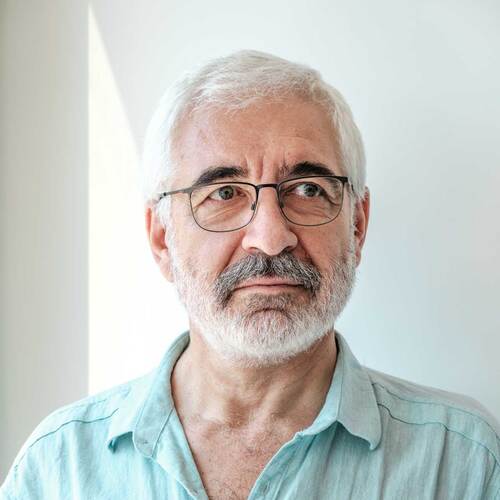
    Marc Noël Avatar was born in Belgium and is an internationally recognized artist. His artistic career is atypical and does not stem from classical training. From an early age, he had a passion for pencil drawing. However, it was at the age of 26, following a serious car accident that left him in a coma and forced him into seven years of rehabilitation, that his artistic vision truly evolved.
    The rehabilitation period was difficult, but thanks to his perseverance and the professionalism of an exceptional therapist specializing in supporting children with motor disorders, Marc Noël Avatar began to master every gesture and every action, and discovered a growing fascination with the creative process.

    Later, the art of Shodo, a Japanese gestural calligraphy, entered his life. He met talented professionals who taught him the power of this discipline, in which each brushstroke is imbued with a vital energy, a breath called “chi.” Today, every brushstroke he creates is charged with this essence. Shodo has profoundly influenced his creations, and he has also developed his own techniques by observing other Japanese artists. 
    His approach is unique, fueled by constant self-taught learning. His art, which he calls quantum painting, is inspired by the principles of quantum physics in science, where the observer influences the result.
    His works are a reflection of his intention, created in daylight with acrylic paints, featuring a variety of bright and powerful colors, and designed to make the invisible tangible, leaving the viewer with the power to feel, interpret, become, and inviting them to engage beyond mere viewing.
    His desire is to create a hypnotic magic, where each observation of a work reveals a new perception, influenced by each person’s personal evolution. Those who own his works testify to a continuous experience, discovering new dimensions every day.
    Therefore, Marc Noël Avatar seeks to make the invisible not only visible, but also palpable, establishing a deep and evolutionary connection with his art.

    Artist statement

    “As an Avatar artist, my objective is to bring paintings to the world, which have to be « felt ». That is the first step.
    The second step is to invite your brain to discover through your eyes what is painted on the canvas.
    My artwork is always an invitation «to feel outside of the box»!“

    more. myquantumpaintings-marcnoel.com | mapeinturequantique-fushigina.com
    Facebook: Marc Noël Avatar | Youtube @mapeinturequantique.fushigina

    Solo exhibition in Matera

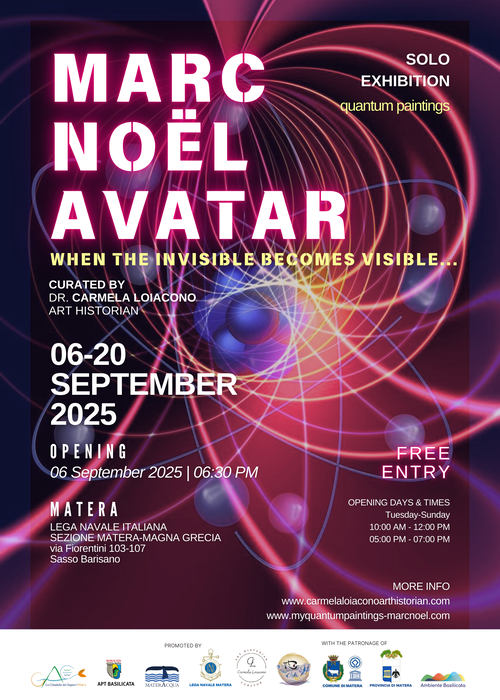
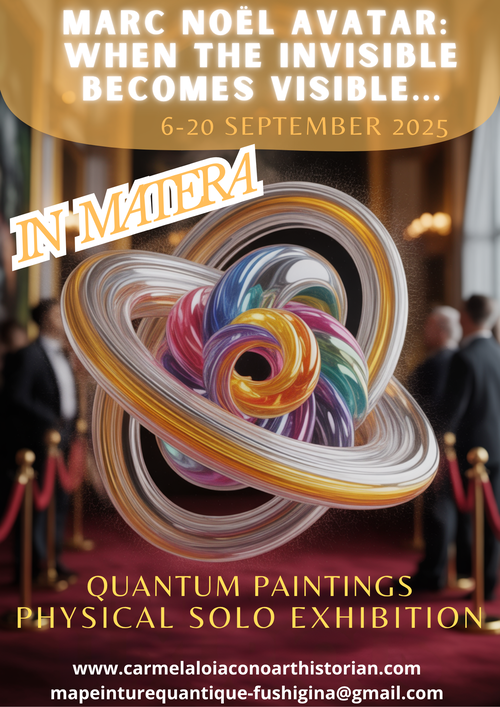
    The solo exhibition “Marc Noël Avatar: When the Invisible Becomes Visible…” was a great success!
    The solo exhibition of the Belgian artist Marc Noël Avatar has been opened from September 6, 2025 to 20, 2025 at the Cultural Hypogeum of Lega Navale Italiana Sezione di Matera–Magna Grecia, located at Via Fiorentini 103–107, in the Sassi of Matera.

    The solo exhibition has been curated by art historian Dr. Carmela Loiacono, promoted by Lega Navale Italiana Sezione di Matera–Magna Grecia and MaterAcqua, with the patronage of the Municipality of Matera, the Province of Matera, and Ambiente Basilicata.

    Click the following links to know more about Marc Noël Avatar:

    Presentation of the solo exhibition


    The idea for the solo exhibition arose from the close collaboration between art historian Carmela Loiacono and artist Marc Noël Avatar, who together invested a great deal of time, dedication, and passion in creating a unique and inimitable experience: an invitation to discover something completely new and different, not a conventional art exhibition, but rather an exhibition of quantum paintings. 
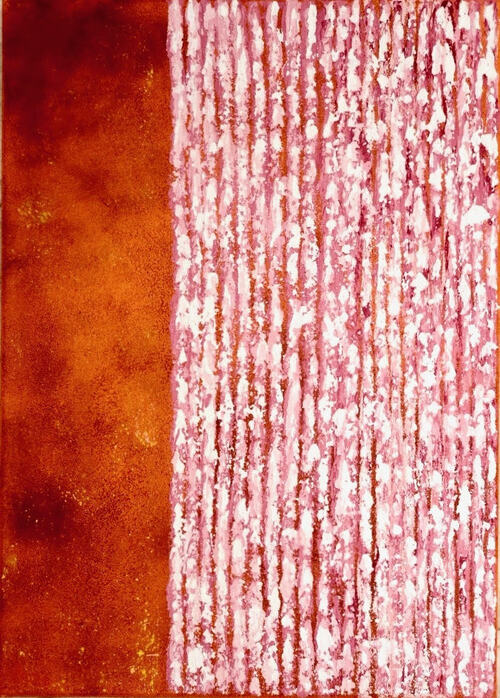
    Marc Noël Avatar’s quantum paintings can be appreciated from three distinct perspectives: in daylight, under UV light, and in complete darkness, where, surprisingly, they remain visible and come to life even in the absence of light. 
    The exhibition becomes a discovery, where visitors are invited to perceive these different facets. Each work is imbued with a unique and special energy.

    For more information about Marc Noël Avatar visit: myquantumpaintings-marcnoel.com | mapeinturequantique-fushigina.com
    Facebook: Marc Noël Avatar | Youtube @mapeinturequantique.fushigina

  • Alain Churlaud

    Artist from France

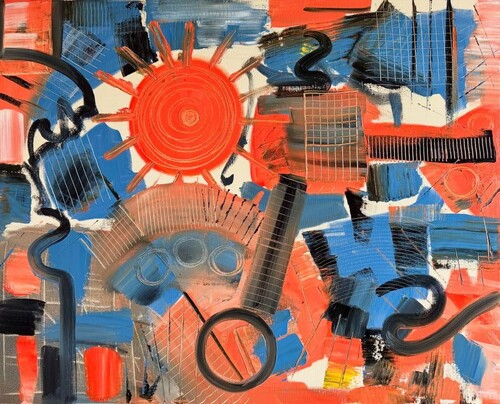
    Alain Churlaud is a French painter whose work juggles with the themes of water, mountains, countryside and concepts. His approach is to get into the feeling of the things before the making of a painting. In other words; first of all, there is astonishment at the surrounding simplicity, an emotion that is received. A story that is being built. A clash of colors, a play of lines, a structure that challenges him then builds, conceptualizes itself.
    Painting is freedom for him, starting from an idea, Alain does deconstruction-reconstruction work. Reconstruction can move as much towards simplification and purification as towards complexity and overload.
    He let himself work in abstract, minimalism, outsider art or figurative manner. Inspired by nature, Alain uses distinctive techniques such as the use of spatula, brush, roller, sand and sawdust to create a unique natural texture and specific shapes. To give more strength to his painting, he only uses pigments to create his colors. Cadmium Orange Red is a must-have that you can find in most of his work. The binder can be matte, satin or glossy according to his inspiration.
    His work has an international impact, in France and in Europe in large towns such as Rome, Venice and Barcelona and accepted in well known French sites such as Singulart and Artsper.


    more. blogs.churlaud.com/

    INTERVIEW with Alain Churlaud
    Carmela Loiacono talks with Alain Churlaud who takes part in the International Art Exhibition STORIES OF IDENTITY – The 2nd Edition in Matera, at cultural hypogeum Lega Navale Italiana Matera-Magna Grecia.

    Carmela Loiacono – Please introduce yourself.
    Alain Churlaud – I’m a French painter. Mywork juggles with the themes of water, mountains, countryside and concepts. My approach is to get into the feeling of the things before the making of a painting. In other words; first of all, there is astonishment at the surrounding simplicity, an emotion that is received. A story that is being built. A clash of colors, a play of lines, a structure that challenges me then builds, conceptualizes itself.
    Painting is freedom for me, starting from an idea, I do deconstruction- reconstruction work. Reconstruction can move as much towards simplification and purification as towards complexity and overload.
    I let myself work in abstract, minimalism, outsider art or figurative manner. Inspired by nature, I use distinctive techniques such as the use of spatula, brush, roller, sand and sawdust to create a unique natural texture and specific shapes.
    To give more strength to my painting, I only use pigments to create my colors. Cadmium Orange Red is a must-have that you can find in most of my work. The binder can be matte, satin or glossy according to his inspiration.

    Carmela Loiacono – Talk about the selected works: “Composition in Orange” and “Composition in Red” presented during the exhibition STORIES OF IDENTITY – The 2nd Edition in Matera. 
    Alain Churlaud – When you asked me to present my work for your exhibition. I founded it so great to have the opportunity to work with this theme « Stories of identities ». A way to show what makes my painting identity. And most of all presenting 2 new paintings was exiting. I wanted for that occasion to create something strong, full of natural materials. A lot of saw dust and some sand. The sand would have been just spread on the canvas. As you may know I’m so found of nature, I was to tend toward structures like moss or lichen you sometimes see on rocks. Sawdust had to be covered by beautiful bright colors as yellow orange cadmium, red orange cadmium to give strength and energy. 

    Carmela Loiacono – How would you describe your creative process? What or who influenced or is influencing your work?
    Alain Churlaud – The main lines, structures, materials and colors are set when I start painting. In the making, events happen and take the direction. For example, the sawdust is not made of the same shape. So it doesn’t follow exactly what I expected to do when I lay it on the canvas. In the go, the mixing I did with binder is not always as liquid as the other time. I let it do its own thing once on the canvas. Sometimes, drops of color fell on the painting and it wasn’t expected. We’re making the painting together, it’s a collaborative work. I’m mainly influenced by Nicolas de Staël, Braque, Soulage and Kandinsky. I also listen to lot of music, I paint surrounded by most of all ambient music and new classical. I’m really fond of Ian Hawgood, Wil Bolton, Enrico Coniglio, Stefano Guzzetti and Valgeir Sigurðsson to give few names (the list can be very long ;-)). 

    Carmela Loiacono – What do you think about shared art on social media? Could it be an alternative way of communicating contemporary art?
    Alain Churlaud – Social media is a way to reach and to be reach. For me, it’s a way to be better known as a person and artist. There one can see that you do not have a single center of interest but many, you don’t work the same way each time. You are multiple in your work as you are in your personal life. So everyone can find in my work the different shapes of what I am and do. It’s a great way to connect our emotions and perceptions of life.

    Carmela Loiacono – What are your future goals and/or projects?
    Alain Churlaud – I started a project with Enrico Coniglio that will be seen during 2026. If you follow me on Instagram, you’ll have news about it very soon. My paintings and his music together for a trip from my place (Niort, France) to his place (Venice, Italy). I’ll paint, he’ll play. We’ll be live together.
    New paintings for 2025 2nd semester, a handful about water (the sea, the pool, the lake, …) and another about flowers (my sketches are waiting for me).

  • Vladimir Vankov

    Artist from Bulgaria 

    A Freelance artist with interests in sculpture, art glass, art jewellery, and fine arts.
    Born on July 10, 1964, in Varna.
    Graduated high school in his hometown – Varna.
    Graduate of St. Kliment Ohridski Sofia University, Major: Informatics, Specialty Computer Graphics, in 1991.
    Earned the title Master of the Co-operative of Masters of Arts and Crafts for artistic jewelry in 2011.
    A Master of the National Chamber of Crafts, in Media Technology and Media Design in 2009.
    Founder of DESIGN Ltd, Manager, Designer and Production Engineer thereof, from 1994 to 2013. DESIGN Ltd was a company that specialised in art and advertising glass and ceramics products, featuring in its portfolio the décor of a major part of the glass, porcelain, ceramics, and enamel products plants and ateliers in Bulgaria, as well as of a number of private workshops. The company also created art glass products exported to the Netherlands and France.
    Founder of IRIS Ltd, Manager, Designer and Production Engineer thereof since 1996. The company specializes in artistic and advertising print, as well as in organizing and participating in culture related events.

    Artist statement
    Through language that is as abstract and figurative as it is minimalistic, I address moral and ethical issues that, as time goes by, inevitably trouble each one of us. I compile a narrative about the life of the character by putting the viewer in their place; it is not always a comfortable one, and quite windy at that.


    more. www.vladimirvankov.com

    INTERVIEW with Vladimir Vankov
    Carmela Loiacono talks with Vladimir Vankov who takes part in the International Art Exhibition STORIES OF IDENTITY – The 2nd Edition in Matera, at cultural hypogeum Lega Navale Italiana Matera-Magna Grecia.

    Carmela Loiacono – Please introduce yourself and talk about the selected works: “Paternity”, “Maternity” and “Internal Conflict” during the exhibition STORIES OF IDENTITY – The 2nd Edition. 
    Vladimir Vankov – My name is Vladimir Vankov, and I am an independent visual artist working primarily in sculpture, but also in painting, glass art, and artistic jewelry. I was born on July 10, 1964, in Varna, Bulgaria. I have an university degree in mathematic sciences and a long background as a founder, manager, technologist, and designer of companies working in artistic glass, porcelain, and industrial printing. Over 40 years of artistic practice, I have participated in numerous exhibitions, both solo and group. My works are held in private collections in Bulgaria, the United Kingdom, Austria, Belgium, Denmark, Germany, Russia, Ukraine, Japan, the USA, and Canada.
    I was delighted that my works “Paternity,” “Maternity,” and “Internal Conflict” were selected for the curatorial project “Stories of identity II.” They are part of the narrative in my cycle “Where to now?” Perhaps not the most visually spectacular pieces (like the levitating figures “Alone” and “Where to now?”), but they are maybe the most intimately human. “Paternity” was the first artwork I created using this abstract visual language. Naturally, it was dedicated to my children. I was incredibly happy when I managed (in my opinion) to transform such an abstract category, such a profound feeling, into a plastic form—encompassing its past, present, and future. “Maternity” was the logical continuation, and the two pieces marked the beginning of “Where to now?” cycle. It’s a story about human life and the moments that define it: the searchings, the hesitation, the suffering, the joy, the decisions, and the responsibilities. My aim was to present these moments in a way that puts the viewer in the protagonist’s shoes. The idea was for the viewer not to think about the material, color, texture, or background—just to see a sculptural form that speaks. That was also why I chose this size, as it’s the optimal size to be taken in with a single glance. As for “Internal Conflict,” the idea for it came to me at the beginning of the war in Ukraine. It took me some time to realize that war is not so much a conflict between two forces as it is an internal conflict of humanity itself. The parallel with the internal conflict of the human soul came naturally. The sculptural solution was a real challenge: a defined, unified whole that tears apart while remaining whole—on the verge of disintegration, but with the possibility of becoming whole again.

    Carmela Loiacono – How would you describe your creative process? What or who influenced or is influencing your work?
    Vladimir Vankov – Every artist’s creative process is different. At my age, after experiencing many personal and social upheavals and re-evaluations of societal value systems, as well as learning many lessons from life, a natural approach has developed that allows me to examine the philosophical and ethical problems and mental states that concern every person. First, through my own lens, I analyze a problem in depth—rationally, emotionally, and morally. I clarify my position and concept for myself, and only then do I begin to search for its plastic expression. This is an iterative process that continues until I achieve a result that is as expressive and stripped of all unnecessary details as possible. In doing so, I let the form evolve according to its own internal forces; I don’t compromise it to fit the requirements of a specific technology or material. Only at the end do I choose the appropriate material and technique for execution. I also pay serious attention to the presentation of the finished work, believing that its adequate presentation by creating its own environment (a stage) is essential for the audience to fully perceive it. Working with a highly abstract visual language, I prefer to add a text with my own vision, which is an integral part of the work and sometimes the most difficult part. My task is to ask questions—not always pleasant or easy ones—when the audience encounters my art, and I leave the answers to the responsibility of each individual viewer. It is a real satisfaction to see that no visitor remains indifferent. That is where I find meaning in my work and motivation to continue.
    This is where my inspiration comes from: seeing people entangled in their daily worries and their unresolved internal, interpersonal, and social problems, without expecting to be put in front of a mirror and asked the questions they avoid or have not yet reached. Then, I see the change in their gaze. It’s incredible. And deeply obligating. As for the artists who inspire me, there are many in one way or another, but I believe that the main inspiration must come from within and be hard-won.

    Carmela Loiacono – What do you think about shared art on social media? Could it be an alternative way of communicating contemporary art?
    Vladimir Vankov – I don’t have a simple answer regarding the online sharing of modern visual art, especially on social media. Of course, given the speed and immediacy with which published information reaches its target audience, these platforms should not be underestimated, especially considering the minimal effort required from the viewer. On the other hand, these channels cannot provide the experience of a live encounter with the artwork, of sharing the feeling and breathing with it. The effort a viewer makes to visit a gallery and immerse themselves in the specially created atmosphere guarantees a much more fulfilling connection with the artwork. It is on its “stage,” which is something unattainable when viewing it on a screen at the current level of technology (with the exception, to some extent, of some interactive 3D platforms), especially on a smartphone screen. The sense of real dimensions and the interaction with the environment and other exhibited works are also lost. The artwork is in an uncontrolled light and color environment. From my own experience, I can say that the live experience is in the vast majority of cases significantly different from the expectation built from prior visual information. In short, at the risk of sounding a little retrograde, I believe that publishing visual art online is an inseparable part of modern life, but it should be done with taste and moderation. The photo or video material and its presentation should be thoughtful to preserve the idea as much as possible and avoid the simplified, fast-food-style perception. At best, it should be an invitation to a live meeting. And that requires a special kind of professionalism.

    Carmela Loiacono – What are your future goals and/or projects?
    Vladimir Vankov – My main goal is to continue working. I have a number of works started that I need to finish, as well as some that are at the idea and sketch stage. But even more important is to provide the ways for them to reach a wider audience. In particular, this means organizing exhibitions, with my current focus being on Europe. Of course, this also implies an organized online presence.
    To be specific, these are works in the philosophy and style of my cycle “Where to now?”, as well as large-format works in metal, stone, and glass. I am also working on two monumental metal compositions for an urban environment. But most of all, I am working on the philosophical dimension of my ideas—exploring what each of them can contribute to a better world inhabited by more consciously humane people. I do not impose my views, but I offer them, along with the questions they raise. Each person makes their own choices—and takes responsibility for them.

  • Minkah Amen-Ra

    Artist from Jamaica 

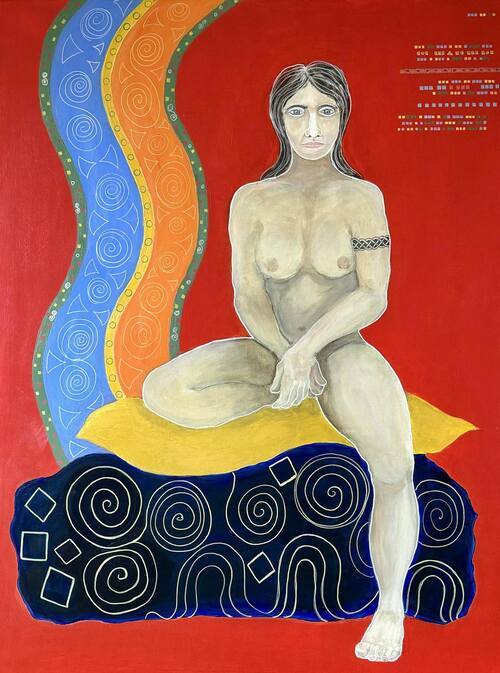
    Minkah Amen-Ra is a self-taught visual artist based in Kingston, Jamaica. Her work uses bold color, symbolism, and expressionist techniques to explore identity, emotion, and the spiritual self. Drawing from Afro-Caribbean heritage and inner reflection, Minkah’s portraits often feature surreal, dreamlike elements that evoke both vulnerability and power. Her process is intuitive and deeply personal, guided by ancestral memory and emotional resonance. Without formal training, she has developed a unique visual language that challenges conventional beauty and celebrates the complexity of being. Minkah continues to share her work through digital platforms, contributing a fresh and powerful voice to Jamaica’s contemporary art landscape.

    Artist statement
    “I am a self-taught visual artist based in Kingston, Jamaica, specializing in acrylic on canvas. My work explores themes of identity, introspection and spirituality, characterized by vibrant colors and symbolic imagery. Drawing inspiration from meditative insight, I aim to create pieces that resonate with viewers on a profound level. Over the past year, I have contributed illustrations to two forthcoming publications, marking the beginning of my professional artistic journey.” 


    more. portfolio

    INTERVIEW with Minkah Amen-Ra
    Carmela Loiacono talks with Minkah Amen-Ra who takes part in the International Art Exhibition STORIES OF IDENTITY – The 2nd Edition in Matera, at cultural hypogeum Lega Navale Italiana Matera-Magna Grecia.

    Carmela Loiacono – Please introduce yourself and talk about the selected works: “The Movement” and “Identified” presented during the exhibition STORIES OF IDENTITY – The 2nd Edition. 
    Minkah Amen-Ra – My name is Minkah Amen-Ra and I am a self-taught artist based in Kingston, Jamaica. “Identified” is a personal piece that is unlike my other works. It is a physical representation of the cathartic release I experienced during some self-therapy. It relates to my personal struggle growing up with a radical pan-Africanist, idealist parent while living in a colonial-retentive country like Jamaica.The overt identity confusion displayed appears political, but at the core it is the confusion and lack of belonging that one experiences under the effects of a dysfunctional parent. The sense of loss and wanting is splayed onto the canvas with dark colours, covering up what used to be my first ever painting that I was once too scared to “ruin”.
    The title “Identified” is chosen because the painting released me from this confusion-causing childhood burden; and since then my artistic approach and style has shifted. I am free. Free to forge my identity.
    The second piece, “The Movement” thematically proceeds “Identified” as it is the continuance of this new-found freedom in self, artistic expression and identities. It is the processing and release of the resentments that create causes of suffering and restraint on the canvas.

    Carmela Loiacono – How would you describe your creative process? What or who influenced or is influencing your work?
    Minkah Amen-Ra – My work is mainly influenced by my spiritual journey. I am not a strictly religious person but I meditate and pray to connect to source as needed. My ongoing journey of spiritual awakening constantly rewards me with inner clarity and visual insight into elements of the “inner worlds”. That introspect and intuit are what guide my hands when I draw and paint. Most if not all of my paintings have origins in some random vision I may have while praying, dreaming or simply gazing.
    I have no formal training in art but I grew up with parents who are fine artists. Though I only developed an interest in fine art during adulthood, I have come to realise how influential watching them do art as a child has been.

    Carmela Loiacono – What do you think about shared art on social media? Could it be an alternative way of communicating contemporary art?
    Minkah Amen-Ra – In a world where we have subjected ourselves to trends, derivatives and artificial intelligence, originality is like gold. It is important for artists to have an online presence as it benefits us all when we are able to witness the powerful materialisation of the  inner workings of a person’s mind. It is important because it inspires, disturbs and stirs the spirit; and it is done in a space that can reach anyone in the world, rather than a museum or a sophisticated gallery in a fixed location where many would ordinarily not have access or be too intimidated to go. Also, social media is an excellent way for artists to connect directly with collectors and achieve financial stability without an intermediary.
    Yes, social media has become a necessary alternative to the traditional means of communicating contemporary art.

    Carmela Loiacono – What are your future goals and/or projects?
    Minkah Amen-Ra  – I am currently working on a series called “The Mirror” which shows the spiritual evolution a person experiences during enlightenment as their eyes begin to see beyond the (MUNDANE) physical representation of self. The series features the progress of a woman who is looking in a mirror as she trains herself to see her truest form, beyond the unsubtle physical form.

  • Teresa Godfrey

    Artist from N Ireland 

    Teresa Godfrey is a full-time artist based in Co Fermanagh, N Ireland. 
    She is an alumnus of the Art2Life Creative Visionary Programme 2024 and is currently a member of the Art2Life Academy. She is also a member of Visual Artists Ireland and The Irish Palette Artists Collective. Her work has been selected for several group exhibitions in Ireland and the UK and her first solo exhibition was hosted by Solas Art Gallery, Co Leitrim in April/May 2025. 
    Teresa left school at sixteen and began a career as a Draughtsman in various engineering and architectural offices before entering university as a mature student and gaining a BSc Hons in Geography and an MA in Documentary Film Production.
    She continued developing her drawing and art skills by regularly attending Life Drawing classes and Fine Art courses at Belfast Metropolitan College, The Crescent Arts Centre Belfast, the South-West College, Enniskillen, and Strule Arts Centre Omagh.
    Teresa’s art was featured in Collect Art magazine, Autumn issue, Vol 52 along with an interview about her practice (www.collectartwork.org)
    Also, her artwork has been featured on the cover of “How Will They Name Us?” published by Revival Press, Limerick, 2024 and on “This, Also, Is Mercy” published by Summer Palace Press, 2021
    Teresa is also a published poet, novelist, award-winning screenwriter, and filmmaker. Her written work has been broadcast on UK radio and her films have been produced on UK’s Channel 4 Television.


    Artist’s Statement
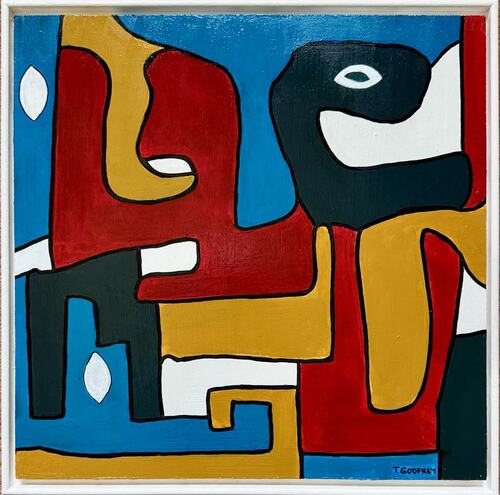
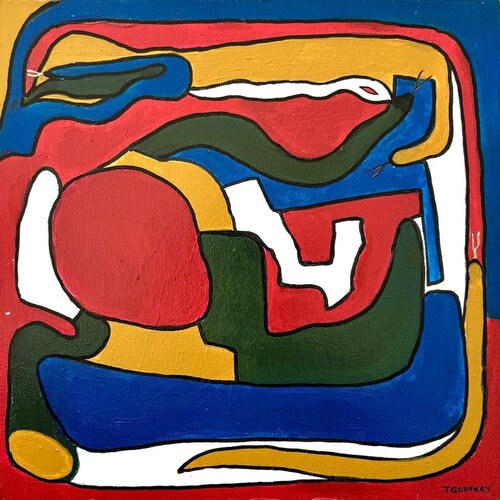
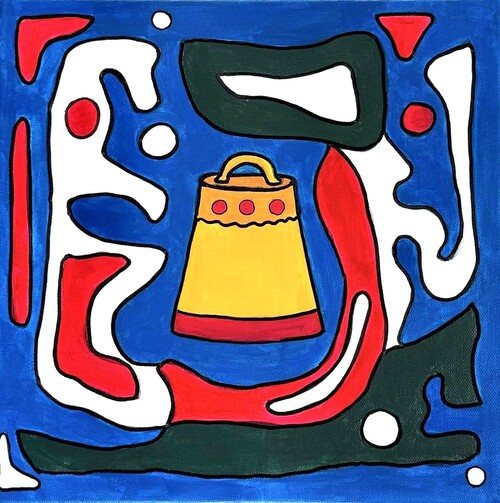
    As an Irish artist, my work is rooted in the ancient soil of my homeland – its myths, its relics, its voices echoing through time. The nine small paintings I wish to subit to Stories of Identity are visual translations of Ireland’s layered past: mythological tales, historical icons, and cultural totems reimagined through color, form, and rhythm.
    Each of these pieces is inspired by a specific narrative or artifact from Irish heritage. From the mysterious presence of Sheela na Gig – an ancient fertility icon known throughout Ireland and Europe – to the dual-faced Janus figure watching both past and future, and the resonance of the Loughnashade Horn, I explore how identity is carried not only in our stories, but in the shapes we inherit and reinterpret. The abstract forms echo stone carvings, ceremonial instruments, and oral tradition – ancient expressions filtered through a contemporary lens.
    This work is deeply personal. It is my way of connecting to lineage, of honouring what endures, and of asking how the past continues to shape us. In layering these histories into abstraction, I aim to create space for viewers – Irish and European – to find their own reflections in the myths we all share.
    more. www.instagram.com/mteresagodfrey/ | www.brush.bio/teresa-godfrey

    INTERVIEW with Teresa Godfrey
    Carmela Loiacono talks with Teresa Godfrey who takes part in the International Art Exhibition STORIES OF IDENTITY – The 2nd Edition in Matera, at cultural hypogeum Lega Navale Italiana Matera-Magna Grecia.

    Carmela Loiacono – Please introduce yourself and talk about the selected works: “Balor”, “Banished”, “Cloch”, “Cuchulain”, “Janus”, “Loughnashade Horn”, “Messenger”, “Sheela na Gig” and “Sinner” presented during the exhibition STORIES OF IDENTITY – The 2nd Edition. 
    Teresa Godfrey – Teresa Godfrey. I’m an Irish artist working mainly in oils or acrylic to create abstract or semi-abstract paintings. My 9 works exhibited in Stories of Identity 2 are all based on characters or events from Irish history or mythology: Balor the one-eyed giant. Banished inspired by the legend of Saint Patrick banishing the snakes from Ireland. Cloch,  a medieval Irish bell and symbol of spirituality. Cúchulainn, the tragic hero of the Irish epic tradition. Janus, based on the Co Fermanagh version of the famous Roman god. The Loughnashade Horn, an Irish Bronze Age ceremonial instrument with deep connections to nature and the spirit world. Messenger, inspired by the ancient Irish belief that birds are messengers from the otherworld. Sheela na Gig, the provocative and archaic representation of a female figure, often seen as a symbol of fertility, but also of protection and resistance to patriarchal power. And, finally, The Sinner, a symbol of shame and redemption and of social constructions of guilt.

    Carmela Loiacono – How would you describe your creative process? What or who influenced or is influencing your work?
    Teresa Godfrey – I work on my art every day. If I’m not actually painting I’m researching opportunities to show my work, or I’m learning about other artists and their work by going to exhibitions or researching them on the Internet. Although I’ve always drawn or painted and I’ve participated in several art courses, I started late as a full-time artist so I feel I have a lot to catch up with. My inspiration mainly comes from my concern about contemporary social and political issues such as climate change and care for the environment. I don’t start with a plan or with sketches but I do always have some idea of what I hope to convey in my work and let my subconscious take over, unless of course I’m doing figurative work, in which case a more disciplined approach is needed. The artists whom I admire and who inspire me are numerous. They include Anselm Kiefer, Susan Rothenberg, Sharon Paster, David Mankin, and the Irish artists JB Vallely, and also Sarah Longley and John Price for their drawings.

    Carmela Loiacono – What do you think about shared art on social media? Could it be an alternative way of communicating contemporary art?
    Teresa Godfrey – Making art is an important form of communication. I want my art to be seen and the best and easiest way is via social media. I post a lot of art on Instagram and Threads and on Facebook. But visual art is more than the communication of an idea. It can and often is a powerful expression of beauty – the beauty of its physical self as an object, and the beauty within the human soul that perceives it. This is why art galleries and museums where art can be seen “live” are vitally important. Art is an experience, not just in its making but in its viewing. As an artist, I need a live audience to truly bring my art to life. Equally, as an audience member, I need the artist to grab my attention, to make me think, and to allow me to glimpse our common humanity. Only the live experience can fully do that.

    Carmela Loiacono – What are your future goals and/or projects?
    Teresa Godfrey  – I have just finished two major series of medium to large-scale oil paintings, both inspired by my concerns about climate change. One series has the overall title “Wastelands” and the other is provisionally titled “Heatwave”. These have been quite intense projects so now I need to have some time out. I’m planning to return to my first love and draw simply for the joy of handling charcoal or pencil and bringing something figurative or realistic to life.

    Carmela Loiacono – We had the pleasure to meet in person in Matera, during the opening of the exhibition, did you enjoy cooperating with me? Did you like to stay in Matera?
    Teresa Godfrey  – Attending the opening of Stories of Identity 2nd Edition in Matera has been one of the highlights of my artistic career. It was wonderful to see my 9 paintings taking their place as part of an international exhibition beautifully curated by the excellent Dr Carmela Loiacono and to have the privilege of speaking about my work to a very attentive and appreciative audience.  I hadn’t been to Matera before and I was enthralled by the beauty and magic of this very ancient and special place – a perfect venue for the ancient stories of my identity symbolised in my art. I know that Matera will call me back again.

  • Nanako

    Artist from Japan  

    A picture diary artist / A modernologist of food culture / An installation artist
    Based in Kagawa/Kobe, JPN.
    Theme: Time, Space and Joy.

    Nanako, originally from Japan, began studying traditional dance in 1991 and later entered the Tokyo theater scene as a playwright and director. In 2003, she transitioned to burlesque performance under the name Cherry Typhoon, gaining recognition as an award-winning performer at festivals worldwide. After a heart attack during a performance in 2016, she took time to recover before returning as an MC and starting the art project “The Time-Space Installation” in Japan. In April 2024, Nanako retired from show business to focus on new artistic endeavors, including creating illustrations, essays, and installations on the themes of time, space, and joy. She currently works on a project called “Viva Food Culture,” where she illustrates her daily meals and writes about the history and personal significance of the dishes. This project serves as both a personal diary and a reflection of life in the 21st century.

    more. note.com/nanako_oishii | raymma.info/en/nanako-ijichi

    INTERVIEW with Nanako
    Carmela Loiacono talks with Nanako who takes part in the International Art Exhibition CREACTION in Matera, at cultural hypogeum Lega Navale Italiana Matera-Magna Grecia.

    Carmela Loiacono – Please introduce yourself and talk about the selected works: “Coffee and Basque Cheesecake”, “Grilled Chicken with Bone”, “Stir-fried Noodles with Thick Sauce”, “Tagliere misto Lucano”, “Green diary” and “Pink diary” presented during the exhibition CREACTION.
    Nanako – Hello. I’m Nanako, A picture diary artist / A modernologist of food culture / An installation artist based in Kagawa/Kobe, JAPAN.
    I consider food as a symbol of everyday joy, and by depicting these scenes, I hope to resonate with people’s inner sense of peace and contentment. Let me introduce you to some of my work.
    ”Coffee and Basque Cheesecake”. This is a scene at my favorite cafe “dolce Coffee” in Kobe. I stopped by during work. The aromatic coffee and the rich flavor of the cheese spread joy in my heart.
    “Grilled Chicken with Bone”. This delicious chicken is a specialty of Marugame City in Kagawa Prefecture, another of my home bases. It is grilled in two varieties, parent and baby chickens, and the one pictured here is the baby chicken. Tender and slightly spicy, the oil dripping from the grill adds a richness of flavor.
    “Stir-fried Noodles with Thick Sauce”. This Stir-fried Noodles was served at an unpretentious Chinese restaurant in Kobe, Hyogo Prefecture. Kobe has long been home to many “overseas Chinese” of Chinese origin, and Chinese food has permeated the food culture. The restaurant is really popular and always makes me feel warm.
    I like to depict such moments of “sudden warmth”.
    “Tagliere misto Lucano”. This is a wonderful assortment of foods from the Matera, or Lucania region of southern Italy. They are all made using traditional methods, and with each taste you can feel the rich nature and culture of the mountainous region. The flavors of the ingredients come alive in this dish, which I feel is common to Japanese cuisine as well. It was an unforgettable dish.
    “Green diary”. This is a picture diary in a sketchbook that I started drawing for the first time in my life in July 2024. I had kept a diary before, but this was the first time I started to continuously draw my daily food as a picture diary. This small sketchbook contains my daily meals in Japan and memories of my travels around the country.
    “Pink diary”. This is my second picture diary, twice the size of the Green Diary. So I can now write in a variety of scenes. It was also around this time that I started drawing not only pictures of meals, but also my own fantasies. Through writing in my picture diary, my ideas must have become freer.

    Carmela Loiacono – How would you describe your creative process? What or who influenced or is influencing your work?
    Nanako – I paint from the perspective of “depicting joy in everyday life. Therefore, the common theme of my work is joy. However, I am not making art with the intention of making art, nor am I making art for art’s sake. My moments of pure joy come first, and then the pictorial diary is born. The picture diary exists as a witness to that moment of joy.
    No specific person or work of art influences the creation of my picture diaries, but they could not have been created without encountering many people, places, and moments. The coincidence of time and space influences my work.

    Carmela Loiacono – We had the pleasure to meet in person in Matera , staying together, living the moment of creation, did you enjoy cooperating with me? Did you like to stay in Matera and create your artwork “Tagliere misto Lucano”? 
    Nanako – Yes, it was a great experience for me to collaborate with you. It has been a wonderful experience for me to collaborate with you. You know very well that art is born from a deep connection with the individual’s way of being. I felt that the time we spent together during the residency was a time that was born out of that relationship, and that is what art is about.
    It was a great experience for me to paint the work, but it was also very meaningful for me to share the time and space, and to see the changes that were born from that experience.

    Carmela Loiacono – What do you think about shared art on social media? Could it be an alternative way of communicating contemporary art?
    Nanako – Social media is very useful in creating encounters that transcend time, space, and existence. However, what truly changes lives is always a direct experience. Social media is art as an entry point, not a substitute for art.  It‘s my personal point of view.

    Carmela Loiacono – What are your future goals and/or projects?
    Nanako  – To create a place of resonance.

  • Paige Young

    Artist from USA  

    Paige Young is a photographer located in the midwest of the United States. Her love with photography began with the connection between psychology and photography. She saw the intimacy between photographer and subject and how images can affect the love and compassion we find for ourselves. 

    Her commercial work and fine art work revolve around the idea of self-compassion, and tackles ideas of grief, eating disorders, mental health, and representation in communities that are being politically erased. She has owned her own business for more than 15 years, normalizing and representing all forms of love and diversity in her work. Besides equality, storytelling and freezing moments in time are elements that are incredibly important to Paige, especially as she ages.

    more. paigekyoung.com

    INTERVIEW with Paige Young
    Carmela Loiacono talks with Paige Young who takes part in the International Art Exhibition STORIES OF IDENTITY – The 2nd Edition in Matera, at cultural hypogeum Lega Navale Italiana Matera-Magna Grecia.

    Carmela Loiacono – Please introduce yourself and talk about the selected photo series: “These Died With You” presented during the exhibition STORIES OF IDENTITY – The 2nd Edition. 
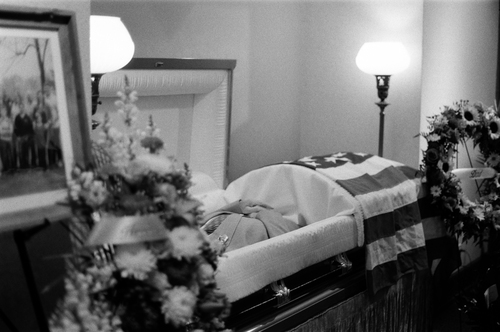
    Paige Young – My name is Paige Young – I am a film and digital photographer, yet I find myself shooting more analog and in the darkroom the more the world leans into the digital era and moves 100 miles a minute. I’ve been working really hard on slowing down and embracing every moment, and the darkroom really makes you have to do that. “These Died With You” is a work that is of founded images from my grandfathers basement of images that range from 1850-1960. My family was extremely broke in these times, but my great great grandfather and my great uncle had an interest in photography and some how came about the means to develop and produce images in these times. I didn’t have the negatives, but I did have the darkroom prints. Being an educator who teaches film, I have create negative prints and positive prints from existing prints before, so I thought I would try to create something new from these old images.

    When I inherited these images I didn’t really know the stories behind them. I was enthralled with the images because they were dated and showed the history, but I didn’t really know the people or the stories. Luckily my grandmother of my grandfather is still alive, so I took these images back to her and asked her about them. Even in my bachelor’s degree I was kind of obsessed with this idea of what we leave behind.  Why do we keep things that if we didn’t have attachments to, would they be disregarded as trash? These images are kind of like that. Without my grandmother telling me these stories, I wouldn’t know them. However, these stories are stories she has heard, but none that she truly lived until she shows up in the frames of them. So as much as she can believe the stories, the identity behind them is still a mystery. I hope these people were good people – but it was the 1850’s, when racism was raging in America, and although we lived in the North, that doesn’t really say much. 

    Carmela Loiacono – How would you describe your creative process? What or who influenced or is influencing your work?
    Paige Young – The creative process is very much experimental. This is so opposite of how my brain works, and opposite of every other process I have digitally. However, it works for my concept. The less I feel I know about the individuals in the photographs, the less I want the viewer to identify. I play around with distance between the papers while enlarging, causing them to be more out of focus, and I also play around with paper negatives, leaving the viewer a bit disoriented while reading them, since they are opposite than the positive intended.  

    I have SO many influences for my film art. Duane Michels, Diane Arbus, Mary Ellen Mark – all of these artists I teach about daily. I love the real and raw of their documentary while also telling the viewer a narrative. I love Michel’s post processing and double negatives in the darkroom and in camera. He was really the one that got me playing around in the darkroom and got me in an experimental mode with my work – that eventually made it into the way of all of the darkroom classes I teach. 

    Carmela Loiacono – What do you think about shared art on social media? Could it be an alternative way of communicating contemporary art?
    Paige Young – I think sharing art on social media only globalizes art for accessibility. Not everyone can make it to an art gallery. Notoriously, art has always been so exclusive to certain classes and types of people. I truly believe that contemporary art and social media is breaking that stereotype, inviting people of all classes, races, and identities to join it. There have been so many cool pieces of art shared on social media, within websites, on google docs, and have also invited the general public to play along or add their voice to it. It’s not changing art, it’s adding a new genre. I think that is a beautiful thing – and something we really need today to unify us.

    Carmela Loiacono – What are your future goals and/or projects?
    Paige Young  – As many people can see, the United States is a mess. We are so divided, it’s painful and feels so hopeless. One of the main reasons I shifted to grief and joy is because it does humanize us. It is the two emotions that we do all feel. Not everyone can feel empathy, but for the most part, everyone can feel sympathy… or can understand these two emotions. Along with that, I deal with my own set of obstacles – like manic depression, major anxiety, and autism. I am currently building two installations that focus on grief, but have an additive layer of medication that sometimes may this emotion difficult to feel, even though we are very aware we are in it. IT is VERY exciting to be making trans-disciplinary art with installation and photography.
    You never have to be put in one category – just make what you need to make, to say what you need to say.
    I will be showing work in Florence, Italy October 18-25, and Outside of the Louvre in Paris, France April 10-12.