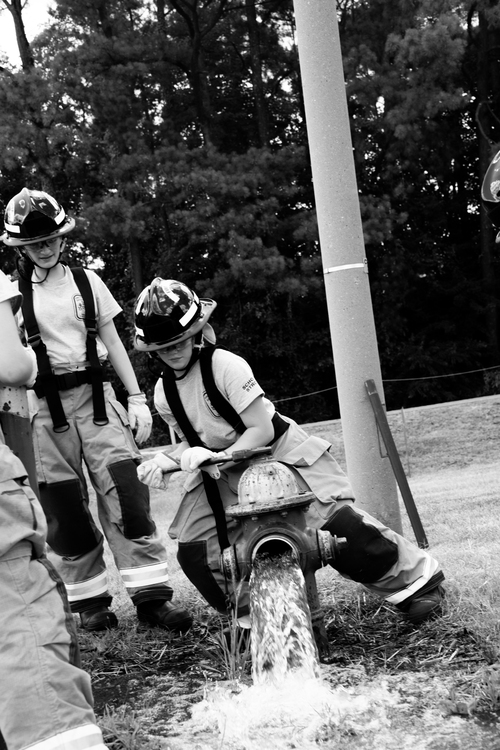
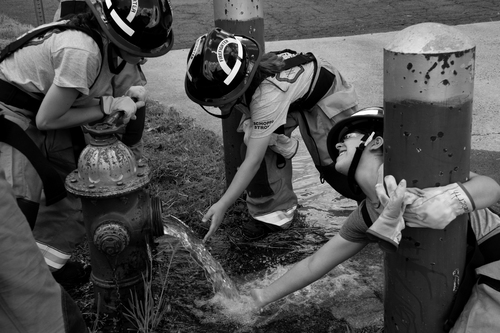
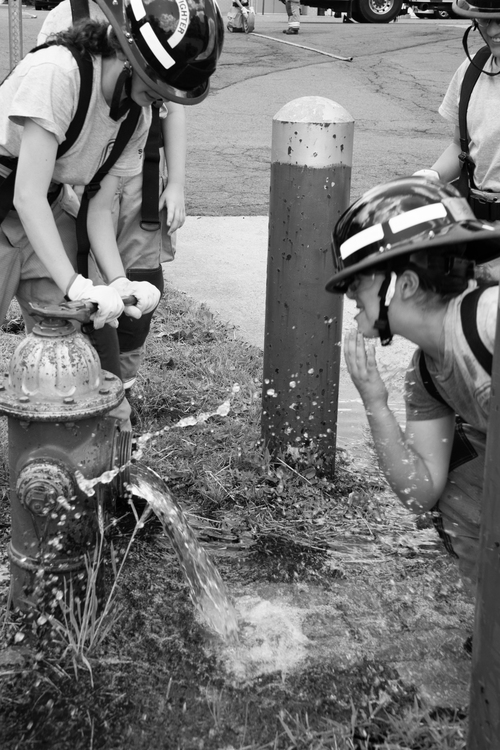
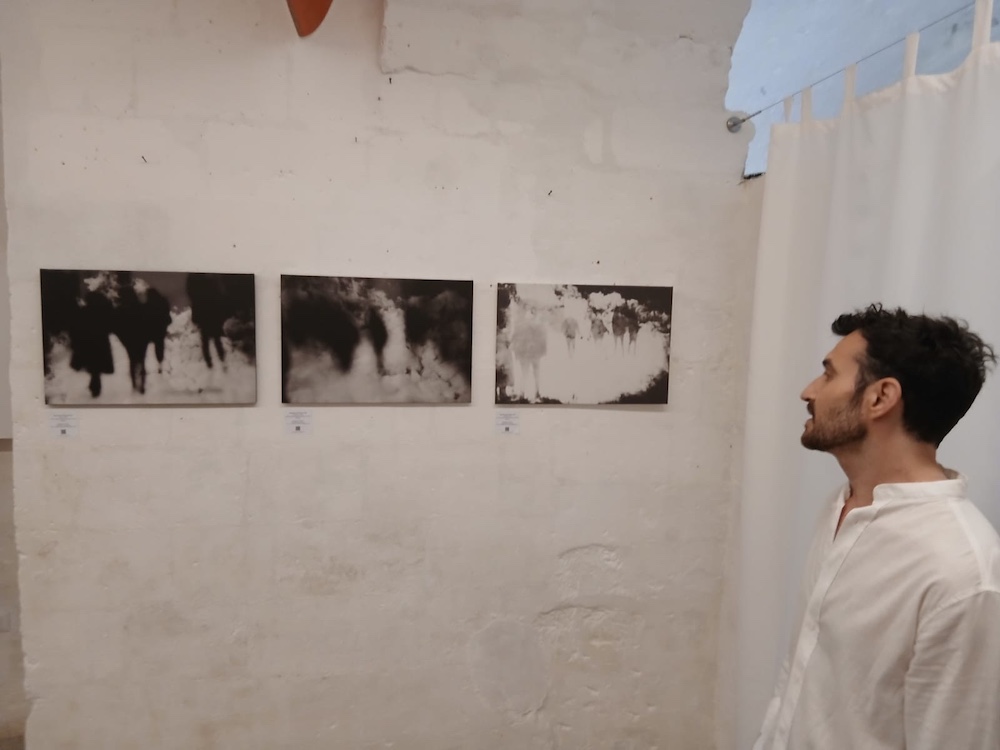
Helen Sorokach is a visual artist working with photo and video, based in the United States. Originally from Phoenix, Arizona, completed film studies in Paris, France and attended the Tokyo International Film Festival in 2022. These photos were taken in 2024, while employed by the Fairfax County Fire Department.
INTERVIEW with Helen Sorokach Carmela Loiacono talks with Helen Sorokach who takes part in the International Art Exhibition NATURAL FLOW – Exploring water’s essence in Matera, at cultural hypogeum Lega Navale Italiana Matera-Magna Grecia.
Carmela Loiacono – Please introduce yourself and talk about the selected photo series: “Water in Motion” you presented during the exhibition NATURAL FLOW – Exploring water’s essence. Helen Sorokach – My name is Helen Sorokach and I am a photographer and visual artist from the United States. The photo series “Water” is a collection of shots taken during a firefighting summer camp for teenage girls, and the photos exhibit various training exercises in which the girls took part.
Carmela Loiacono – How would you describe your creative process? What or who influenced or is influencing your work? Helen Sorokach – For photography, preparation is everything. Making sure that I am ready and present in the moment to capture the photographs as they happen is very important. After the photos have been shot, I like to do minimal edits to bring to focus what I find most essential in the photograph. Usually, this is cropping the photograph so that the lines and silhouettes are balanced to me. I am influenced by various other visual mediums when shooting and editing photos – both painting and architecture are interesting to consider when thinking about the flow and structure created by a photograph.
Carmela Loiacono – What do you think about shared art on social media? Could it be an alternative way of communicating contemporary art? Helen Sorokach – I think that social media is a great tool for opening works up to a much broader audience, much more quickly than ever before. Art works shared via social media have the ability to much more rapidly become a part of the cultural consciousness, but also to much more rapidly fade from this cultural consciousness in the rapid-fire cycle of content.
Carmela Loiacono – What are your future goals and/or projects? Helen Sorokach – I plan on continuing to photograph events and situations that are meaningful to me, and am interested in translating still work behind the camera to moving pictures and cinematography in the future!
Carmela Loiacono – We had the pleasure to meet in person in Matera, during the opening of the exhibition, did you enjoy cooperating with me? Did you like to stay in Matera? Helen Sorokach – The location of the exhibition – the UNESCO World Heritage Site and ancient town of Matera – was incredible to walk through before and after the exhibition, and the space used to display the works was beautiful and full of so much history. It felt like an honor to have photos displayed on a centuries-old cave-like wall, to be surrounded by and a part of so much history! Carmela was an incredible host and director of the exhibition, and a fantastic translator between English and Italian to explain the included works.
Andrea Kraus was born in 1970 and lives in Aschaffenburg, Germany. Andrea studied to the School Of Art in Würzburg, Germany. She had Free Art Studies with artist Dr. Arpad Bari, Aschaffenburg, Germany. From 2000 to 2008 she has been an Art Teacher at the First School Of Art in Aschaffenburg, Germany. Since 2000 she is a freelance artist. From 2008 to now she is the Founder of Atelier Raumkünste, Aschaffenburg in Germany, realizing tromp l’óeil, wall painting, stage design, portraits, CD-Cover, book illustration. From 2020 to now she is a Systemic and Psychologic Consultant, and from 2021 to now Andrea is also Art Therapist.
Unveiled – immersive: Project description “Unveiled – immersive” is based on my performance art “unveiled”, whichI showed in 2022 – 2024. In these years, 150 pictures were taken at ten different events. During the performance, complete strangers sat across from me in complete silence. We didn’t talk, we just looked into each other’s eyes. I tried to capture their “essence”, to perceive their inner being, hidden behind their external appearance. During these minutes of perception, a motif developed in my mind. I call it an “inner portrait.” The animation “unveiled – immersive” now shows the process of creating these inner portraits as it happened in my head. And on the one hand it shows the people who look at me as well as the process of creating their inner portraits, animated in beautiful images and accompanied by atmospheric music.”
INTERVIEW with Andrea Kraus Carmela Loiacono talks with Andrea Kraus who takes part in the International Art Exhibition NATURAL FLOW – Exploring water’s essence in Matera, at cultural hypogeum Lega Navale Italiana Matera-Magna Grecia.
Carmela Loiacono – Please introduce yourself and talk about the selected videos animation about the creation process of the “Unveiled – immersive”: “Nathalie” and “Veronika&Olivia” you presented during the exhibition NATURAL FLOW – Exploring water’s essence. Andrea Kraus – My name is Andrea Kraus, 54 years old, living in Germany. I feel like I have been an artist my whole life. After my college of design in Würzburg I completed a private study with the hungarian artist Dr. Arpad Bari for about five years. He teached me all his knowledge about technique, composition, colours and the secrets behind artworks. After that I started to work as an art teacher for many years. Parallel to my job I had many single and group exhibitions, primarily with oil and acrylic paintings. After a while the performance art came along and I started to paint at many events, on stage and in front of an audience. 2022 I developed a kind of portait art called “unveiled”. In this performance art I painted visitors, who sat down next to me. I didn’t know them, we didn’t talk at all. We were just looking in each other´s eyes. I didn’t paint their physical appearance rather than their effect on me. I portayed a feeling that they gave me about themselves. I call it a “portrait of the soul”. After 10 events and 150 resulting images I finished this art 2024. But I had a following idea: I wanted to show – via video animation – the process of creating these inner portraits as it happened in my head. And so, the video art “unveiled – immersive” was born. The artwork “Nathalie” was such an emotional process! This young lady sat in front of me and I felt her immediately. Her deep feelings, her fears, her hopes. It was like there were no distance between us, just flowing emotions. Im my imagination a lonely person appeared out of a blue light. She carries a light inside, which she protects near at her body. After a while I felt that she don´t want to keep this light for herself anymore. She wants to share this light with the world. This portrait was one of the most emotional and deepest process of all my 150 portraits. The artwork “Veronika & Olivia” was rather an exception, because I rarely portrayed two people in one picture. But in this case I took it as a challenge because I was curious to discover the similarities and differences between these beautiful twins. I felt their strong connection right away. They came out of one tree. But developed into very different personalities. Olivia, sitting on the left side, seemed to me introverted, serious, rather reserved, self-assured and very self-confident. She appeared to me like a beautiful blue rose. Veronika’s energy felt completely different to me. She was a shining angel. Curious, positive, bright, open to the world, positive, warm-hearted. Thats why I painted her as a bright shining diamond.
Carmela Loiacono – How would you describe your creative process? What or who influenced or is influencing your work? Andrea Kraus – I would describe my creative process as an intuitive, spontaneous process, which is influences so much more by my subconcious than by my concious. The decisions which I make during the process of painting is influencend by my inner world just in this moment. Or, in case of the portrait painting “unveiled”, by the inner world of the portrayed people. I thought about the question, who influended my work. I think, there is no specific artist. But I admire all artists, whether contemporary or from the past, who were committed solely to their art, who were authentic and made their inner world visible through their art. Artists who paid no attention to the current needs of the art market, who were merely pleasing or simply wanted to make money.
Carmela Loiacono – What do you think about shared art on social media? Could it be an alternative way of communicating contemporary art? Andrea Kraus – Of cause sharing art on social media is a great opportunity to reach many people. Social media platforms are particularly well suited for video art. When it comes to paintings, I’m a little more critical. Because even the best digital platform can’t replace seeing a painting in person. If you’ve ever seen a Marc Chagall or a Francis Bacon painting in real life, you’ll know what I’m talking about.
Carmela Loiacono – What are your future goals and/or projects? Andrea Kraus – One of my future project is called “THE STATE OF PLAY”. It describes a performance art that interacts with the audience. The visitors to the exhibition receive a sheet of paper with the sentence “The world is full of…” written on it. They are asked to complete this sentence with just one word. All sheets will be collected. One sheet after the other is drawn and the term mentioned on it is now depicted on the canvas. Over time, the canvas will fill up with all the terms that come from the audience. The individual motifs merge into a total work of art. The interaction in “THE STATE OF PLAY” creates a closeness that breaks down the barriers between artist and audience. The visitor decides on the motifs of the picture through his terms. My intention is to create a work of art that shows a cross-section of all the beliefs, thoughts, feelings, fears and hopes of people. I want to portray a view of society from here and now and manifest the state of play in a work of art. Also I want to implement this concept in different countries, exactly one picture per country. In this way, I want to reveal both the similarities and the differences that arise from the different cultures, mentalities and perspectives in today’s world. The other project will be a serial of seven oil paintings which I call “Under Trees”. I love the nature, i love forests and I love standing under a tree and looking up or out of it. This energy fills me anew every time, and I want to capture this energy in my paintings. The first two pictures are already finished and I love them
Carmela Loiacono –We had the pleasure to meet in person in Matera, during the opening of the exhibition, did you enjoy cooperating with me? Did you like to stay in Matera? Andrea Kraus – Yes, I had the pleasure to join the opening of the exhibition NATURAL FLOW and to meet you wonderful person, Carmela. You curated this exhibition with so much love and sense of the effect of art on the visitor. Every artist had its own place in the gallery, chosen by you with great feeling! I felt very welcome and I’m still happy and proud to know you. The venue was perfect! Both the gallery and the beautiful city of Matera. I would love to cooperate with you again and exhibit in this exceptionally beautiful city!
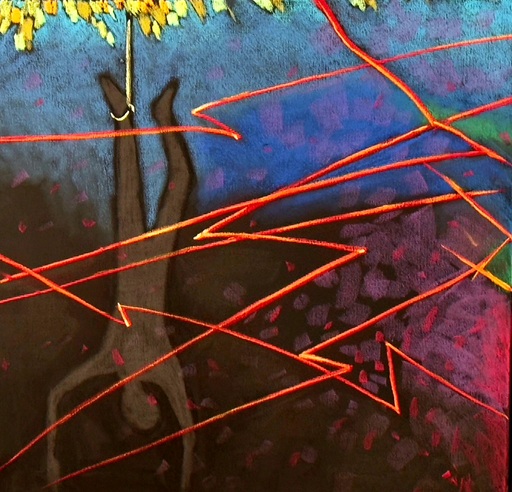
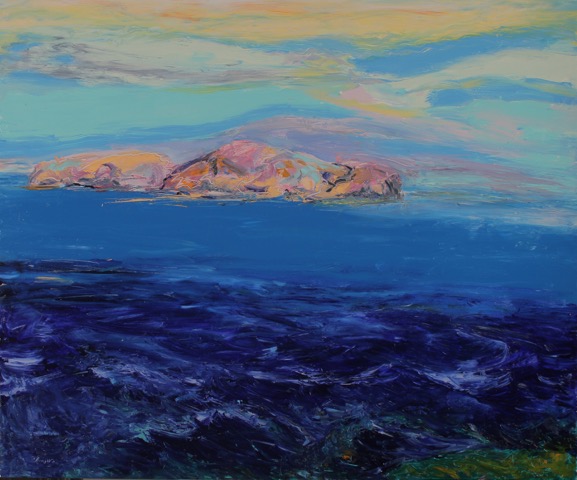
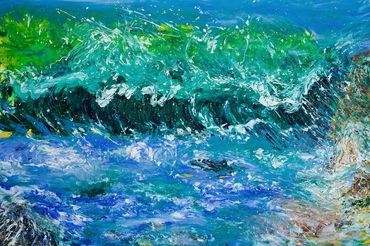
Marius Starkey was born in Sterling, Kansas. He is an American painter known for his bold colors with an emphasis on landscape and figurative paintings. Marius received a BA degree from Baker University in Baldwin, Kansas and did his graduate studies at Croydon College in London, England where he received a Master’s degree. He has had numerous exhibitions in Northern California and in San Francisco, where he is living since 1989. He has exhibited his work in various cities across the country as well as abroad in places like Osaka, Japan and London, England.
INSPIRATION
“It was the Impressionists that first inspired me. When I saw their original paintings in person, I reveled in their colors and saw how the artists applied their paints. I threw myself into my own paintings with a fury and explored my own ways to paint that pushed me into different realms of visions. I am as excited and thrilled today about painting as I was when I first started. When I immerse myself into the next painting, I am always surprised by the results of my own work. My inner vision propels me to constantly develop and refine my own unique style of painting. This part of my life will continue unabated until I can no longer lift a brush. I am smitten and committed to the work.” – Marius Starkey
INTERVIEW with Marius Starkey Carmela Loiacono talks with Marius Starkey who takes part in the International Art Exhibition NATURAL FLOW – Exploring water’s essence in Matera, at cultural hypogeum Lega Navale Italiana Matera-Magna Grecia.
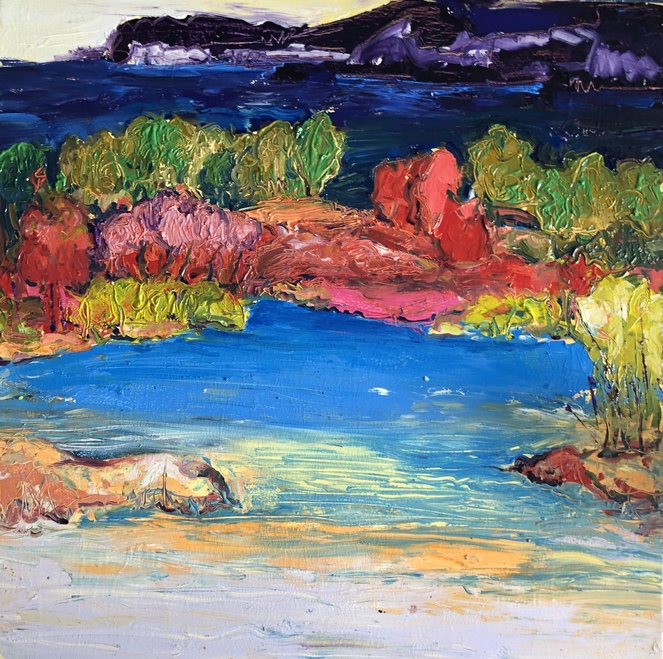
Carmela Loiacono – Please introduce yourself and talk about the selected artwork: “Ocean Marsh” you presented during the exhibition NATURAL FLOW – Exploring water’s essence. How would you describe your creative process? What or who influenced or is influencing your work? Marius Starkey – I’ve been making images my entire life inspired by nature and by the many artists that have come before. There is no time, no fear, & no expectations when I work, only the chance to understand my deep emotional & physical connections with each image. Each painting is a journey inspired by my love of nature which many have water as a central theme. “Ocean Marsh” emerged from my time in San Francisco and the Bay Area. With every brush stroke I capture compositions that resonate with my emotional being in that moment.
Carmela Loiacono – What do you think about shared art on social media? Could it be an alternative way of communicating contemporary art? Marius Starkey – I enjoy sharing my images on social media to encourage viewers to explore their own emotional connection with their surroundings. I hope they can reflect on their ties to the environment in which they reside.
Carmela Loiacono – What are your future goals and/or projects? Marius Starkey – I will pursue my artistic endeavors for the rest of my life, following inspiration in all aspects.
Roland Kaiser was born on the 9th of May in 1962 in Pulheim, Cologne- area, Germany. He is a self- taught artist from Germany. Especially since some crucial times in hospital in his early youth he felt the need expressing himself via drawing and painting and developed it further. In 1979 he moved to Cologne – the ‘big’ city -. Exhibitions in the 90th followed, also did my 1st. Internet- exhibition “Back to Basics“ in the year 1997. In 1990 he invented the Recycling-Art-Concept, which basically is founded on the principle to use only used and found material for creating art and developing it to a better self – looking and feeling brand new. The idea was and still is to create sustainable Art and at the same time saving resources due to the responsibility modern man has with regards to material and nature; long before this was discovered by politics and industry. In order to be authentic and also to show aspects of sustainability, his works show visible traces of an engagement with his vision of the finished work, his own life and the mostly used material that he processes and that seems new and fresh at the same time, as it were reborn, and that being even and especially true for digital art, which he started producing in the 1980 as well. Dr. Erich Franz, former deputy artistic director of the Westphalian State Museum for Art and Cultural History in Münster, Germany wrote about his artworks in 1996 said, that he liked them and stated that they are [….] put together carefully and do so also in leading to different moments of stability and movement. Also the clashes of colors are not without a silent form of energy.
Smooth and cautious seem to be indeed most of his art- works, always characterized by helping things to develop and flourish. An effect that the viewer of his works can also notice in himself, feeling the shown enthusiasm and love for life. Then the miracle happens and a portal is opened to a harmonic, brighter and better world.
INTERVIEW with Roland Kaiser Carmela Loiacono talks with Roland Kaiser who takes part in the International Art Exhibition NATURAL FLOW – Exploring water’s essence in Matera, at cultural hypogeum Lega Navale Italiana Matera-Magna Grecia.
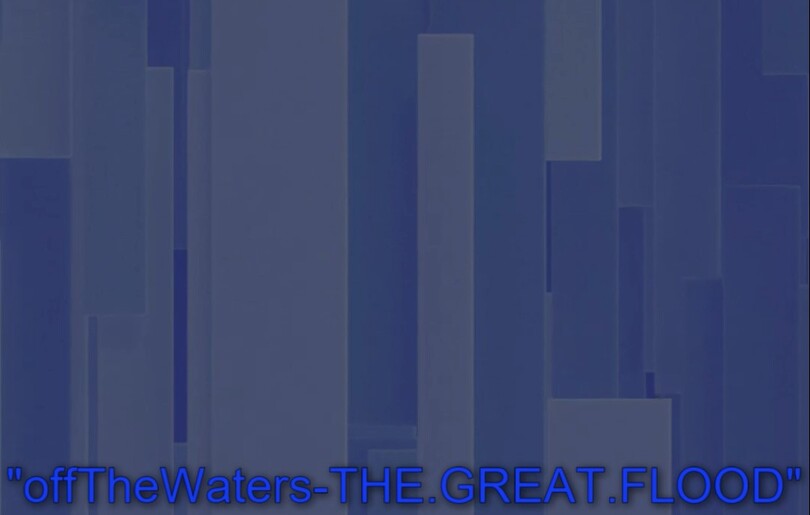
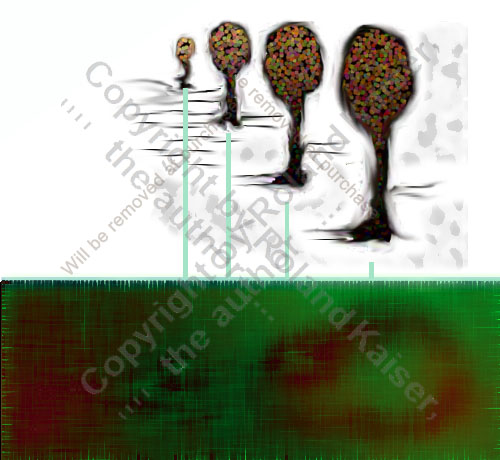
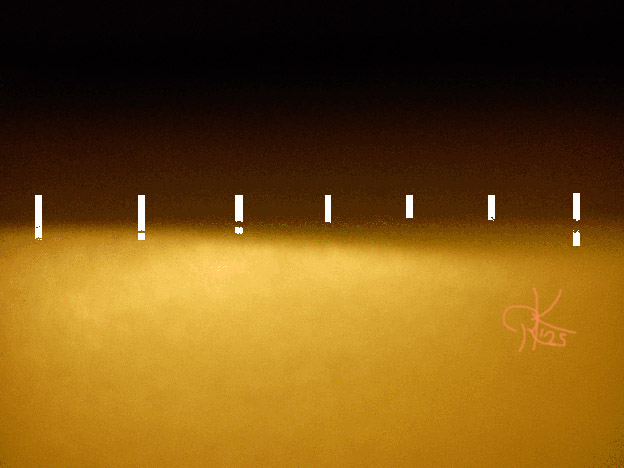
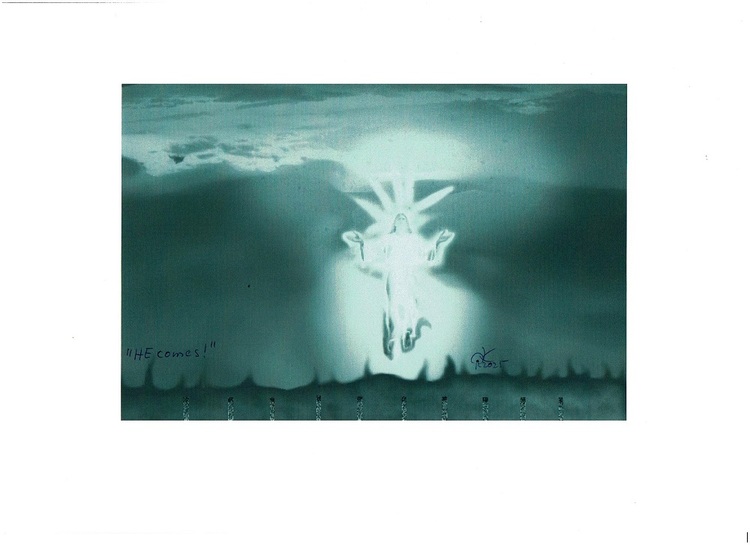
Carmela Loiacono – Please introduce yourself and talk about the selected video art work “offTheWaters-THE.GREAT.FLOOD”you presented during the exhibition NATURAL FLOW – Exploring water’s essence. Roland Kaiser– I am Roland Kaiser, born on the 9th of May in 1962 in Pulheim, Cologne- area, Germany. I am a self- taught artist from Germany. I always found so much interest and joy in creating art, even as a little boy. Especially since some crucial times in hospital in my early youth at the beginning of the 70s decade I felt the need expressing myself via drawing and painting and developed it further. I had a very critical objective and distant attitude on my own works, 1st being supported, but as I grew older I got more and more criticized for wanting to become an artist and this fight against conventional thinking of my environment 1st demotivated and then strongly was my drive to make it better and show “them” that I am still trying and won’t give in being an artist. In the long run I won and am now thankful for both of it: the critics and the motivation to do better! In 1979 I moved to Cologne – the ‘big’ city -. Exhibitions in the 90th followed, also did my 1st.Internet- exhibition “Basics,“ in the year 1997. In 1990 I invented the Recycling-Art-Concept, which basically is founded on the principle to use only used – even in digital form! – and found material for creating art and developing it to a better self – looking and feeling brand new. This can be seen also to with respect to the conditions in our human form: accepting the SCARs we’ve got to become healed and made whole again and reach out for a new and better life. The idea was and still is to create sustainable Art and at the same time saving resources due to the responsibility modern man has with regards to material and nature; long before this was discovered by politics and industry. In order to be authentic and also to show aspects of sustainability, my works show visible traces of an engagement with my vision of the finished work, my own life and the mostly used material that I process and that seems new and fresh at the same time, as it were reborn, and that being even and especially true for digital art, which I started producing in the 1980 as well. Dr. Erich Franz for example, former deputy artistic director of the Westphalian State Museum for Art and Cultural History in Münster, Germany wrote about my artworks in 1996 and said, that he liked them and stated that they are [….] put together carefully and do so also in leading to different moments of stability and movement. Also the clashes of colors are not without a silent form of energy. Smooth and cautious seem to be indeed most of my art- works, always characterized by helping things to develop and flourish. An effect that the viewer of my works can also notice in himself, feeling the shown enthusiasm and love for life. Then the miracle happens and a portal is opened to a harmonic, brighter and better world. I am achieving this results, I call them miracles, by being surrounded most of my time daily by my art, my studio is also my home, I collect materials as I am still obliged to my RAC (see above) from 1990, which applies also for my digital art. Sometimes it took a piece decades to be in the final form. Being confronted with all my art- pieces and files and own unique documentation style and praying a lot I get the revelation and help from above to get things done and get better and more effective. I just want to create and please God making it right? Last year I started ma RAC_ART- Database project, documenting everything and that means literally every piece I ever created online on a secret site buried somewhere around my website https://aarontec.de/. It’s a very neat and smoothly operating CMS I developed myself as I am not only and selftaught artist but also a selftaught programmer. This site is for selected customers and curators or art- dealers which show interest in exploring my “multiverse” of creations? My video art work “offTheWaters-THE.GREAT.FLOOD” exhibited during the exhibition NATURAL FLOW – Exploring water’s essence for example is also a very good example for recycling digital art within my RAC – concept from 1990: the waves, which are in the center of the beholders attention I created in the late summer of 1998. Now they are the fundamental part of a video, which would have been technically impossible to create back in 1998. As I also produce music, it was possible to give it the perfect “it- vintage- style” with the tools I now can use, when Carmela invited me to participate during her exhibition in Matera, Italy. The theme added exactly the part which was missing to animate those digital waves from 1998 waves and giving them a stage and a soundtrack also. As an RAC- concept artist the ART_ViDEO “offTheWaters-THE.GREAT.FLOOD” is about not only the sparse use of water to save resources but has also a very spiritual dimension: as I use water in my everyday- life, I wonder how God is moving them (the waters)?Sometimes it is just very smooth and clam, maybe a tiny dripping only or just lying on the grass at morning… but then, the other day, it may be as well very disruptive and loud even dangerous, jumping right out of its bounds changing whole landscapes and wash everything in its way, so you better stay out! People often wonder what God is like or what he does. And waters can give answers in its behavior and ways. God uses not only the still and small voice to talk to us but sometimes he uses nature and its power also to speak. At the end of that video, there is a question put on the screen: “So what happens next?” as God has promised to never again send SUCH a flood. As we anticipate the 2nd coming of Jesus Christ the answer will be visible soon. And that is something which drives and motivates me, getting better and getting ready.
Carmela Loiacono – How would you describe your creative process? What or who influenced or is influencing your work? Roland Kaiser – It works out like that, describing my creative process: collecting materials, pondering, praying, getting guidance and support from God, looking after the pieces or data or documentations over and over, praying again and then standing up, going to do the creation or the art- piece. I am influenced by the news, scripture studies, prayers, my experiences in life, my past, other artists, for example: Helmut Federle, whom I met personally in November 1995, giving me valuable advice for my art, Roy Lichtenstein, as I still “melt” the comic- and the abstract- approach in my “art- laboratory”, curators, critics and my wife who really saved a lot of my pieces when I was close to shutting down my creative efforts when the negative phases came.
Carmela Loiacono – What do you think about shared art on social media? Could it be an alternative way of communicating contemporary art? Roland Kaiser– Shared art on social media? Well, if the copyright is respected, yes. Often exhibitions are done online nowadays, also because of the hard lockdowns we had, especially in Germany. Its surely is an alternative way of communicating contemporary art, so done with a sense of proportion and in a targeted manner, yes, of course!
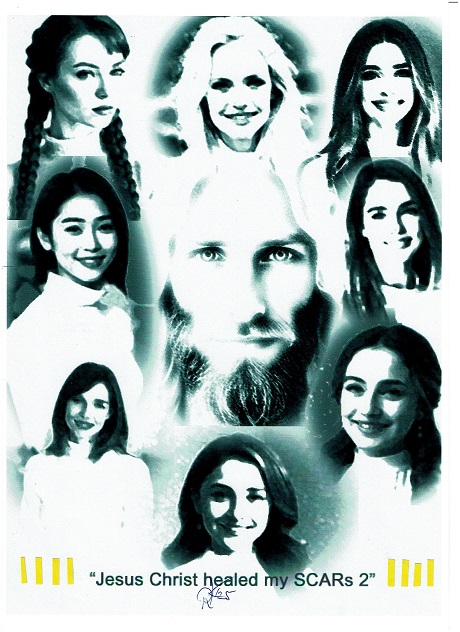
Carmela Loiacono – What are your future goals and/or projects? Roland Kaiser – a) Some of my future goals are to get a wider reach (USA I started successful in April this year with the award I got there), b) exploring new ways expressing myself without leaving my lifelong “SCARs”- theme, cause they are what brought me where I am now, c) honoring my priesthood, becoming a more Christ- like and better person, exploring more of God’s secrets. D) Concrete projects are my RAC-ART- Database, as I want to complete the project soon, I will then e) use my customers- and curators-/ gallerists- database to contact potentially interested art- lovers and invite them to visit that virtual space also. My concrete efforts with regards to creating more pieces now will f) definitely be the “Jesus Christ healed my SCARs …” – series which I have just begun!
Jiaying Qian is a designer and maker. Jiaying’s work draws on traditional and contemporary textile craft methods and techniques, exploring nature and humanity through slow design and handwork.
Jiaying began her design journey at the University of New South Wales Art & Design, where she completed a Bachelor design. Jiaying considers her work to be a meditative exercise, using textiles as a medium for her creations, and focuses on the use of natural fibers and the research of sustainable materials. Her practice often to explore the possibilities of biomaterials/environmentally friendly materials for textile development. Create visual, tactile and emotional experiences for the audience.
INTERVIEW with Jiaying Qian Carmela Loiacono talks with Jiaying Qian who takes part in the International Art Exhibition NATURAL FLOW – Exploring water’s essence in Matera, at cultural hypogeum Lega Navale Italiana Matera-Magna Grecia.
Carmela Loiacono – Please introduce yourself and talk about the selected video artwork: “Fading Ocean” you presented during the exhibition NATURAL FLOW – Exploring water’s essence. Jiaying Qian – My name is Jiaying Qian, originally from China, and I’m currently a practice-based PhD candidate at the University of New South Wales Art & Design in Australia. I’m a designer, researcher, and textile artist, focusing on the intersection of material, technology, and smart textile design. The artwork “Fading Ocean” was created as a textile installation to raise environmental awareness, particularly about the bleaching of coral reefs due to rising sea temperatures, which is a serious issue affecting Australia’s Great Barrier Reef. I handcrafted each piece of coral using 100% wool yarn, which I spun myself from raw fleece sourced from Australian farms. Through the integration of thermochromic pigments and shape memory alloys, the corals respond to heat—gradually turning white and curling up, as if struggling for survival. It was important for me to create a tactile, responsive medium that evokes an emotional connection to environmental degradation.
Carmela Loiacono – How would you describe your creative process? What or who influenced or is influencing your work? Jiaying Qian – My creative process is rooted in a deep curiosity about non-human life forms and how we might collaborate with them in design. I often start by researching biological systems, then translate that knowledge into experimental material exploration—whether that’s through smart textiles, interactive installations, or speculative devices. One of my early inspirations was the Crochet Coral Reef project by Christine and Margaret Wertheim. Their work beautifully connects handcraft, mathematics, and environmental activism. It was eye-opening to see how something as traditional as crochet could be reimagined as a powerful language for scientific and ecological storytelling. That project inspired me to explore textile as a medium not just for expression, but for critical engagement with urgent issues like climate change and species loss. I’m also influenced by scholars like Neri Oxman, and Katherine Hayles, whose work challenges anthropocentric perspectives and opens up new ways of thinking about ecology, material agency, and co-creation. I find myself constantly drawn to the intersection of traditional craft and emerging technologies as a space for dialogue between the human and non-human world.
Carmela Loiacono – What do you think about shared art on social media? Could it be an alternative way of communicating contemporary art? Jiaying Qian – Absolutely. Social media creates a space for art to reach beyond the walls of galleries and museums. It allows for more experimental, personal, and even vulnerable forms of expression. For textile and interactive works, where touch and transformation are key elements, videos and process documentation shared online can make the artwork accessible in new ways. It also opens up global conversations—someone on the other side of the world might respond to the themes of environmental loss in Fading Ocean and reflect on their own ecological reality. I see it as a collaborative form of storytelling.
Carmela Loiacono – What are your future goals and/or projects? Jiaying Qian – My current research explores co-creative textile production involving biological, digital, and human agents. One ongoing project involves translating data from living organisms like kombucha or slime mold into sounds and G-code, allowing these non-human entities to “design” textile patterns through 3D printing. In the future, I aim to continue developing wearable and responsive textile installations that challenge traditional notions of authorship and highlight more-than-human forms of creativity. I hope to contribute to a broader conversation about sustainability, empathy, and collaboration—both within and beyond the field of design.
Mohammad Kamal is a landscape and portraiture photographer based in Dubai. His work has featured in international exhibitions including the Xposure Photography Festival in Sharjah, UAE, as well as a solo exhibition at The Empty Quarter Fine Art Photography Gallery in Dubai. His landscape and documentary work has earned winning placements in the Prix de la Photographie de Paris (PX3) awards, the International Photo Awards, the Budapest International Foto Awards, the Tokyo International Foto Awards, the Neutral Density Awards, Chromatic Awards, and the Epson Pano Awards, as well as featuring in the final rounds of the Hamdan Al Maktoum International Photography Awards. Mohammad lives in the UAE with his family. When not working with his camera, he looks after a research team at a regional investment firm.
Artist statement “As children, we all possess a curious ‘image sensor’ for the world. Our eyes and minds create storylines that we process as both fact and fantasy melded into one. We are incapable of skepticism; we see and believe with a curiosity that is both innocent and piercing in a way that adults do not understand. As adults ourselves, our ‘eye’ is both informed and corrupted. Informed by experience and corrupted by selective filters that exclude much of what the imagination used to create. Photography draws me in as a means of rediscovering my creative self and the fleeting magic of seeing with a child’s eyes. Photography is my friend and a conduit for lifelong discovery and exploration.”
INTERVIEW with Mohammad Kamal Carmela Loiacono talks with Mohammad Kamal who takes part in the International Art Exhibition NATURAL FLOW – Exploring water’s essence in Matera, at cultural hypogeum Lega Navale Italiana Matera-Magna Grecia.
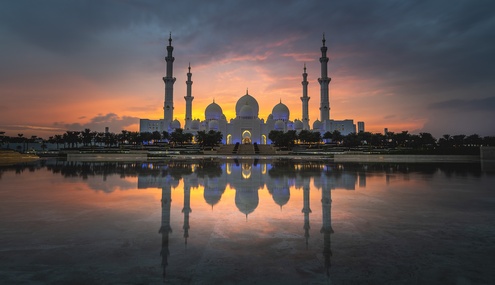
Carmela Loiacono – Please introduce yourself and talk about the selected artworks: “Contemplation”, “Morning Stillness” and “Mosque after rain” you presented during the exhibition NATURAL FLOW – Exploring water’s essence. Mohammad Kamal – Thank you for interviewing me! I am a landscape and portraiture photographer based in Dubai. Photography has been quite a journey for the past 10 years, and a source of creative fullfilment, physical and mental challenge, and a conduit for expression. I don’t do it for a living, and that’s probably a good thing as it has never crossed over into the realm of work, which I believe really affects the creative decisions available to you. In terms of the works displayed at Natural Flow, you could say that “Contemplation” is a meditation on the unseen power of the mind, not through might, but through stillness. The sadhu’s gaze into the waters is about the quiet, unseen power of thought. The juxtaposition of spiritual traditions in the background (the temples and mosque on the hill top) brings out the universality of the moment. He is almost a vessel of something far greater; the frame holds a moment where time, faith, and thought converge—and in that convergence, a quiet authority emerges. “Morning Stillness” holds far less symbolic value to me. The location is somewhat of a guarded secret that few guides will take you to. The subjects were arranged and posed for the shot. It’s really just a visual piece that has dream-like qualities, thanks to the type of light we had that morning, the mist in the background, and the reflection in water. It looks like one of those typical, traditional paintings from classical Chinese art. “Mosque After Rain” is a well-kown composition here in the UAE, as it makes use of a shallow architectural feature in the foreground that collects rain water, and creates a reflection of the grand structure far in the background. I kept my gear on hand in the car for weeks as I drove past it every day towards my office. Finally, on a rare rainy afternoon, I rushed out to the spot and made it in time to capture the combination of dramatic sunset light, undisturbed water in the forground, and no cars driving by, for about 30 seconds. The months-long wait was worth it I think!
Carmela Loiacono – How would you describe your creative process? What or who influenced or is influencing your work? Mohammad Kamal – I usually start with a blank slate and try to find locations or groups of people that may have interesting stories to capture. Social media is a great place to start, and sometimes I just pull up a world map and just scan across and see if any location or country has something about it that I would like to explore photographically. I’ve recently been making light use of AI to gather information about remote communities and under-photographed groups that could make for good, unique subject matter. At exhibitions, I often meet photographers and enthusiasts who suggest ideas to me and at times those really open up entirely new directions that I had never considered before. I was exhibiting my large scale landscape prints in Sharjah, UAE, when a renowned photographer suggested I look at the monasteries in Meteora, Greece, because of the breathtaking natural setting surrounding them. That led me down a rabbit hole of exploring themes to do with monastic life and evetually spending time with the monks in a similar but far less accessible location, Mount Athos, and producing a documentary portraiture series about them. In my research, I came across a Youtube video of a documentary film made in the 1980s about the monasteries, and I took note of some obscure spaces that I was hoping were still around, including the ‘skull library’ shown here. Amazingly, we managed to locate it, and from that a unique and striking composition emerged. Some of the monks featured in the documentary from 40 years ago were still there. I recognized them instantly, and ended up spending invaluable time with them. So the lesson I learned from all this is that listening to input from anyone willing to share it is an invaluable way to find fresh ideas. When I’ve got the basic theme or idea decided, I do a bit of planning, but leave a lot to be decided on the spot and on location. Some of my favorite images came about while responding to how the elements in the frame were behaving while I was shooting, rather than trying to force a composition. That to me is the best part of the whole process; discovering your subjects as you go along. It’s great to work with location guides and fixers who understand photographers and can draw my attention to something I would otherwise miss.
Carmela Loiacono – What do you think about shared art on social media? Could it be an alternative way of communicating contemporary art? Mohammad Kamal – It’s a great place to discover art, but nothing beats seeing quality prints on a gallery wall. I really like watching informed hosts interview or showcase great work on social media; it’s great exposure for emerging artists.
Carmela Loiacono – What are your future goals and/or projects? Mohammad Kamal – Artifical Intelligence is taking art and specifically photography, in a very interesting direction. On the one hand, hardward and software will change dramatically, making the entire workflow completely different. From focus acquisition and stacking to dynamic range and even composition, everything looks like it will make huge forward leaps very soon. On the other hand, AI is generating imagery that is arguably superior in impact to traditional landscape work, and that brings into question the relevance of authenticity; does it matter if a grand vista actually exists or not? I already feel like working with my DSLR camera, which I havent upgraded in almost 8 years, is now some form of retro/old school art, only a few years away from being consigned to the same niche categorization as film photography. I’ll probably spend some time figuring out how the medium reains relevant in the long run, and how I can adapt to all the changes. I’ve also found it increasingly difficult to find uniqie subject matter that someone hasn’t done before. Nevertheless, there’s an infinite number of ways to interpret a theme or idea, and that’s a good thing. I’m looking at locations such as the Algerian desert, Pakistan, and Mongolia for my next project.
Philip van den Dool is a Dutch artist born in 1950 in The Hague. He currently lives and works in Uithoorn near Amsterdam. Philip van den Dool followed in the 1980s in The Hague, in addition to his work as an engineer, the famous Free Academic art school. His practice relies in addition to traditional techniques, the use of the iPad as an innovative technology and he uniquely combines digital technology with artistic expression. The bright colours, the fast, direct and clean working with layers, brushes and colours, offers plenty of room to experiment. On the iPad, Philip draws and paints with an Apple pencil in a personal style. The drawings are built up in layers with a variety of digital brushes and a rich palette of colours. The digital paintings are printed on art paper, acrylate or Canvas on small, medium and large formats. The works of Phlip van den Dool can be characterized as expressive with a lively colour palette and own handwriting. In 2021 he made a unique series of 110 paintings during the Lockdown, with title: Lockdown 2 Spring which shows the climate that year. A summary of these paintings was exhibited during the climate 2022 exhibition in Zwolle (NL) in the Dependence of the Fundatie Museum. In 2019 he received in 2019 the Green Heart Art Prize and in 2024 his art was on display in Palazzo Albrizzi – Capello in Venice during the 60th Biennale.
Statement: ‘From pigment to pixel, creativity on a digital canvas’.
INTERVIEW with Philip van den Dool Carmela Loiacono talks with Philip van den Dool who takes part in the International Art Exhibition NATURAL FLOW – Exploring water’s essence in Matera, at cultural hypogeum Lega Navale Italiana Matera-Magna Grecia.
Carmela Loiacono – Please introduce yourself and talk about the selected artworks: “Jardin de Monet Giverny-3, 4, 5, 6” you presented during the exhibition NATURAL FLOW – Exploring water’s essence. Philip van den Dool– I would like to take this opportunity to introduce myself. My name is Philip van den Dool. I am a Dutch artist, born in 1950 in The Hague. I pursued my artistic education alongside my career as a physicist-engineer in the 1980s at the Free Academy of Visual Arts in The Hague, where I was taught by inspiring artists. After retiring as an engineer, I dedicated myself further to my artistic pursuits, with a particular interest in the intersection of new technologies and art from an engineer’s perspective. The introduction of the iPad in 2010 was a catalyst for me to explore this new medium. The direct way of painting, the vast color palette, and the ability to work with layers add a new dimension to two-dimensional art. For the exhibition in Matera, NATURAL FLOW – Exploring Water’s Essence, I have selected four works from my series Jardin de Monet – Giverny. In June 2024, I had the opportunity to visit this garden, located 100 km west of Paris, which still exudes the same atmosphere found in Monet’s paintings. Based on photos and sketches taken on-site, I have captured my vision of this garden—its magnificent pond, water lilies, and characteristic bridge—on the iPad in my own style. In these digital paintings, water and the reflections of plants, trees, and objects play a crucial role, adding depth to the compositions. In my iPad paintings, I employ a distinct style using various digital brushes, including dots, lines, and combinations of different forms. This approach creates a sense of depth and movement while maintaining an impressionistic atmosphere focused on light and color rather than rigid details. The combination of abstraction and recognizable elements makes my work contemporary yet also classically inspired.
Carmela Loiacono – How would you describe your creative process? What or who influenced or is influencing your work? Philip van den Dool – My creative process begins with careful observation on location, followed by sketches and photographs. In my studio, I use these as a foundation to develop the artwork further on the iPad. Intermediate results are reviewed, and accents are adjusted. The iPad allows me to correct mistakes and experiment with new layers. Once the final piece reaches a satisfactory resolution, it is sent to a photo printer or printing service. Prints can be made in both small and large formats. For the Matera exhibition, I have chosen a 30×30 cm format, printed on art paper. Among the artists who have influenced my work, I would like to mention Vincent van Gogh and David Hockney—one of the first artists to fully embrace the iPad as a painting medium.
Carmela Loiacono – What do you think about shared art on social media? Could it be an alternative way of communicating contemporary art? Philip van den Dool– Social media offers an alternative way to share contemporary art. I personally use Instagram for this purpose, though I still prefer presenting my artwork in hardcopy form. Social media can be fleeting, and screens too small to fully appreciate the details. Large-format prints and physical presentations have a stronger impact on the viewer. However, a disadvantage of hardcopy prints is the need for international shipping, which comes with logistical challenges and costs. In this regard, digital works have an advantage, as they can be showcased globally without physical transportation.
Carmela Loiacono – What are your future goals and/or projects? Philip van den Dool – My future goals and projects include various international and national exhibitions, as well as continuing to experiment and create new work. Participating in the Matera exhibition, NATURAL FLOW – Exploring Water’s Essence, aligns perfectly with these ambitions, and I hope to have the opportunity to visit Matera and Puglia and meet dr. Carmela Loiacono in the future.
Born in Shiga, Japan. Raised in a life of familiarity with nature and Japanese traditional spirituality in her everyday life. After training as a professional Japanese traditional cuisine chef, she started managing a Japanese restaurant at the age of 38. After that, one day – in between a dream and reality – she saw a universal mandala vision. She thought it was from the Wisdom of the Universe. On September 4, 2022, she got an inspiration to paint that mandala.
The idea was just like the advise from the higher dimensional world, she thought. Then she started creating her artworks although she had no experience at all in painting and moved into the world of expression.
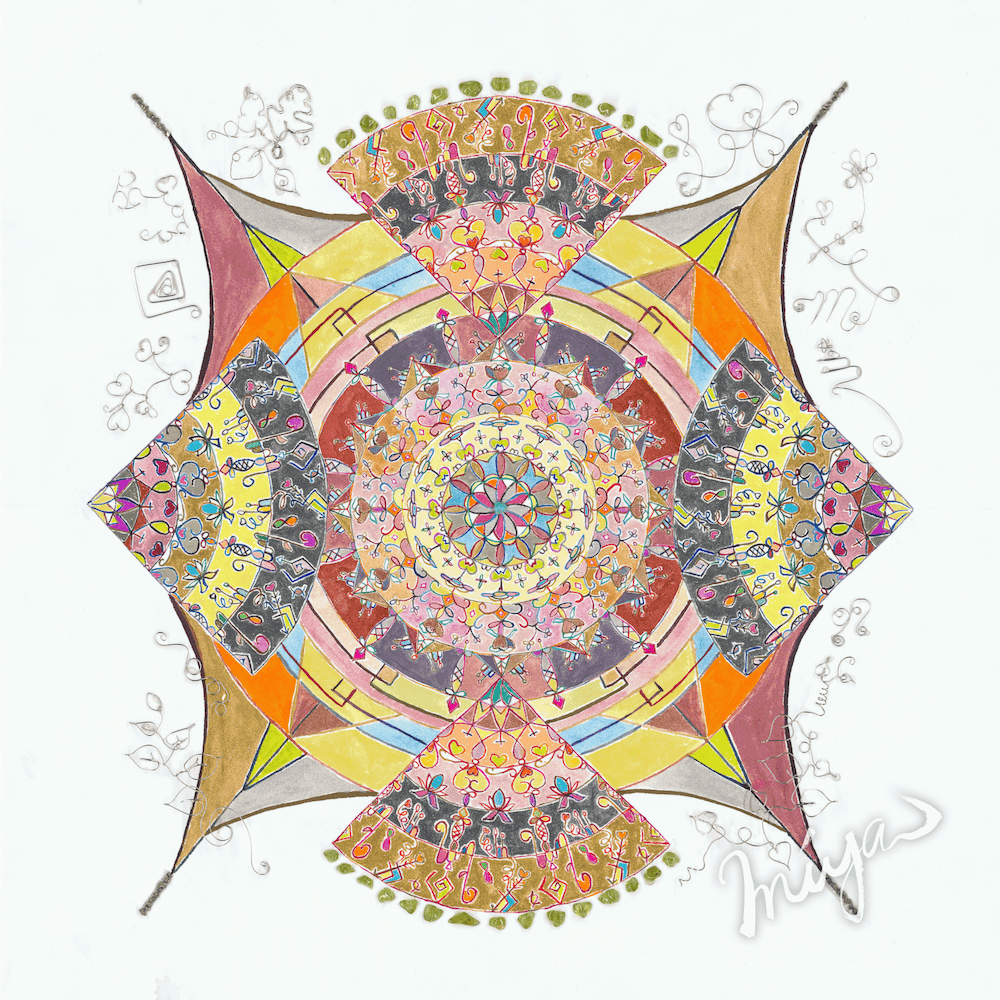
Miyako Shimizu’s artwork expresses the wisdom from higher dimensions. Using carefully selected Japanese paper, this watercolor painting is made with sacred water from two Japanese spiritual locations. Holding a Lemurian crystal in her left hand, she carefully depicts a world beyond time and space on paper. “A special message for you is vibrating in the paintings. I hope to deliver them to those who can sense them.” – Miyako Shimizu
INTERVIEW with Miyako Shimizu Carmela Loiacono talks with Miyako Shimizu who takes part in the International Art Exhibition NATURAL FLOW – Exploring water’s essence in Matera, at cultural hypogeum Lega Navale Italiana Matera-Magna Grecia.
Carmela Loiacono – Please introduce yourself and talk about the selected artworks: “0058” and “0060” you presented during the exhibition NATURAL FLOW – Exploring water’s essence. Miyako Shimizu– This artwork expresses information from higher dimensions. It is a watercolor painting created using carefully selected washi paper and sacred water collected from two different sources. Holding a Lemurian crystal in my left hand, I meticulously paint a world beyond time and space on the paper. The design varies according to the information received from higher dimensions, and each person resonates with different aspects. I am confident that these paintings serve as a switch to awaken and open the door to the potential of those who resonate with them. A special message for you vibrates within the painting. I hope to deliver this message to those who are able to feel it. 0058/0060 The artworks are a pair, but not created simultaneously. The one completed before the spring equinox of 2024 is 0058, and the one completed after the equinox is 0060.
Carmela Loiacono – How would you describe your creative process? What or who influenced or is influencing your work? Miyako Shimizu – The creative process does not involve deciding the final form from the beginning, but rather it unfolds as I paint. I carefully separate the colors and work on each line, so I would be happy if you take your time to observe even the smallest details.
Carmela Loiacono – What do you think about shared art on social media? Could it be an alternative way of communicating contemporary art? Miyako Shimizu– I would like to share my art with as many people as possible through social media and reach those who need it. It is important for people to first become aware of it, then see it in person, and receive the energy it carries.
Carmela Loiacono – What are your future goals and/or projects? Miyako Shimizu – I will continue to work on my creative endeavors. I plan to exhibit my works not only in Japan but also around the world, delivering them to those who can feel their energy. Thank you for your support!
Gwendoline Nalvarte is an interdisciplinary researcher and artist who seamlessly merges documentary filmmaking, performance art, and visual arts. Her upbringing in Lima, Peru, amidst a diverse blend of cultures and traditions during a politically turbulent era, significantly shaped her unique artistic journey. Her heritage, a mix of Basque, African, indigenous, and Spanish ancestry, is a rich and intriguing influence on her craft. At 12, Gwendoline Nalvarte moved to Sweden, a pivotal moment that shaped her identity and artistic perspective as she learned to navigate the complexities of living between two distinct worlds. After completing her BA in Film and Drama Studies at Queen Mary University of London, Nalvarte immersed herself in diverse cultures and explored the intersection of performance art, theatre, and filmmaking. These experiences further enriched her understanding of the human condition and the power of art to challenge conventions, enlightening her and the audience about the beauty of diversity in art. Upon returning to Sweden, Gwendoline Nalvarte rediscovered a newfound appreciation for the country’s natural beauty and peaceful atmosphere. Despite feeling a solid connection to
Sweden and Peru, she ultimately identifies as a citizen of the world, recognizing the interconnectedness of humanity and the importance of preserving cultural heritage.
In Sweden, Gwendoline Nalvarte pursued a Master’s in Film and Media History at Lund University. This rigorous academic training, which deepened her understanding of the historical context of cinema and media, is a testament to her knowledge and expertise. It provided her with a solid foundation for her future artistic endeavours. For instance, her thesis on the influence of Indigenous cultures on modern cinema directly informed her passion for ‘ayahuasca documentaries’.
INTERVIEW with Gwendoline Nalvarte Carmela Loiacono talks with Gwendoline Nalvarte who takes part in the International Art Exhibition STORIES OF IDENTITY – From hidden places to daily life in Matera, at cultural hypogeum Lega Navale Italiana Matera-Magna Grecia.
Carmela Loiacono – Please introduce yourself and talk about the selected video art work: “Latin Swedish Women, 2024” you presented during the exhibition STORIES OF IDENTITY – From hidden places to daily life. Gwendoline Nalvarte– born Swedish artist. Concerning The Stories of Identity exhibition, I wanted it to be something organically made. All I wanted to do was to connect to the inner child, because I think connecting to the inner child… will unfold answers… So I asked, these women to write a letter to their individual inner child and that is how we started with a workshop. We actually filmed outside my house in the surroundings. I live close to a natural reserve and so we went outdoors and just being connected to nature. Being grounded in that way. So that felt… Organic and raw, somehow where we could be ourselves without any masks.
Carmela Loiacono – How would you describe your creative process? What or who influenced or is influencing your work? Gwendoline Nalvarte – Sometimes we lose the connection to who we really are inside and we are a bit, you know looking for answers. But really, it’s about looking inside and so I wanted to build this bridge, first for myself in developing the process, but also for these two women that I interviewed and that was part of the creative process… And then… that actually unfolded memories… And they remembered games, that they have kind of kept locked in the back of their heads. So it was fascinating to look that happening right there. Frida Kahlo, because of her unfiltered human experience, the power of authentic storytelling, the vulnerability. Salvador Dalí, because of… the surrealism and boundary pushing visuals… which in this case, I didn’t use it as much in that short video piece that I had. But there are elements that I considered when exploring… the physical. Agnes Varda, who is a documentary filmmaker from France. She is such a dynamical… eh… influence because of her energetic candor and she is also very intimate with the things that she films and I like that. Lastly, Paramahansa Yogananda, because of the spirituality and her focus of introspection.
Carmela Loiacono – What do you think about shared art on social media? Could it be an alternative way of communicating contemporary art? Gwendoline Nalvarte– I believe social media it’s a vital tool for Art communication because it democratizes Art connecting people and stories that might otherwise be unseen. It allows us to transcend geographical and linguistic barriers through, features like… Multilingual subtitles now we have that so we live in a world where now we are having all these different tools and we should use them, but the way on how we use them plays in the intention. It’s all about the intention.
Carmela Loiacono – What are your future goals and/or projects? Gwendoline Nalvarte – Well, I want to continue on portraying different women in Sweden. Sweden it’s a small country with about ten million people, but we do have about over a million of immigrants or generational mixed races, ethnicities and cultures, nonetheless. So I want to explore that. I look forward to it to interview and… to meet different cultures within Sweden, to explore and also to raise awareness, because there is so much we can learn from these women.
“Every piece of art tells a story made up of emotions, memories and experiences that are part of the lived of each artist. “
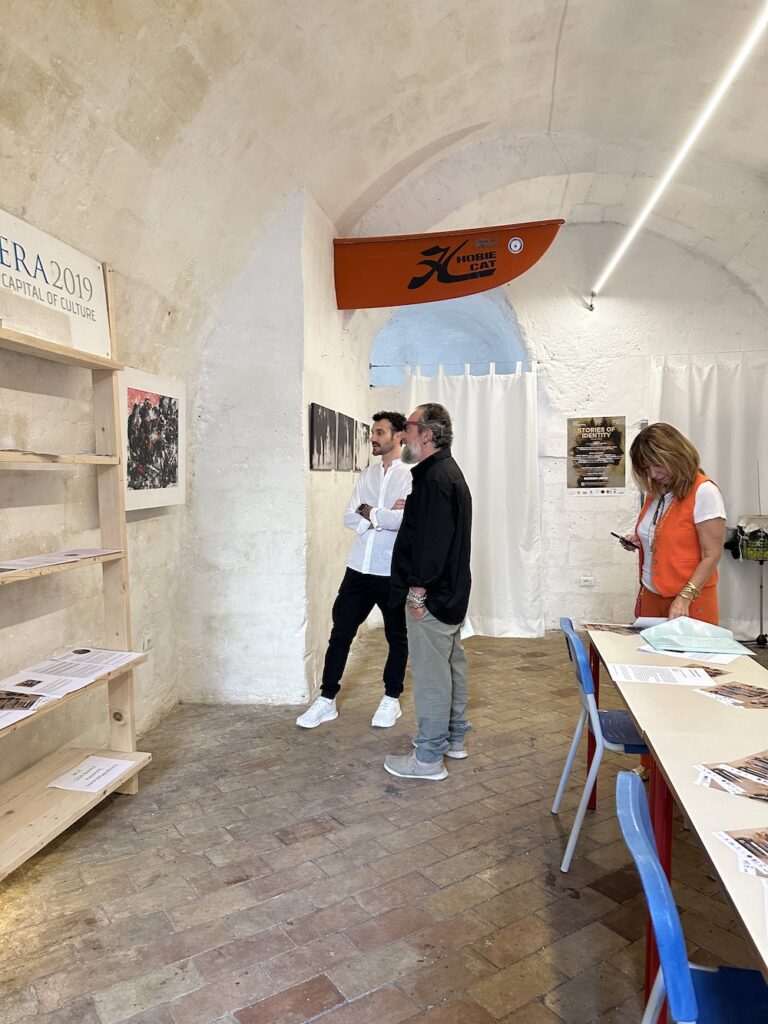
The exhibition STORIES OF IDENTITY – The 2nd Edition aims to observe, analyze and share the stories behind the artworks, to become a visual tale, a continuous narration through images in a constant dialogue with the visitor.
Artists are invited to share any kind of story and personal experience, starting from the most hidden places of their souls and touching on everyday life.
All the artworks selected will be stories of identity, capable of confronting and dealing with the changes of the contemporary world, allowing themselves to be contaminated by it and preserving their uniqueness.
Gestisci Consenso
Per fornire le migliori esperienze, utilizziamo tecnologie come i cookie per memorizzare e/o accedere alle informazioni del dispositivo. Il consenso a queste tecnologie ci permetterà di elaborare dati come il comportamento di navigazione o ID unici su questo sito. Non acconsentire o ritirare il consenso può influire negativamente su alcune caratteristiche e funzioni.
Funzionale
Sempre attivo
L'archiviazione tecnica o l'accesso sono strettamente necessari al fine legittimo di consentire l'uso di un servizio specifico esplicitamente richiesto dall'abbonato o dall'utente, o al solo scopo di effettuare la trasmissione di una comunicazione su una rete di comunicazione elettronica.
Preferenze
L'archiviazione tecnica o l'accesso sono necessari per lo scopo legittimo di memorizzare le preferenze che non sono richieste dall'abbonato o dall'utente.
Statistiche
L'archiviazione tecnica o l'accesso che viene utilizzato esclusivamente per scopi statistici.L'archiviazione tecnica o l'accesso che viene utilizzato esclusivamente per scopi statistici anonimi. Senza un mandato di comparizione, una conformità volontaria da parte del vostro Fornitore di Servizi Internet, o ulteriori registrazioni da parte di terzi, le informazioni memorizzate o recuperate per questo scopo da sole non possono di solito essere utilizzate per l'identificazione.
Marketing
L'archiviazione tecnica o l'accesso sono necessari per creare profili di utenti per inviare pubblicità, o per tracciare l'utente su un sito web o su diversi siti web per scopi di marketing simili.