Autore: Carmela Loiacono

  • Minkah Amen-Ra

    Artist from Jamaica 

    Minkah Amen-Ra is a self-taught visual artist based in Kingston, Jamaica. Her work uses bold color, symbolism, and expressionist techniques to explore identity, emotion, and the spiritual self. Drawing from Afro-Caribbean heritage and inner reflection, Minkah’s portraits often feature surreal, dreamlike elements that evoke both vulnerability and power. Her process is intuitive and deeply personal, guided by ancestral memory and emotional resonance. Without formal training, she has developed a unique visual language that challenges conventional beauty and celebrates the complexity of being. Minkah continues to share her work through digital platforms, contributing a fresh and powerful voice to Jamaica’s contemporary art landscape.

    Artist statement
    “I am a self-taught visual artist based in Kingston, Jamaica, specializing in acrylic on canvas. My work explores themes of identity, introspection and spirituality, characterized by vibrant colors and symbolic imagery. Drawing inspiration from meditative insight, I aim to create pieces that resonate with viewers on a profound level. Over the past year, I have contributed illustrations to two forthcoming publications, marking the beginning of my professional artistic journey.” 


    more. portfolio

    INTERVIEW with Minkah Amen-Ra
    Carmela Loiacono talks with Minkah Amen-Ra who takes part in the International Art Exhibition STORIES OF IDENTITY – The 2nd Edition in Matera, at cultural hypogeum Lega Navale Italiana Matera-Magna Grecia.

    Carmela Loiacono – Please introduce yourself and talk about the selected works: “The Movement” and “Identified” presented during the exhibition STORIES OF IDENTITY – The 2nd Edition. 
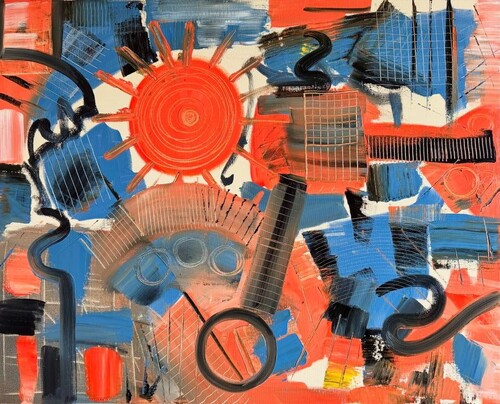
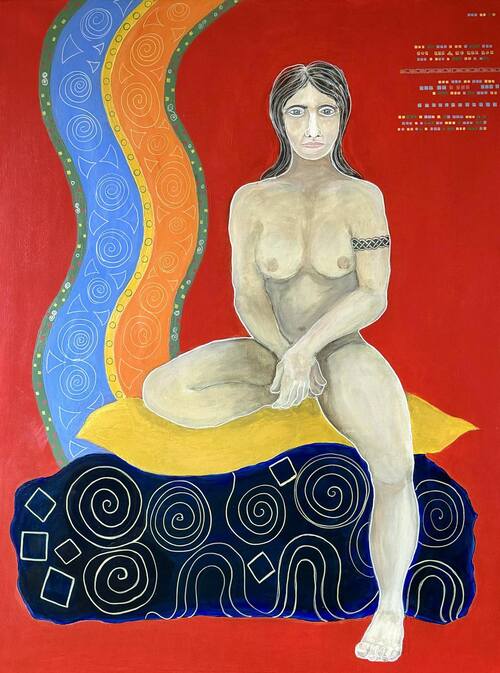
    Minkah Amen-Ra – My name is Minkah Amen-Ra and I am a self-taught artist based in Kingston, Jamaica. “Identified” is a personal piece that is unlike my other works. It is a physical representation of the cathartic release I experienced during some self-therapy. It relates to my personal struggle growing up with a radical pan-Africanist, idealist parent while living in a colonial-retentive country like Jamaica.The overt identity confusion displayed appears political, but at the core it is the confusion and lack of belonging that one experiences under the effects of a dysfunctional parent. The sense of loss and wanting is splayed onto the canvas with dark colours, covering up what used to be my first ever painting that I was once too scared to “ruin”.
    The title “Identified” is chosen because the painting released me from this confusion-causing childhood burden; and since then my artistic approach and style has shifted. I am free. Free to forge my identity.
    The second piece, “The Movement” thematically proceeds “Identified” as it is the continuance of this new-found freedom in self, artistic expression and identities. It is the processing and release of the resentments that create causes of suffering and restraint on the canvas.

    Carmela Loiacono – How would you describe your creative process? What or who influenced or is influencing your work?
    Minkah Amen-Ra – My work is mainly influenced by my spiritual journey. I am not a strictly religious person but I meditate and pray to connect to source as needed. My ongoing journey of spiritual awakening constantly rewards me with inner clarity and visual insight into elements of the “inner worlds”. That introspect and intuit are what guide my hands when I draw and paint. Most if not all of my paintings have origins in some random vision I may have while praying, dreaming or simply gazing.
    I have no formal training in art but I grew up with parents who are fine artists. Though I only developed an interest in fine art during adulthood, I have come to realise how influential watching them do art as a child has been.

    Carmela Loiacono – What do you think about shared art on social media? Could it be an alternative way of communicating contemporary art?
    Minkah Amen-Ra – In a world where we have subjected ourselves to trends, derivatives and artificial intelligence, originality is like gold. It is important for artists to have an online presence as it benefits us all when we are able to witness the powerful materialisation of the  inner workings of a person’s mind. It is important because it inspires, disturbs and stirs the spirit; and it is done in a space that can reach anyone in the world, rather than a museum or a sophisticated gallery in a fixed location where many would ordinarily not have access or be too intimidated to go. Also, social media is an excellent way for artists to connect directly with collectors and achieve financial stability without an intermediary.
    Yes, social media has become a necessary alternative to the traditional means of communicating contemporary art.

    Carmela Loiacono – What are your future goals and/or projects?
    Minkah Amen-Ra  – I am currently working on a series called “The Mirror” which shows the spiritual evolution a person experiences during enlightenment as their eyes begin to see beyond the (MUNDANE) physical representation of self. The series features the progress of a woman who is looking in a mirror as she trains herself to see her truest form, beyond the unsubtle physical form.

  • Teresa Godfrey

    Artist from N Ireland 

    Teresa Godfrey is a full-time artist based in Co Fermanagh, N Ireland. 
    She is an alumnus of the Art2Life Creative Visionary Programme 2024 and is currently a member of the Art2Life Academy. She is also a member of Visual Artists Ireland and The Irish Palette Artists Collective. Her work has been selected for several group exhibitions in Ireland and the UK and her first solo exhibition was hosted by Solas Art Gallery, Co Leitrim in April/May 2025. 
    Teresa left school at sixteen and began a career as a Draughtsman in various engineering and architectural offices before entering university as a mature student and gaining a BSc Hons in Geography and an MA in Documentary Film Production.
    She continued developing her drawing and art skills by regularly attending Life Drawing classes and Fine Art courses at Belfast Metropolitan College, The Crescent Arts Centre Belfast, the South-West College, Enniskillen, and Strule Arts Centre Omagh.
    Teresa’s art was featured in Collect Art magazine, Autumn issue, Vol 52 along with an interview about her practice (www.collectartwork.org)
    Also, her artwork has been featured on the cover of “How Will They Name Us?” published by Revival Press, Limerick, 2024 and on “This, Also, Is Mercy” published by Summer Palace Press, 2021
    Teresa is also a published poet, novelist, award-winning screenwriter, and filmmaker. Her written work has been broadcast on UK radio and her films have been produced on UK’s Channel 4 Television.


    Artist’s Statement
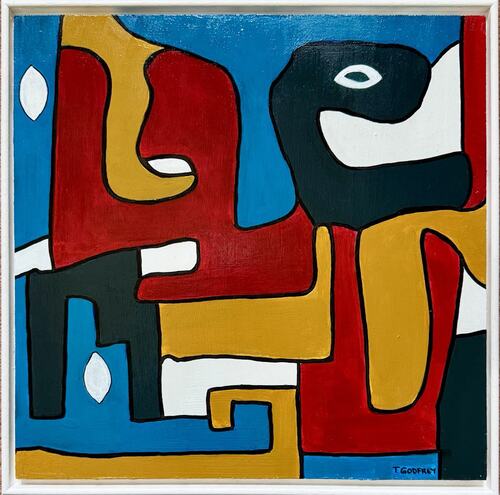
    As an Irish artist, my work is rooted in the ancient soil of my homeland – its myths, its relics, its voices echoing through time. The nine small paintings I wish to subit to Stories of Identity are visual translations of Ireland’s layered past: mythological tales, historical icons, and cultural totems reimagined through color, form, and rhythm.
    Each of these pieces is inspired by a specific narrative or artifact from Irish heritage. From the mysterious presence of Sheela na Gig – an ancient fertility icon known throughout Ireland and Europe – to the dual-faced Janus figure watching both past and future, and the resonance of the Loughnashade Horn, I explore how identity is carried not only in our stories, but in the shapes we inherit and reinterpret. The abstract forms echo stone carvings, ceremonial instruments, and oral tradition – ancient expressions filtered through a contemporary lens.
    This work is deeply personal. It is my way of connecting to lineage, of honouring what endures, and of asking how the past continues to shape us. In layering these histories into abstraction, I aim to create space for viewers – Irish and European – to find their own reflections in the myths we all share.
    more. www.instagram.com/mteresagodfrey/www.brush.bio/teresa-godfrey

    INTERVIEW with Teresa Godfrey
    Carmela Loiacono talks with Teresa Godfrey who takes part in the International Art Exhibition STORIES OF IDENTITY – The 2nd Edition in Matera, at cultural hypogeum Lega Navale Italiana Matera-Magna Grecia.

    Carmela Loiacono – Please introduce yourself and talk about the selected works: “Balor”, “Banished”, “Cloch”, “Cuchulain”, “Janus”, “Loughnashade Horn”, “Messenger”, “Sheela na Gig” and “Sinner” presented during the exhibition STORIES OF IDENTITY – The 2nd Edition. 
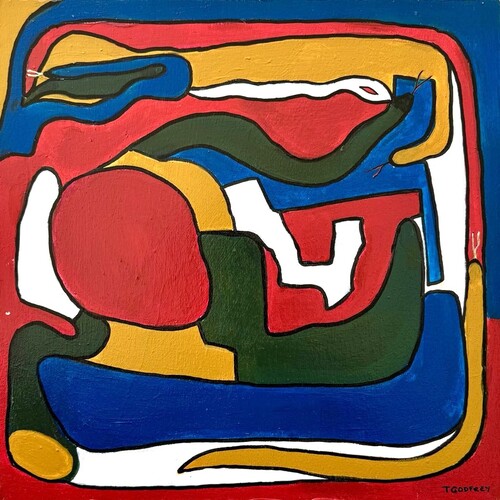
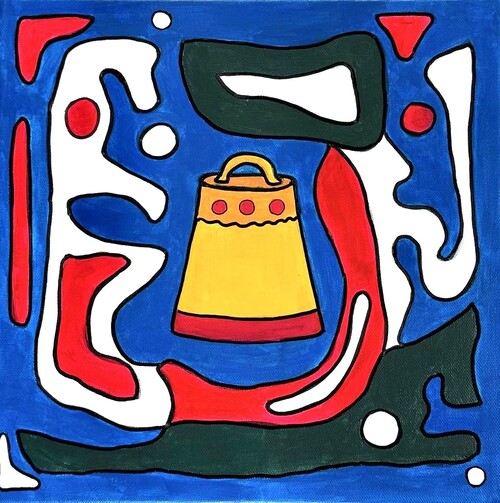
    Teresa Godfrey – Teresa Godfrey. I’m an Irish artist working mainly in oils or acrylic to create abstract or semi-abstract paintings. My 9 works exhibited in Stories of Identity 2 are all based on characters or events from Irish history or mythology: Balor the one-eyed giant. Banished inspired by the legend of Saint Patrick banishing the snakes from Ireland. Cloch,  a medieval Irish bell and symbol of spirituality. Cúchulainn, the tragic hero of the Irish epic tradition. Janus, based on the Co Fermanagh version of the famous Roman god. The Loughnashade Horn, an Irish Bronze Age ceremonial instrument with deep connections to nature and the spirit world. Messenger, inspired by the ancient Irish belief that birds are messengers from the otherworld. Sheela na Gig, the provocative and archaic representation of a female figure, often seen as a symbol of fertility, but also of protection and resistance to patriarchal power. And, finally, The Sinner, a symbol of shame and redemption and of social constructions of guilt.

    Carmela Loiacono – How would you describe your creative process? What or who influenced or is influencing your work?
    Teresa Godfrey – I work on my art every day. If I’m not actually painting I’m researching opportunities to show my work, or I’m learning about other artists and their work by going to exhibitions or researching them on the Internet. Although I’ve always drawn or painted and I’ve participated in several art courses, I started late as a full-time artist so I feel I have a lot to catch up with. My inspiration mainly comes from my concern about contemporary social and political issues such as climate change and care for the environment. I don’t start with a plan or with sketches but I do always have some idea of what I hope to convey in my work and let my subconscious take over, unless of course I’m doing figurative work, in which case a more disciplined approach is needed. The artists whom I admire and who inspire me are numerous. They include Anselm Kiefer, Susan Rothenberg, Sharon Paster, David Mankin, and the Irish artists JB Vallely, and also Sarah Longley and John Price for their drawings.

    Carmela Loiacono – What do you think about shared art on social media? Could it be an alternative way of communicating contemporary art?
    Teresa Godfrey – Making art is an important form of communication. I want my art to be seen and the best and easiest way is via social media. I post a lot of art on Instagram and Threads and on Facebook. But visual art is more than the communication of an idea. It can and often is a powerful expression of beauty – the beauty of its physical self as an object, and the beauty within the human soul that perceives it. This is why art galleries and museums where art can be seen “live” are vitally important. Art is an experience, not just in its making but in its viewing. As an artist, I need a live audience to truly bring my art to life. Equally, as an audience member, I need the artist to grab my attention, to make me think, and to allow me to glimpse our common humanity. Only the live experience can fully do that.

    Carmela Loiacono – What are your future goals and/or projects?
    Teresa Godfrey  – I have just finished two major series of medium to large-scale oil paintings, both inspired by my concerns about climate change. One series has the overall title “Wastelands” and the other is provisionally titled “Heatwave”. These have been quite intense projects so now I need to have some time out. I’m planning to return to my first love and draw simply for the joy of handling charcoal or pencil and bringing something figurative or realistic to life.

    Carmela Loiacono – We had the pleasure to meet in person in Matera, during the opening of the exhibition, did you enjoy cooperating with me? Did you like to stay in Matera?
    Teresa Godfrey  – Attending the opening of Stories of Identity 2nd Edition in Matera has been one of the highlights of my artistic career. It was wonderful to see my 9 paintings taking their place as part of an international exhibition beautifully curated by the excellent Dr Carmela Loiacono and to have the privilege of speaking about my work to a very attentive and appreciative audience.  I hadn’t been to Matera before and I was enthralled by the beauty and magic of this very ancient and special place – a perfect venue for the ancient stories of my identity symbolised in my art. I know that Matera will call me back again.

  • Nanako

    Artist from Japan  

    A picture diary artist / A modernologist of food culture / An installation artist
    Based in Kagawa/Kobe, JPN.
    Theme: Time, Space and Joy.

    Nanako, originally from Japan, began studying traditional dance in 1991 and later entered the Tokyo theater scene as a playwright and director. In 2003, she transitioned to burlesque performance under the name Cherry Typhoon, gaining recognition as an award-winning performer at festivals worldwide. After a heart attack during a performance in 2016, she took time to recover before returning as an MC and starting the art project “The Time-Space Installation” in Japan. In April 2024, Nanako retired from show business to focus on new artistic endeavors, including creating illustrations, essays, and installations on the themes of time, space, and joy. She currently works on a project called “Viva Food Culture,” where she illustrates her daily meals and writes about the history and personal significance of the dishes. This project serves as both a personal diary and a reflection of life in the 21st century.

    more. note.com/nanako_oishii | raymma.info/en/nanako-ijichi

    INTERVIEW with Nanako
    Carmela Loiacono talks with Nanako who takes part in the International Art Exhibition CREACTION in Matera, at cultural hypogeum Lega Navale Italiana Matera-Magna Grecia.

    Carmela Loiacono – Please introduce yourself and talk about the selected works: “Coffee and Basque Cheesecake”, “Grilled Chicken with Bone”, “Stir-fried Noodles with Thick Sauce”, “Tagliere misto Lucano”, “Green diary” and “Pink diary” presented during the exhibition CREACTION.
    Nanako – Hello. I’m Nanako, A picture diary artist / A modernologist of food culture / An installation artist based in Kagawa/Kobe, JAPAN.
    I consider food as a symbol of everyday joy, and by depicting these scenes, I hope to resonate with people’s inner sense of peace and contentment. Let me introduce you to some of my work.
    ”Coffee and Basque Cheesecake”. This is a scene at my favorite cafe “dolce Coffee” in Kobe. I stopped by during work. The aromatic coffee and the rich flavor of the cheese spread joy in my heart.
    “Grilled Chicken with Bone”. This delicious chicken is a specialty of Marugame City in Kagawa Prefecture, another of my home bases. It is grilled in two varieties, parent and baby chickens, and the one pictured here is the baby chicken. Tender and slightly spicy, the oil dripping from the grill adds a richness of flavor.
    “Stir-fried Noodles with Thick Sauce”. This Stir-fried Noodles was served at an unpretentious Chinese restaurant in Kobe, Hyogo Prefecture. Kobe has long been home to many “overseas Chinese” of Chinese origin, and Chinese food has permeated the food culture. The restaurant is really popular and always makes me feel warm.
    I like to depict such moments of “sudden warmth”.
    “Tagliere misto Lucano”. This is a wonderful assortment of foods from the Matera, or Lucania region of southern Italy. They are all made using traditional methods, and with each taste you can feel the rich nature and culture of the mountainous region. The flavors of the ingredients come alive in this dish, which I feel is common to Japanese cuisine as well. It was an unforgettable dish.
    “Green diary”. This is a picture diary in a sketchbook that I started drawing for the first time in my life in July 2024. I had kept a diary before, but this was the first time I started to continuously draw my daily food as a picture diary. This small sketchbook contains my daily meals in Japan and memories of my travels around the country.
    “Pink diary”. This is my second picture diary, twice the size of the Green Diary. So I can now write in a variety of scenes. It was also around this time that I started drawing not only pictures of meals, but also my own fantasies. Through writing in my picture diary, my ideas must have become freer.

    Carmela Loiacono – How would you describe your creative process? What or who influenced or is influencing your work?
    Nanako – I paint from the perspective of “depicting joy in everyday life. Therefore, the common theme of my work is joy. However, I am not making art with the intention of making art, nor am I making art for art’s sake. My moments of pure joy come first, and then the pictorial diary is born. The picture diary exists as a witness to that moment of joy.
    No specific person or work of art influences the creation of my picture diaries, but they could not have been created without encountering many people, places, and moments. The coincidence of time and space influences my work.

    Carmela LoiaconoWe had the pleasure to meet in person in Matera , staying together, living the moment of creation, did you enjoy cooperating with me? Did you like to stay in Matera and create your artwork “Tagliere misto Lucano”? 
    Nanako – Yes, it was a great experience for me to collaborate with you. It has been a wonderful experience for me to collaborate with you. You know very well that art is born from a deep connection with the individual’s way of being. I felt that the time we spent together during the residency was a time that was born out of that relationship, and that is what art is about.
    It was a great experience for me to paint the work, but it was also very meaningful for me to share the time and space, and to see the changes that were born from that experience.

    Carmela Loiacono – What do you think about shared art on social media? Could it be an alternative way of communicating contemporary art?
    Nanako – Social media is very useful in creating encounters that transcend time, space, and existence. However, what truly changes lives is always a direct experience. Social media is art as an entry point, not a substitute for art.  It‘s my personal point of view.

    Carmela Loiacono – What are your future goals and/or projects?
    Nanako  – To create a place of resonance.

  • Paige Young

    Artist from USA  

    Paige Young is a photographer located in the midwest of the United States. Her love with photography began with the connection between psychology and photography. She saw the intimacy between photographer and subject and how images can affect the love and compassion we find for ourselves. 

    Her commercial work and fine art work revolve around the idea of self-compassion, and tackles ideas of grief, eating disorders, mental health, and representation in communities that are being politically erased. She has owned her own business for more than 15 years, normalizing and representing all forms of love and diversity in her work. Besides equality, storytelling and freezing moments in time are elements that are incredibly important to Paige, especially as she ages.

    more. paigekyoung.com

    INTERVIEW with Paige Young
    Carmela Loiacono talks with Paige Young who takes part in the International Art Exhibition STORIES OF IDENTITY – The 2nd Edition in Matera, at cultural hypogeum Lega Navale Italiana Matera-Magna Grecia.

    Carmela Loiacono – Please introduce yourself and talk about the selected photo series: “These Died With You” presented during the exhibition STORIES OF IDENTITY – The 2nd Edition. 
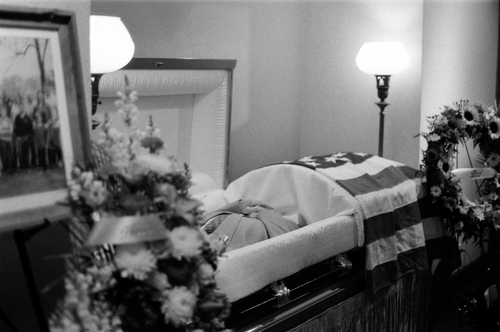
    Paige Young – My name is Paige Young – I am a film and digital photographer, yet I find myself shooting more analog and in the darkroom the more the world leans into the digital era and moves 100 miles a minute. I’ve been working really hard on slowing down and embracing every moment, and the darkroom really makes you have to do that. “These Died With You” is a work that is of founded images from my grandfathers basement of images that range from 1850-1960. My family was extremely broke in these times, but my great great grandfather and my great uncle had an interest in photography and some how came about the means to develop and produce images in these times. I didn’t have the negatives, but I did have the darkroom prints. Being an educator who teaches film, I have create negative prints and positive prints from existing prints before, so I thought I would try to create something new from these old images.

    When I inherited these images I didn’t really know the stories behind them. I was enthralled with the images because they were dated and showed the history, but I didn’t really know the people or the stories. Luckily my grandmother of my grandfather is still alive, so I took these images back to her and asked her about them. Even in my bachelor’s degree I was kind of obsessed with this idea of what we leave behind.  Why do we keep things that if we didn’t have attachments to, would they be disregarded as trash? These images are kind of like that. Without my grandmother telling me these stories, I wouldn’t know them. However, these stories are stories she has heard, but none that she truly lived until she shows up in the frames of them. So as much as she can believe the stories, the identity behind them is still a mystery. I hope these people were good people – but it was the 1850’s, when racism was raging in America, and although we lived in the North, that doesn’t really say much. 
    Carmela Loiacono – How would you describe your creative process? What or who influenced or is influencing your work?
    Paige Young – The creative process is very much experimental. This is so opposite of how my brain works, and opposite of every other process I have digitally. However, it works for my concept. The less I feel I know about the individuals in the photographs, the less I want the viewer to identify. I play around with distance between the papers while enlarging, causing them to be more out of focus, and I also play around with paper negatives, leaving the viewer a bit disoriented while reading them, since they are opposite than the positive intended.  

    I have SO many influences for my film art. Duane Michels, Diane Arbus, Mary Ellen Mark – all of these artists I teach about daily. I love the real and raw of their documentary while also telling the viewer a narrative. I love Michel’s post processing and double negatives in the darkroom and in camera. He was really the one that got me playing around in the darkroom and got me in an experimental mode with my work – that eventually made it into the way of all of the darkroom classes I teach. 

    Carmela Loiacono – What do you think about shared art on social media? Could it be an alternative way of communicating contemporary art?
    Paige Young – I think sharing art on social media only globalizes art for accessibility. Not everyone can make it to an art gallery. Notoriously, art has always been so exclusive to certain classes and types of people. I truly believe that contemporary art and social media is breaking that stereotype, inviting people of all classes, races, and identities to join it. There have been so many cool pieces of art shared on social media, within websites, on google docs, and have also invited the general public to play along or add their voice to it. It’s not changing art, it’s adding a new genre. I think that is a beautiful thing – and something we really need today to unify us.

    Carmela Loiacono – What are your future goals and/or projects?
    Paige Young  – As many people can see, the United States is a mess. We are so divided, it’s painful and feels so hopeless. One of the main reasons I shifted to grief and joy is because it does humanize us. It is the two emotions that we do all feel. Not everyone can feel empathy, but for the most part, everyone can feel sympathy… or can understand these two emotions. Along with that, I deal with my own set of obstacles – like manic depression, major anxiety, and autism. I am currently building two installations that focus on grief, but have an additive layer of medication that sometimes may this emotion difficult to feel, even though we are very aware we are in it. IT is VERY exciting to be making trans-disciplinary art with installation and photography.
    You never have to be put in one category – just make what you need to make, to say what you need to say.
    I will be showing work in Florence, Italy October 18-25, and Outside of the Louvre in Paris, France April 10-12.

  • Noam Ben-jacov

    Artist from The Netherlands 

    Noam Ben-jacov was born in Israel and lived there until 1977, he traveled the world until 1982. Then he studied in the Nova Scotia College of Art and Design (83-85) Canada, and from 1985 to 1989 he studied at the Rietveld Academy in Amsterdam the Netherlands.
    At present Noam Ben-jacov lives and works in The Netherlands as full time artist.
    His main activity’s at the last few years are performances, creating performances based on the integrations between the human body (dancers) & construction, and installations’ see website /video section.
    He is an established artist with decades experience in performance and body-sculpture.


    Artist statement
    “My work is mostly biographical with existential tones, emphasizing the creative process. Perhaps an attempt to perpetuate important moments I go through along the way. It is sourced from small anecdotes, situations, experiences I collect translated into reliefs, forms – work. It is very much about my own journey, where in a way I am both viewer and participant, as if I am far above but also walking along the path kicking some stones…experiences, thoughts, imaginations and scenery. Perhaps it is first and foremost about the atmosphere I am experiencing during this ‘ being there’ in the walk. As for me it is after all more about the search than anything else. And yes, at the end of the day when I am looking at my work as a whole, then I like them to talk, scream… preferably just to sing.”

    more. noamben-jacov.nl

    INTERVIEW with Noam Ben-jacov
    Carmela Loiacono talks with Noam Ben-jacov who takes part in the International Art Exhibition NATURAL FLOW – Exploring water’s essence in Matera, at cultural hypogeum Lega Navale Italiana Matera-Magna Grecia.

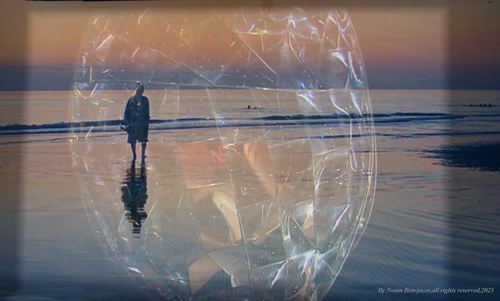
    Carmela Loiacono – Please introduce yourself and talk about the selected video art work “Cherish the water” you exhibited during the exhibition NATURAL FLOW – Exploring water’s essence. 
    Noam Ben-jacov – As a very concern world citizen I feels have own responsibility to next generations to come (in general…), never been in wonderful Matera so just gave it the go…

    Carmela Loiacono – How would you describe your creative process? What or who influenced or is influencing your work?
    Noam Ben-jacov – Listening… feels the sphere… listening to the unspoken…to sound before created to sights before drawn…imagining the day lights before…just before down is rising.  
    My life…influenced by much…many but life simple life first.
    Try not to think too much but feel lots more as looking at steps before putting the foot on the ground….

    Carmela Loiacono – What do you think about shared art on social media?
    Noam Ben-jacov – oh…in general -NOTHING, in general with some exceptions…yes I do it too if no I left total alone so…? But if liking it… (just as me liking hamburgers… (or any of that… and the culture it comes from)
    Carmela Loiacono – Could it be an alternative way of communicating contemporary art? oh please not, I hope for the new generation’s -NO… easy… maybe yes, empty… but good, quality???… NO! 

    Carmela Loiacono – What are your future goals and/or projects?
    Noam Ben-jacov – Few …some…future? Honestly ,do not think of future thinking of now only ,not because I’m so pessimistic more because I’m …rather not such a bad realistic… p.s. maybe like to join your water project, as I’m a very aware… concern citizen. I’m open, if can I contribute? Great, I do, May like to join on an important universal issue. Yes, I’m not an…present …EVERYBODY DOES IT…
    And yes whatever I do I like it at the end of the day…to talk, to shout?…preferably to sing.

    Carmela Loiacono – We had the pleasure to meet in person in Matera, during the opening of the exhibition, did you enjoy cooperating with me?
    Noam Ben-jacov – Yes, I loved too. Did you like to stay in Matera? LOVED Too. 

  • Jonas Deubelbeiss

    Artist from Switzerland  

    Art should inspire, yes I love myself.
    The roots of his art base in hip-hop culture. The graffiti scene and the attitude to life associated with it characterize his style. The name Jonas Deubelbeiss has become an integral part of the art scene. As a graffiti artist he once used walls, and as a tattoo motif artist he used human body as a projection surface. Today, the Swiss artist is a popular artist and performer in Switzerland and internationally.
    Jonas Deubelbeiss speaks directly to viewers with his abstract expressionist portraits and immediately captivates them. His dance inspires. Both tell of his irrepressible passion for expressing emotions through his art and letting people to share in them.
    With rhythm in his blood, love in his heart and an exquisite feeling in his brush, the constantly developing self-taught artist creates his art. It is lively and explosive at the same time. He paints his works with quick, curved strokes of color, giving the viewer a feeling of freedom and connection with themselves.
    He says: “The face is the most emotional and expressive medium with which I can best express my emotions and my passion for people. My art should inspire people.”
    In this way, he artistically gets to the bottom of human nature and shows his hidden messages in his works: values, vitality and the desire for recognition. Whether these characteristics are discovered in detail or are not immediately recognizable remains a surprise. In the end, viewers find traces of their identity in the works of Jonas Deubelbeiss.

    more. www.jonasdeubelbeiss.com

    INTERVIEW with Jonas Deubelbeiss
    Carmela Loiacono talks with Jonas Deubelbeiss who takes part in the International Art Exhibition CREACTION in Matera, at cultural hypogeum Lega Navale Italiana Matera-Magna Grecia.

    Carmela Loiacono – Please introduce yourself and talk about the selected artworks: “Black Pearl” and “Gladiator” you presented during the exhibition CREACTION. 
    Jonas Deubelbeiss – My Name is Jonas Deubelbeiss i come from Switzerland and I’m an international
    artist.
    He roots of his art base in hip-hop culture. The graffiti scene and the attitude to life associated with it characterize his style. The name Jonas Deubelbeiss has become an integral part of the art scene. As a graffiti artist he once used walls, and as a tattoo motif artist he used human body as a projection surface. Today, the Swiss artist is a popular artist and performer in Switzerland and internationally.
    Black Pearl: in nature, it is very difficult to find a peal. It is hidden in a shell and is carefully stored there. In our lives we also have such black pearls, which are kept with much respect and love. This artwork embodies a pearl. It is sensitivity to something that seems valuable and has not yet reached true value.
    Gladiator: this artwork exudes power and elegance at the same time. a work that illuminates our inner strength. as in difficult but also in good days. We all have strengths and weaknesses. This makes us what we are. a gladiator also has his weaknesses, but he uses his strengths to progress. it speaks from the depth and the colors reflect the power.

    Carmela Loiacono – How would you describe your creative process? What or who influenced or is influencing your work?
    Jonas Deubelbeiss – Versatile and determined. I try to achieve the goal I’ve set for myself. I often succeed, and I know or already imagine in my head what the end result should be. The people who interest and move me influence my work and the stories they tell. Often, these are impressions and stories that I incorporate into my works.

    Carmela Loiacono – What do you think about shared art on social media? Could it be an alternative way of communicating contemporary art?
    Jonas Deubelbeiss – I think social media has become indispensable in art these days, as it’s a medium that allows you to reach a large number of people with little effort. However, seeing art will never be the same experience as seeing and discovering it in person.

    Carmela Loiacono – We had the pleasure to meet in person in Matera , staying together, living the moment of creation, did you enjoy cooperating with me? Did you like to stay in Matera?
    Jonas Deubelbeiss  – Oh yes Matera was beautiful nice locations, and restaurant, the food was so good.
    The cooperation was very good, also the shipping the artworks was a great job. Thanks, I thing you make that very good and I like to work with you. 

    Carmela Loiacono – What are your future goals and/or projects?
    Jonas Deubelbeiss  – We’re working on a few more projects. A solo exhibition in Baden, Switzerland, will be launched in 2027. Further exhibitions in Switzerland and Germany are planned after that.

  • J.griMo

    Artist from France  

    J.griMo is a French artist living in Provence. Her scientific background made it possible for her to live and travel all over the world before settling down in Maussane-les Alpilles (south of France) by the end of the nineteen nineties. 
    Ten years later as she felt that drawing, painting and showing her work will bring coherence to all the facets of her personality, she began her career as a painter.
    Every year since 2010 she shares  her creations in various exhibitions, mainly in Provence but also in Venice (2023) and Paris (2024, 2025).

    Artist statement 
    “The beginning of the path, that very part that starts from the gaze all the way to the inner vibe, was there. 
    The painterly gesture was yet to be mastered, as they could not be any sense nor accomplishment without it.
    Step by step, tools and experience expanded  in order to refine the expression, so this inner emotion could be translated as honestly as possible. It was the only way it could be shared.”

    more. www.jgrimo.com

    INTERVIEW with J.griMo
    Carmela Loiacono talks with J.griMo who takes part in the International Art Exhibition CREACTION in Matera, at cultural hypogeum Lega Navale Italiana Matera-Magna Grecia.

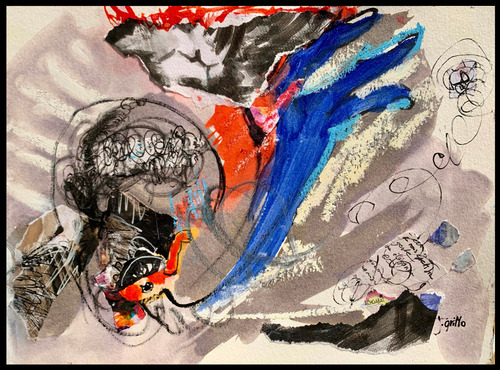
    Carmela Loiacono – Please introduce yourself and talk about the selected artworks: “Mitsy” and “Yes I Can” you presented during the exhibition CREACTION. 
    J.griMo – My scientific background allowed me to live and travel all over the world before settling down at the end of the 90’s in southeast of France where, a few years later, I began a career as a painter.
    I experimented different technics following various sources of inspiration. MITSY and YES I CAN are two examples of my very last form of expression explicitly moved towards lyrical abstraction: the purpose is no longer to transcribe an emotion inspired by visual elements, but states of mind felt half awaken, half asleep. About these two works, I was very pleased before sending them to Matera, to present them in the Paris « Grand Palais » at Art Capital’s exhibition.

    Carmela Loiacono – How would you describe your creative process? What or who influenced or is influencing your work?
    J.griMo – For me the beginning of the process always starts from a gaze or a dream that goes all the way down to the inner vibe. It has then to reach the hand to structure the artistic composition on my mind. Sometimes I go through a kind of destruction/reconstruction scheme in which I shred old works (an intensely liberating as well as exhilarating gesture) producing fragments that reveal unsuspected qualities which were drowned in the mass. I strategically paste them on the medium and convene my sensitivity and my imagination to create a new living environment. This is the way how my vision can be translated as honestly as possible to be eventually shared.
    When you live in Provence, the presence of many illustrious artists, fascinated by the special light of this area, is still alive: Van Gogh and Cezanne of course, but also Picasso, de Stael, Vasarely… and among today’s painters, Fabienne Verdier and Alechinsky. All of them influenced my painting at different levels. After scrutinizing their works, it became clear in my mind that what attracted me the most was composition, colors, contrast and rhythm.

    Carmela Loiacono – What do you think about shared art on social media? Could it be an alternative way of communicating contemporary art?
    J.griMo – Nowadays it seems to be compulsory to use social media to spotlight any kind of art. I am not the last one trying to use this way to promote some event or work of mine. But I reckon that, more that an alternative, it must be seen as an additional way of sharing art in so far as watching pictures or videos will never replace the physical confrontation and the experience of immersion. However, it remains such an easy way for millions of people to get in touch with this universe…

    Carmela Loiacono – What are your future goals and/or projects?
    J.griMo  – I recently opened my own Atelier in Maussane les Alpilles, the place where I live, and it is an amazing but monopolizing experience. In that way my projects for the coming months are very simple: to attract many visitors while keeping enough time for me to paint… let’s talk about this subject some time later again!

  • Francesco Carlucci

    Artist from Italy 

    Francesco Carlucci is a multifaceted figure with interests spanning the worlds of coding, cybersecurity, design, writing, and, more recently, abstract art. “9223372036854775807: The End of Time” is his first creation—a conceptual work and a real-time digital experience.
    Influenced by the work of Korean philosopher Byung-Chul Han on modern society’s obsession with information (Non-things, Han), the author reflects on the concept of the timestamp and how machine-time has redefined the very notion of natural time.
    Once dictated by the natural alternation of day and night, light and darkness, the seasons as an organic cycle of death and rebirth, modern time has lost its cyclical nature. It has become a linear event, progressing with cold precision and shaping our lives.
    We have invented a new Year Zero: January 1, 1970. For a computer, today’s date is simply the difference in seconds between now and January 1, 1970—the timestamp. Every appointment, every photo, every text, and our entire digital life is marked by a timestamp.
    Implicitly, we have also set a date for the “end of the world”: the maximum value of the timestamp in the current 64-bit machine architecture—
    December 4, 292,277,026,596 (about 292 million years from now).
    This arbitrary limit, imposed by technological constraints rather than cosmic forces, raises questions about human constructs, progress, and the illusion of permanence.
    In a way, it echoes the Greek philosopher Plato’s concept of human limitations: no matter how much we strive to surpass them, there are boundaries we cannot escape.

    more. https://9223372036854775807.org

    INTERVIEW with Francesco Carlucci
    Carmela Loiacono talks with Francesco Carlucci who takes part in the International Art Exhibition CREACTION in Matera, at cultural hypogeum Lega Navale Italiana Matera-Magna Grecia.

    Carmela Loiacono – Please introduce yourself and talk about the selected video art work 9223372036854775807: The End of Time” you presented during the exhibition CREACTION
    Francesco Carlucci – I like to define myself as a multifaceted figure, with interests spanning the worlds of coding, cybersecurity, design, writing, and recently, abstract art.
    “9223372036854775807: The End of Time” is my first creation—a conceptual work and a real-time digital experience.
    Influenced by the work of Korean philosopher Byung-Chul Han on modern society’s obsession with information, I try to reflect on the concept of the timestamp and how machine-time has redefined the very notion of natural time.
    Once dictated by the natural alternation of day and night, light and darkness, the seasons as an organic cycle of death and rebirth, modern time has lost its cyclical nature. It has become a linear event, progressing with cold precision and shaping our lives.

    Carmela Loiacono – How would you describe your creative process? What or who influenced or is influencing your work?
    Francesco Carlucci – My inspiration has always come from real-life experiences—they act as triggers for me, and my mind does the rest. The End of Time represents the peak of my reflections on how the digital world is overtaking reality and pulling us further away from a natural way of life.

    Carmela Loiacono – What do you think about shared art on social media? Could it be an alternative way of communicating contemporary art?
    Francesco Carlucci – I liked the soft approach, but involving the artists more through interviews or presentations might have made it feel more personal.

    Carmela Loiacono – What are your future goals and/or projects?
    Francesco Carlucci – I am working on a new concept that aims to bring together artificial intelligence with a sensory experience that’s understandable to humans.

    Carmela Loiacono – We had the pleasure to meet in person in Matera, during the opening of the exhibition, did you enjoy cooperating with me? Did you like to stay in Matera?
    Francesco Carlucci – Matera was already one of my favorite places in Italy, so presenting my creative work there was truly a thrill. Your approach was incredibly professional, and your passion truly brought the opening event to life.

  • Nada Kelemenova

    Artist from Czech Republic 

    Born in Western Bohemia. Nada Kelemenova lives and creates in her own atelier in Northern Czechia surrounded by beautiful nature. Over the last years participated in multiple artwork exhibitions in Czechia and Europe and received several awards for achievement and impact in the visual arts.
    “To become an artist has been my dream which became reality. Inspiration for my work comes to me from nature, thought energies of the universe and feelings which I transfer into my artworks. I enjoy painting flowers, real joy I find in mixing colours and creating organic shapes and patterns. In my artworks I like to experiment. It satisfies me to explore new painting techniques. Nowadays I dedicate to abstract forms of painting where I combine classic oil or acrylic painting technique with structural painting.”

    more. nadakelemen.art 

    INTERVIEW with Nada Kelemenova
    Carmela Loiacono talks with Nada Kelemenova who takes part in the International Art Exhibition NATURAL FLOW – Exploring water’s essence in Matera, at cultural hypogeum Lega Navale Italiana Matera-Magna Grecia.

    Carmela Loiacono – Please introduce yourself and talk about the selected artwork: “Under the Sea Level” you presented during the exhibition NATURAL FLOW – Exploring water’s essence
    Nada Kelemenova – My name is Nada Kelemenová and I am an abstract painter who draws inspiration from nature, energy of the universe and spirituality. I work mainly with acrylic and mixed media and am constantly experimenting with new painting methods to capture the invisible movements of energy and harmony of the world around us through color and composition.
    The painting Under the Sea Level, which was part of the exhibition NATURAL FLOW – Discovering the Essence of Water, represents a deep dive into the world below the surface, where light refracts in changing currents and reflects the infinite variability of life in the ocean. The painting is inspired not only by the visual beauty of the aquatic environment, but also by its elusive energy – flow, changeability and constant movement, which is similar to the dynamics of human consciousness. Working with textures and layers of color allow to create a sense of depth and mystery, dominant blue and turquoise tones evoke calm, meditation, and a connection to the natural rhythm of water.

    Carmela Loiacono – How would you describe your creative process? What or who influenced or is influencing your work?
    Nada Kelemenova – My creative process is intuitive and organic. I do not follow a fixed composition, but rather let myself to be guided by the energy of colors and their interaction. I work with layers, structures, and mixing pigments to achieve depth and movement. I often use techniques that allow for a chance, which I consider an important element of creation – similar to nature, where there are no completely identical structures and each shape is unique.
    A great inspiration for me is nature, its rhythms, harmonies, and forces, which are sometimes calm and sometimes dynamic. I am also influenced by the spirituality and philosophy of Eastern cultures, especially the Japanese aesthetic of wabi-sabi, which celebrates the natural beauty of imperfection and transience. I am also inspired by music, meditation and quantum physics, which connects science with a deep understanding of energy and the universe.

    Carmela Loiacono – What do you think about shared art on social media? Could it be an alternative way of communicating contemporary art?
    Nada Kelemenova – Social media is an important platform for artists today, as it allows for instant sharing of work and connecting with people all over the world. Thanks to them, art can reach a wider audience and enter into a dialogue with viewers who would otherwise not have the opportunity to encounter the work.
    On the other hand, I think that the digital space cannot fully replace direct contact with a work of art. Texture, structure, color nuances – all of this can only be truly perceived when you meet the painting in person. So, online presentation is a great tool for communication and spreading awareness of art, but the real experience takes place in a gallery or studio, where the viewer can not only see the painting, but also feel its energy.

    Carmela Loiacono – What are your future goals and/or projects?
    Nada Kelemenova – I am currently focusing on several projects that connect painting with deeper layers of perception of reality. I plan to expand my series inspired by water elements, where I want to further explore not only the visual side of water, but also its symbolism – as a carrier of memory, energy and connection.
    At the same time, I continue to study figurative art and Japanese calligraphy, as I am fascinated by various forms of visual expression and their connection with movement and energy of the body.
    Exhibiting internationally is still an important part of my journey for me, and therefore I will be participating a several exhibitions abroad later this year – for example Art World Fair Parisin May, Women in art Biennale London and Monaco Art Fair in September, Modern art Masters in complex Louvre in October, RED DOT MIAMI in December, etc., where I want to present my latest work. My goal is not only to share my paintings, but also to inspire to a deeper connection with nature, energy and inner harmony.

  • Tina Hellblom Thibblin

    Artist from Sweden 

    Tina Hellblom-Thibblin is a Swedish visual artist who primarily works with oil on linen canvas. She studied art theory and pedagogy at Uppsala University, where she later earned a Doctor of Philosophy(PhD). Her academic background also includes studies in art history and aesthetics at Uppsala University. Through her studies, she developed a deep interest in Italian and French painting, sculpture, and architecture—both historically and in contemporary contexts.
    Much of the inspiration for her paintings comes from her travels to Italy and France, where she was captivated by Renaissance painting and mural art. Her passion for painting emerged early in life and has remained a continuous pursuit.
    Her artistic practice weaves together multiple themes, including the tension between the imaginary and the concrete, as well as between dreams and reality. Identity and human relationships are also central to her work, often explored through elements of surprise and unpredictability. Spontaneity and a sense of the unfinished are key aspects of many of her pieces. Additionally, her work places a strong emphasis on contrasts and the unseen.
    Tina’s paintings have been exhibited in both solo and group exhibitions in Sweden, as well as in numerous group exhibitions across Europe, including in Italy, Spain, and the United Kingdom. She is also participating in ARTEXPO New York 2025. In recent years, she has received several international awards for her work and has been featured in various international publications on contemporary art.

    more. www.teglet.net

    INTERVIEW with Tina Hellblom-Thibblin
    Carmela Loiacono talks with Tina Hellblom-Thibblin who takes part in the International Art Exhibition CREACTION in Matera, at cultural hypogeum Lega Navale Italiana Matera-Magna Grecia.

    Carmela Loiacono – Please introduce yourself and talk about the selected artworks: “Find Me” and “You and Me” you presented during the exhibition CREACTION
    Tina Hellblom-Thibbin – I am a Swedish visual artist specializing in oil painting on linen canvas. Alongside my artistic practice, I hold a Ph.D. in Pedagogy and have studied Art Theory at Uppsala University. I also served as an Associate Professor. My academic research focuses particularly on identity and the different roles we inhabit to navigate everyday life.
    Art has always been an integral part of my life. Over the years, I have continuously studied and practiced artistic expression, drawing inspiration from travels and study visits to Italy and France —especially from mural paintings that deeply moved me.
    My artistic practice explores the tension between the imaginary and the concrete, between dream and reality. My work often integrates themes of identity, presence, memory, and the poetic. I am interested in the spontaneous and the unfinished—inviting the viewer into an open-ended visual narrative. History plays a vital role in this process; it influences how we understand the world and ourselves. It is within this interplay between the traces of the past and the expressions of the present that my work comes into being. I am captivated by Italian culture—its historic facades and timeless architecture inspire my work and imagination.
    Curators and critics have noted: “Her works express a longing beyond the visible and the familiar, while remaining in a personal, inward stillness. Perspectives shift between the exterior and the interior, in a space where dreams and reality meet.”
    My paintings have recently been exhibited in Europe, the USA, Dubai, and Beijing, and I have recently received several international awards, including the International Prize Botticelli, the International Prize Leonardo da Vinci, the International Prize Velázquez & Goya. My work is also featured in many various contemporary art publications.
    The painting “You and Me” reflects on themes of identity and presence. The soft lighting and hazy contours suggest something elusive—something that cannot be confined within strict boundaries, but instead invites the unexpected. The figure, illuminated from the front, contemplates the many roles we play in life. The approaching mask symbolizes the shifting identities we adopt in different contexts. The window is inspired by Italy’s cultural heritage.
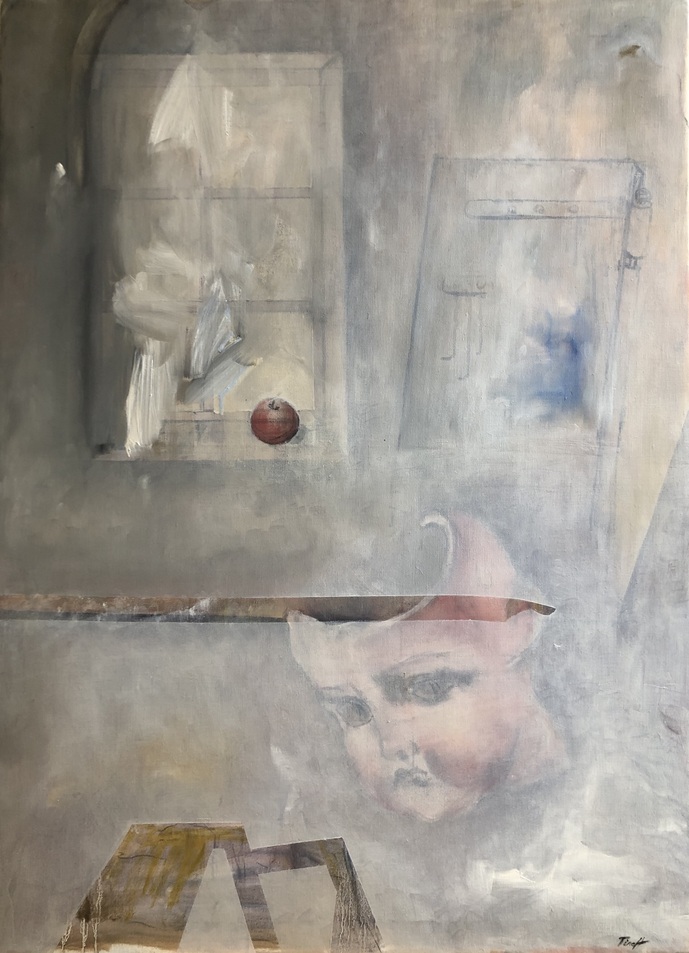
    The painting “Find Me” leans toward the dreamlike and surreal. A child’s face floats in the lower part of the painting, conveying openness to the unknown and the hidden. The small apple resting in the window evokes presence of the now. The shapes and lines are intentionally blurred. Regardless of the subject, I aim to cast my images in a poetic glow, bringing forth ideas as details within a larger whole.

    Carmela Loiacono – How would you describe your creative process? What or who influenced or is influencing your work?
    Tina Hellblom-Thibbin – My creative process began at an early age and has guided me throughout life. For me, creativity means remaining curious and constantly evolving my  artistry. Inspiration comes from encounters with time, daily life, people, thoughts, and ideas. I try to approach each painting with openness, allowing every surface to come alive. My creative process is driven by the desire to bring something new into being something original. While it may begin with a sense of the familiar, it always seeks to unfold into the unexpected and the spontaneous, revealing layers beyond the surface.
    As a teenager, I explored this in a special school project titled ”Children in Motion”, a series of sketches capturing everyday movements of children. Even then, I sought to express fleeting moments through visual storytelling.
    My academic background in art history has deeply enriched my artistic thinking. I have a particular affinity for the Renaissance—especially Leonardo da Vinci, whose ability to bring life into faces has long fascinated me. Another major influence is Odilon Redon, whose color palette and symbolic and also surrealistic compositions have been inspiring. I am drawn to a form of symbolic painting where the underlying thoughts and emotions seek visual expression.

    Carmela Loiacono – What do you think about shared art on social media? Could it be an alternative way of communicating contemporary art?
    Tina Hellblom-Thibbin – I believe social media can serve as one of several important platforms for sharing art and reaching a broader audience. It offers the opportunity to engage with people who may not usually visit galleries—especially in our screen-centric world. However, exhibiting art physically remains a powerful and irreplaceable experience. The physical presence of a painting allows for a deeper existential connection and a more immersive dialogue with the surrounding space.

    Carmela Loiacono – What are your future goals and/or projects?
    Tina Hellblom-Thibbin – I feel a deep passion for working in my studio and for giving form to all the images that have yet to emerge on my canvases. One of my key goals is to hold a solo exhibition, where I can present a broader body of work and share more of my visual language with a wider audience. It is a way of bringing together not just individual paintings, but the ideas and emotions that weave through them all.